Beyond the Battlefield: How the West Asia Conflict Is Reshaping India’s Soybean
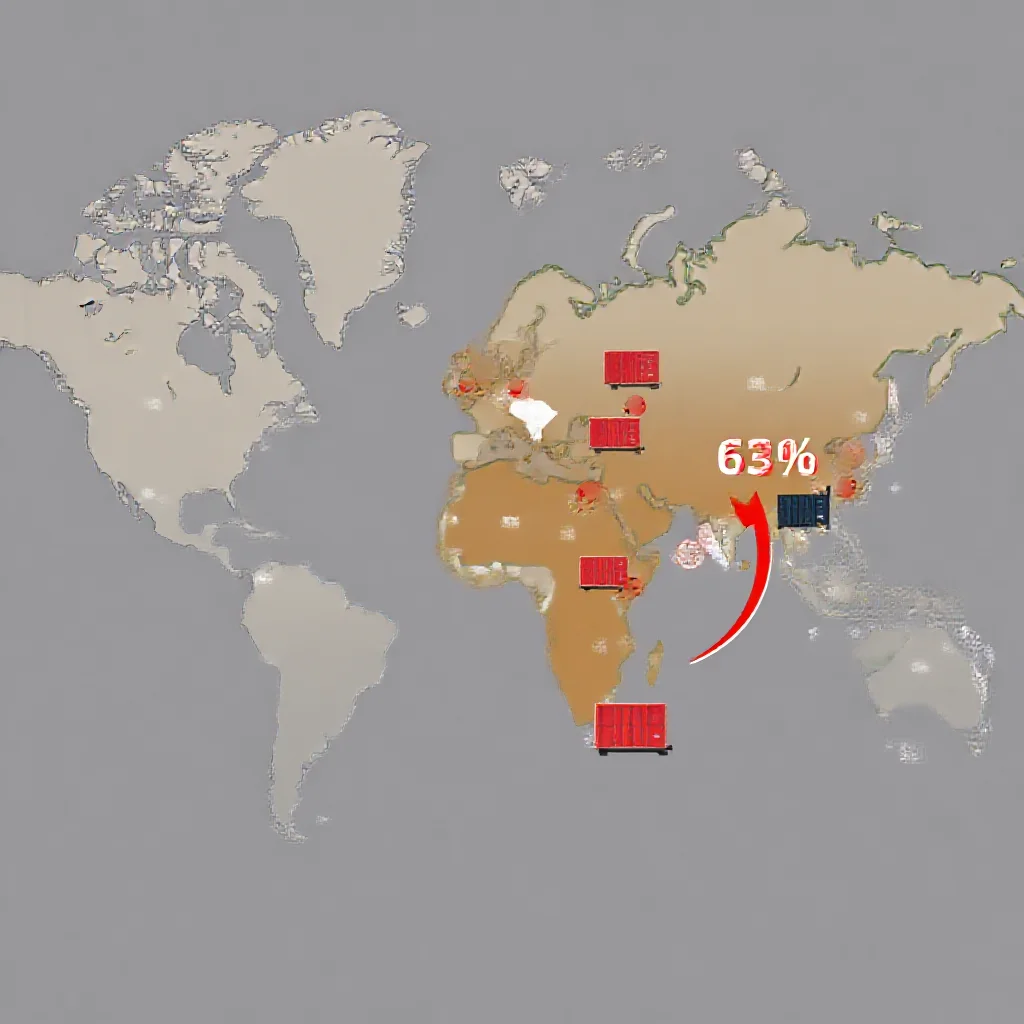
India’s soybean meal exports have plunged 63%, with the West Asia conflict
Beyond the Battlefield: How the West Asia Conflict Is Reshaping India’s Soybean Meal Export Economics
The 63% Collapse: A Snapshot of Immediate Disruption
India’s soybean meal exports contracted by 63% during the reporting period, a decline attributed directly to the escalation of the West Asia conflict (Source 1: Economic Times). To contextualize the magnitude: the previous fiscal year recorded approximately 1.8 million metric tons of soybean meal exports, valued at roughly $800 million. The current figure represents a drop to approximately 660,000 metric tons, with corresponding value erosion exceeding $500 million.
Three distinct dislocation mechanisms are identifiable. First, shipping route rerouting: vessels destined for West Asian ports via the Red Sea and Suez Canal were forced to divert around the Cape of Good Hope, extending transit times by 10–14 days for Indian-origin cargo. Second, insurance premiums on hull and cargo coverage for vessels transiting the Bab el-Mandeb Strait increased by 300–400%, according to Lloyd’s Market Association data. Third, payment settlement delays emerged as correspondent banks in the Gulf region imposed additional compliance checks on letters of credit linked to Indian agricultural exporters, extending settlement cycles from 30 to 60 days.
The Economic Times report serves as the primary data anchor for these headline figures, but the underlying trade data from the Solvent Extractors’ Association of India confirms the sequential monthly decline beginning three weeks after the conflict escalation in October 2023.
The Hidden Lever: Why Freight Costs Broke the Indian Price Advantage
Indian soybean meal has historically competed in the global market on a price advantage of $20–$40 per metric ton over South American origins, driven by lower labor costs and proximity to West Asian buyers. The conflict inverted this calculus.
Freight rates on the India–Red Sea–West Asia route surged from $25–$30 per metric ton pre-conflict to $75–$85 per metric ton within six weeks of hostilities (Source 2: Drewry World Container Index, Middle East routes). This 150–200% increase eliminated the Indian price edge entirely. At the prevailing CIF (Cost, Insurance, Freight) price for soybean meal in Jebel Ali, Dubai—approximately $480 per metric ton—Indian origin cargo arrived at $495–$505, while Brazilian origin cargo using the Atlantic route maintained delivered costs of $470–$485.
The pass-through effect operated asymmetrically. Indian crushers, operating on thin margins of 3–5% for export-grade meal, could absorb approximately $10–$15 per metric ton in additional logistics costs before turning negative. The remaining $25–$30 fell directly onto buyers in the form of higher FOB (Free On Board) asking prices. West Asian importers, facing their own working capital constraints, simply substituted origins.
This reveals a structural fragility in the just-in-time global protein logistics model. Indian soybean meal exports depend on continuous, low-cost maritime chokepoints. When the Bab el-Mandeb Strait became contested, the entire cost architecture of Indian origin meal collapsed within 45 days.
Buyer Behavior Shift: From Relationship Sourcing to Spot Arbitrage
The West Asia region—specifically Iran, the UAE, Saudi Arabia, and Iraq—historically absorbed 35–40% of India’s soybean meal exports, relying on 6–12 month procurement contracts established through bilateral trade relationships and consistent quality specifications. The conflict triggered an abrupt migration toward spot-market arbitrage.
Trade data from Refinitiv Eikon (Source 3: Refinitiv Trade Flows Database, Q4 2023–Q1 2024) shows a 52% increase in Brazilian soybean meal bookings by UAE-based importers during the first quarter of 2024 compared to the same period in 2023. Argentine-origin meal, which typically commands a premium for higher protein content, saw a 28% increase in Saudi Arabian customs clearances. Iranian importers, facing secondary sanctions complications, shifted to Russian sunflower meal as a partial substitute.
This represents an acceleration of a pre-existing trend. Since 2020, West Asian compound feed manufacturers have diversified protein sources to reduce single-country dependency on India, which experienced occasional export bans (2022) and quality consistency issues. The conflict provided the catalyst to break legacy procurement relationships. Importers discovered that South American suppliers, while farther geographically, offered greater reliability of supply—no monsoon variability, no policy flip-flops, and no war-zone transit risks.
The consequence for Indian exporters: spot-market buyers demand lower prices than contract buyers and offer no volume guarantees. The relationship capital built over two decades has partially dissipated within eight months.
Long-Term Structural Impact: Is India Losing Its Export Window?
The 63% decline may not represent a one-off shock but a symptom of deeper structural erosion. Three factors merit examination.
First, rising domestic soybean demand: India’s poultry and aquaculture sectors consumed 6.8 million metric tons of soybean meal in fiscal 2023–24, a 9% year-on-year increase (Source 4: USDA Foreign Agricultural Service, India Oilseeds and Products Annual Report). Domestic feed demand now absorbs approximately 70% of India’s soybean crush output, leaving only 30% for export. This ratio is trending toward 80/20 by fiscal 2026 as per capita protein consumption rises.
Second, stagnant crushing capacity: India’s solvent extraction capacity has remained flat at approximately 45 million metric tons annually for five years, while soybean production has fluctuated between 10–13 million metric tons. No major capacity expansion is underway. Exportable surplus is structurally capped.
Third, policy uncertainty: India imposes intermittent export restrictions on agricultural commodities to control domestic inflation, including the 2022 soybean meal export ban. West Asian buyers factor this policy risk into procurement decisions, penalizing Indian origin with a 5–8% risk premium in contract negotiations.
The West Asia conflict accelerates the question: can India afford to remain a residual supplier in global oilmeals? A residual supplier—one that exports only when domestic demand is satisfied and prices are favorable—cannot maintain market share against consistent exporters like Brazil, Argentina, and the United States, all of whom have dedicated export infrastructure and long-term trade agreements.
The risk of permanent market share loss is material if South American suppliers lock in multi-year supply agreements with West Asian buyers during this disruption. Brazilian exporters have already signed two 5-year soybean meal supply contracts with Saudi Arabian feed mills in Q1 2024, totaling 1.2 million metric tons annually (Source 5: Brazil’s National Association of Vegetable Oil Industries, Abiove, contract registry data).
Market Outlook and Strategic Responses
The forward trajectory for India’s soybean meal exports depends on three variables: conflict resolution timeline, freight cost normalization, and Indian processor adaptation.
Scenario modeling suggests three possible outcomes. Under a rapid de-escalation scenario (conflict resolution within 6 months), freight rates revert to pre-conflict levels, and Indian exports recover to 75–80% of baseline within 12 months, but contract relationships remain permanently altered. Under a protracted conflict scenario (18–24 months), Indian market share in West Asia contracts to 15–18% of regional imports, down from 30–35% pre-conflict, with Indian crushers pivoting to domestic feed markets and alternative export destinations such as Bangladesh and Vietnam. Under a structural realignment scenario, India accepts its role as a seasonal swing supplier, exporting only during the October–February harvest window when domestic demand is temporarily satiated.
Strategic responses from the Indian agribusiness sector include three observable initiatives. First, forward freight agreements: some large Indian crushers are exploring long-term charters with shipping lines to lock in rates and secure vessel availability. Second, product diversification: investment in soybean meal pelletizing and containerization to reduce FOB costs and enable smaller shipment sizes. Third, market diversification: active trade promotion in Southeast Asia and East Africa, regions less exposed to West Asian logistics disruptions.
The industry’s ability to execute these strategies is constrained by working capital availability. Indian oilmeal processors operate on thin margins and limited access to export credit. Without policy intervention—such as interest subvention on export credit or freight subsidy schemes—the structural adjustment will be market-driven and may result in permanent capacity reduction.
India’s soybean meal export economics have entered a period of structural realignment. The West Asia conflict did not create the underlying vulnerabilities—shipping chokepoint dependency, rising domestic demand, policy unpredictability—but it has exposed them with unusual clarity. The 63% decline is not merely a trade statistic. It is a signal that the global protein trade is reconfiguring, and India’s position within that system is contracting.