Beyond the Numbers: The Rs 7.98 Lakh Crore Unincorporated Construction Sector
The reported Gross Value Added (GVA) of Rs 7.98 lakh crore and 10.27 lakh
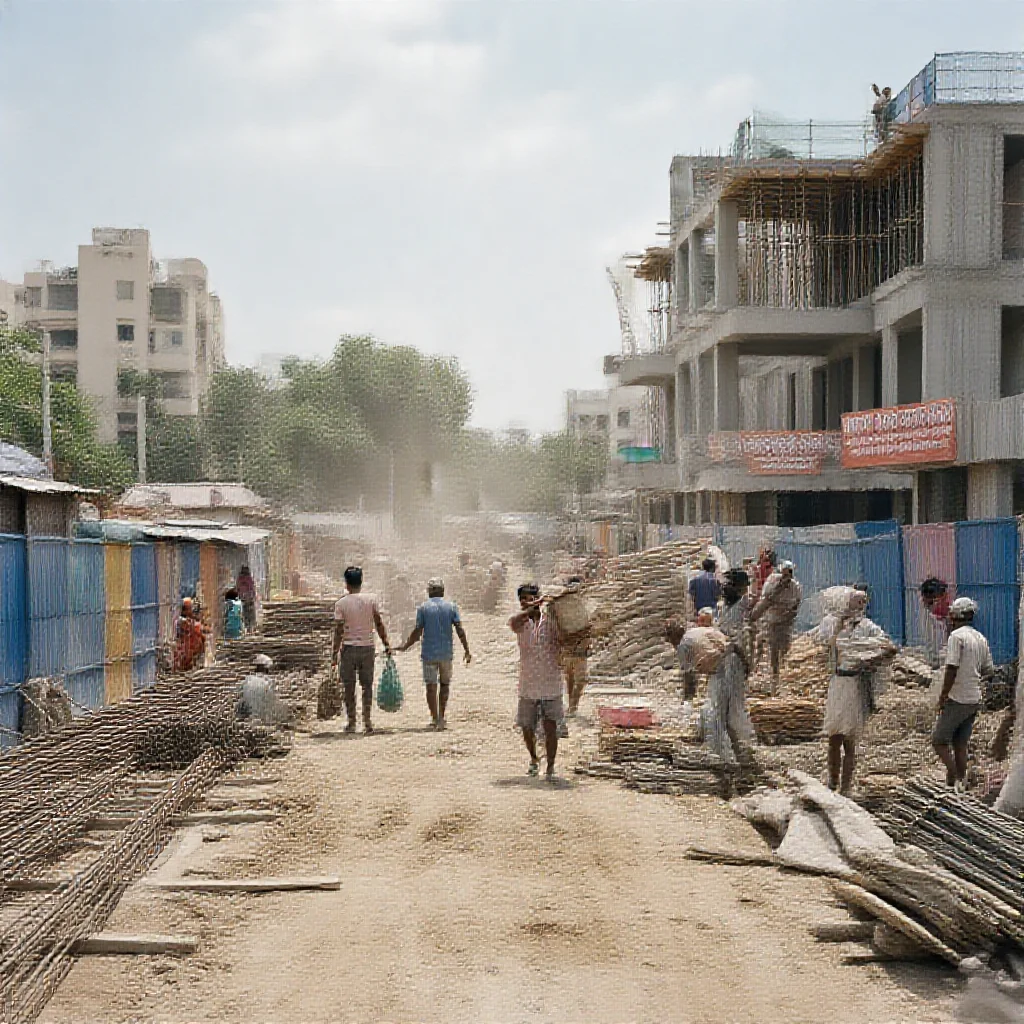
Beyond the Numbers: The Rs 7.98 Lakh Crore Unincorporated Construction Sector and India's Informal Economy
The latest economic data reveals a sector of monumental scale operating largely in the shadows of formal accounting. The unincorporated construction sector in India reported a Gross Value Added (GVA) of Rs 7.98 lakh crore and comprises 10.27 lakh operational units (Source 1: [Primary Data]). These figures, while significant as standalone metrics, serve as a quantitative gateway to a vast, informal ecosystem that is fundamental to India's economic structure and urban morphology. This analysis moves beyond headline output to audit the sector's role as a primary employment engine, its inherent structural vulnerabilities, and its complex position within the broader national economy.
Decoding the Data: Not Just Output, but a Vast Informal Ecosystem
The reported GVA of Rs 7.98 lakh crore requires contextualization against national accounts. Comparative analysis with the National Statistical Office's (NSO) data indicates this figure constitutes a substantial portion of the total construction GVA in the country, representing a critical, yet often unmeasured, component of India's GDP. The scale of output is matched by the sector's organizational fragmentation. The count of 10.27 lakh operational units implies an average unit size that is minuscule, pointing overwhelmingly to micro-enterprises and own-account enterprises rather than structured firms.
This fragmentation is the primary data point. It signals a sector defined not by corporate entities but by a decentralized network of informal labor contractors, small job-work teams, and individual artisans. The high unit count coupled with significant aggregate GVA leads to a logical deduction: this is a sector whose productivity is derived from the aggregation of immense human labor, not from significant capital investment or technological intensity per unit. The data, therefore, does not describe a traditional industry so much as it maps a vast, informal labor market organized around construction activity.
The Dual-Track Reality: Fast Growth on a Foundation of Slow-Burning Risks
A fast-analysis view acknowledges the sector's immediate economic functions. It acts as a primary absorber of low-skilled and migrant labor, providing critical livelihood support, particularly in post-pandemic recovery phases. Its low entry barriers and cash-based nature facilitate rapid employment generation in response to demand spikes, contributing to economic fluidity.
A slow, structural audit, however, reveals embedded vulnerabilities that question the sustainability of this growth model. The high GVA is generated on a foundation of minimal social security, absent formal contracts, and negligible investment in skill development or labor-saving technology. Productivity gains are limited, creating a long-term drag on national economic efficiency. The sector's profitability for micro-enterprises is highly susceptible to volatile raw material costs and cyclical demand shocks, with risks devolved onto the most vulnerable—the workers. The critical audit question is whether this level of output can be maintained or enhanced without addressing the formalization of labor relations, access to institutional credit for capital formation, and systematic skill upgradation. The current model suggests a high-output, low-productivity equilibrium.
The Unseen Engine: Supply Chain Dependencies and Rural-Urban Linkages
The influence of this sector extends far beyond its immediate worksites, creating deep interdependencies within the informal economy. It acts as a core demand driver for upstream informal industries, including unregulated sand and gravel mining, small-scale brick kilns, and a fleet of locally-owned transport vehicles. This creates a parallel, informal supply chain that operates with its own logics of credit, contracting, and regulation.
Furthermore, the sector functions as a critical economic bridge between rural and urban India. It facilitates the circular migration of labor, with remittances from construction work forming a vital income stream for rural households. Conversely, periods of agrarian distress channel labor towards urban construction sites, regulating the sector's wage dynamics. A frequently overlooked viewpoint is the sector's role as a conduit for the circulation of informal credit, from advances to laborers to payment delays down the supply chain, creating a fragile web of financial dependencies that underpins regional economic activity.
Neutral Market and Industry Predictions
Based on the current structural analysis, several trajectories are probable. In the short to medium term, the sector will maintain its scale due to persistent demand for affordable housing and infrastructure, coupled with an abundant supply of low-skilled labor. Its informal nature will continue to offer cost advantages in certain market segments, ensuring its survival.
The long-term trend, however, will be shaped by intersecting forces. Regulatory pushes, such as stricter building codes, labor welfare mandates, and digital payment trails, will incrementally increase formalization pressures. Technological adoption in the formal construction sector may gradually widen the productivity and quality gap, potentially segmenting the market further. The most significant variable is the demographic and aspirational shift in the labor force, which may gradually constrict the supply of willing informal labor, forcing a structural recalibration. The sector's future will likely involve a gradual, uneven transition rather than a sudden transformation, with its informal core persisting even as its edges are slowly incorporated into the formal economic framework.