South Asia Trade and Investment Trends: The Structural Forces Reshaping Regional
This article should take a slow-analysis approach, focusing on the deeper
South Asia Trade and Investment Trends: Structural Forces Reshaping Regional Growth
South Asia’s trade and investment profile is changing in ways that are easier to understand through medium- and long-term data than through quarterly headlines. Trade flows, foreign direct investment, industrial policy, and digital infrastructure are interacting to reshape how goods move, where firms invest, and which sectors can scale. The region remains diverse in income levels and policy regimes, but several structural patterns are visible across the major economies: persistent import dependence in energy, machinery, and intermediate goods; gradual export diversification in selected manufacturing and services segments; and rising attention to logistics, customs systems, and cross-border connectivity.
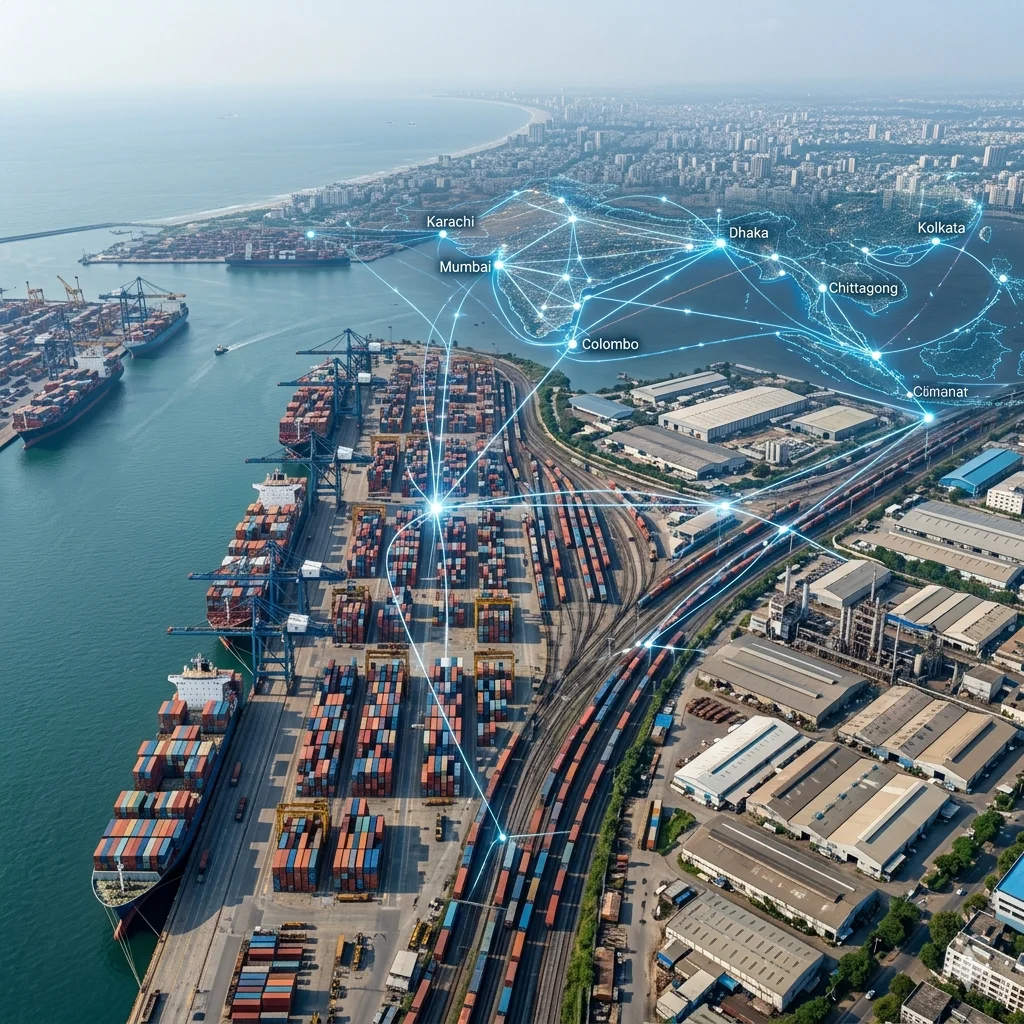
[IMAGE: A wide view of South Asian ports, container stacks, rail freight lines, industrial parks, and a digital network overlay connecting major cities across the region]
1. The Core Economic Axis: Trade and Investment Are Being Rebalanced
The main economic question in South Asia is not whether trade and investment matter, but how they are being reorganized. In many economies, import dependence has historically reflected the need for capital goods, fuel, fertilisers, and industrial inputs. At the same time, export performance has often been concentrated in a limited number of sectors such as garments, pharmaceuticals, rice, IT services, or specific resource-based products. That combination creates a structural need for both industrial upgrading and broader export diversification.
The evidence to examine is straightforward: trade composition by product, the share of intermediate goods in imports, the destination mix of exports, and the sectoral distribution of FDI. Data from the World Bank, UN Comtrade, WTO trade profiles, and national statistical agencies can show whether South Asian economies are moving toward more complex production systems or simply expanding old trade patterns at a larger scale. The key inference is that when imports are dominated by production inputs and exports remain narrow, growth depends heavily on how effectively firms can integrate into regional and global supply chains.
[IMAGE: Map-style illustration of South Asia connected by trade routes and logistics corridors]
2. Why This Topic Requires Slow Analysis
This subject is best treated as slow analysis because the central variables move over years, not weeks. Changes in factory location, port capacity, customs digitization, industrial incentives, and FDI allocation typically unfold across multiple policy cycles. A new trade agreement, a tariff adjustment, or a corridor project may affect business decisions only after firms see evidence that rules are stable and logistics are reliable.
That does not mean timeliness is irrelevant. Recent tariff changes, investment announcements, bilateral corridor projects, and revisions to customs procedures still need verification because they can alter the near-term direction of flows. But the analytical frame should remain structural. The right questions are: Has border clearance time improved according to customs or logistics data? Have firms shifted sourcing in response to supply-chain risk? Are investment approvals being translated into operating capacity? These are empirical questions that require time-series comparison rather than single-event interpretation.
[IMAGE: Timeline graphic showing long-term trade and investment cycles]
3. Trade Patterns Beyond the Headline Numbers
Headline trade figures can obscure what is happening beneath the surface. A rise in imports does not automatically indicate weakness; it may reflect higher purchases of machinery, industrial chemicals, electronics components, or fuel required to expand productive capacity. Likewise, export growth can be misleading if it is concentrated in a small number of products or markets.
A closer look at UN Comtrade and WTO data is needed to separate raw material imports, intermediate goods, and final consumer goods. If a country’s import basket is dominated by capital equipment and production inputs, the trade deficit may be linked to expansion rather than consumption alone. If export growth is driven by one or two industries, such as apparel or refined products, the economy may still face concentration risk. That matters because trade concentration can hide vulnerability to demand shocks, shipping disruptions, or changes in rules of origin.
South Asia’s export profile also varies sharply by economy. Some countries rely heavily on services exports, others on textiles or agriculture, and others on a mix of manufacturing and primary goods. The strategic issue is whether the export base is broadening enough to absorb volatility and support productivity growth.
[IMAGE: Cargo containers and shipping manifests with abstract market charts]
4. Supply Chain Restructuring and Regional Integration
Supply chain decisions are shifting manufacturing and assembly footprints across South Asia, but the effects are uneven. Firms do not relocate production only because of wage differentials. They also respond to customs efficiency, port turnaround times, energy reliability, supplier density, and the predictability of regulatory enforcement. When these conditions improve, a location becomes more attractive for assembly, light manufacturing, and regional distribution.
This is why logistics data matter as much as trade statistics. Port congestion, inland freight costs, border delays, warehousing capacity, and cold-chain availability shape whether firms can participate in regional production networks. World Bank logistics indicators, national port authority reports, and private freight benchmarks can help identify where bottlenecks are most binding.
The long-term implication is not limited to trade balances. Supply chain restructuring affects supplier ecosystems, industrial parks, transport corridors, and the location of ancillary services such as packaging, maintenance, and inventory management. If a region supports more integrated sourcing, it can generate a wider base of jobs and capabilities than commodity-led trade alone.
[IMAGE: Industrial corridor with factories, trucks, ports, and warehouse networks]
5. Foreign Direct Investment: From Capital Inflow to Capability Transfer
Foreign direct investment should be assessed in two different ways. The first is the volume of capital entering a country. The second is the extent to which that capital transfers technology, management practices, quality standards, and market access. The second effect is more important for long-run competitiveness.
Data from UNCTAD, central banks, investment promotion agencies, and national balance-of-payments statistics can show where FDI is going. But sectoral detail matters. Investment in telecom, logistics, pharmaceuticals, electronics assembly, renewable energy, and business services can have stronger spillovers than purely financial or extractive inflows. The question is not only how much FDI arrives, but whether it builds productive capacity.
Some inflows are opportunistic and tied to short-term asset prices or one-time privatisations. Others are strategic and linked to production networks, supplier development, or export platforms. The difference can be observed in project duration, local sourcing requirements, training programs, and the presence of follow-on investment. In South Asia, this distinction is important because durable capability transfer often depends on whether foreign firms integrate local suppliers and whether policy frameworks support reinvestment rather than exit.
FDI should therefore be treated as a structural indicator, not just a headline flow. If the region attracts investment into sectors that upgrade skills, deepen industrial linkages, and improve export sophistication, the effect on growth can persist long after the initial capital is recorded. If inflows remain concentrated in real estate, short-cycle finance, or isolated enclaves, the productivity impact will be weaker.
[IMAGE: Business meeting over factory floor and engineering blueprints]
6. Technology as a Trade Multiplier
Digital infrastructure is now part of trade capacity. Digital customs systems can reduce clearance times. Electronic payments can lower transaction costs for exporters and importers. Logistics software can improve inventory tracking, route planning, and warehouse coordination. Enterprise digitization can help smaller firms document orders, manage compliance, and connect to buyers outside their home market.
This matters because trade participation is often limited not by demand alone, but by administrative and operational friction. A firm that can process invoices digitally, verify origin rules electronically, and receive payments through interoperable systems is better positioned to serve regional and international buyers. Fintech, e-commerce, and digital enterprise tools therefore function as trade enablers, especially for small and medium-sized firms.
The empirical test is whether digital reforms are associated with shorter processing times, lower documentation costs, and a broader exporter base. Evidence can come from customs authority reports, World Bank digital economy work, payment system statistics, and firm surveys. If digitization lowers transaction costs, it may expand the number of firms able to export rather than only increasing volumes for large incumbents.
[IMAGE: Digital trade network overlay across ports, warehouses, and smartphones]
7. Policy, Infrastructure, and the Friction Premium
South Asia still faces a significant friction premium: the added cost created by border delays, energy constraints, port inefficiencies, fragmented regulations, and uncertain implementation. These frictions are often more important than tariff schedules alone. A tariff reduction may have limited effect if freight movement remains slow or if firms cannot rely on stable clearance procedures.
Infrastructure upgrades can therefore unlock trade growth more effectively than tariff cuts alone. Better roads, rail freight, port handling systems, energy transmission, and logistics hubs can reduce end-to-end costs across multiple sectors. In practical terms, that supports more predictable delivery schedules, lower spoilage losses, and wider sourcing networks.
The best evidence to cite here includes port dwell-time data, customs clearance times, World Bank logistics-related indicators, energy reliability measures, and corridor utilization rates. These show whether infrastructure is reducing the cost of moving goods or simply adding capacity without operational improvement. Policy credibility also matters: if regulations change frequently or enforcement is uneven, firms will continue to price in uncertainty even when physical assets improve.
[IMAGE: Border crossing and freight infrastructure with trucks, inspection points, and rail links]
8. What to Watch Next
The next phase of South Asia trade and investment trends will likely depend on four indicators. First, whether export baskets become broader and more technologically dense, as shown in trade data from UN Comtrade and WTO. Second, whether FDI shifts toward sectors that generate skills and supplier linkages, as shown in UNCTAD and national investment records. Third, whether logistics bottlenecks ease through measurable reductions in clearance and transport times. Fourth, whether digital infrastructure continues to lower transaction costs for firms of different sizes.
The central conclusion is that South Asia’s growth path is being shaped less by isolated trade events than by structural forces: industrial policy, infrastructure quality, digital systems, and the composition of capital inflows. These factors determine whether the region remains tied to narrow trade patterns or moves toward more integrated, higher-productivity participation in regional and global value chains.