South Asia at a Crossroads: Navigating Jobs, AI, and Trade in the World Bank’s
The World Bank''s ''South Asia Development Update: Jobs, AI, and Trade –
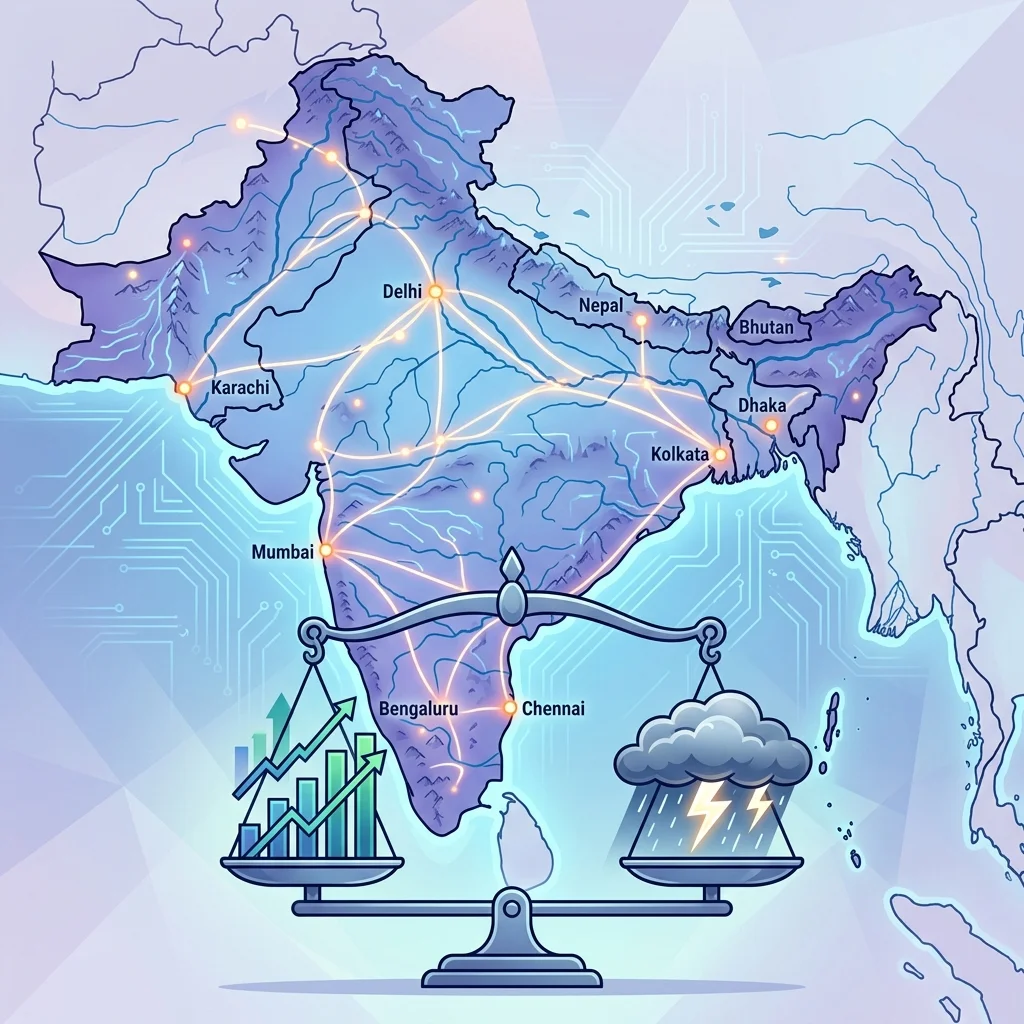
South Asia at a Crossroads: Navigating Jobs, AI, and Trade in the World Bank’s Latest Update
Introduction: Progress and Peril – The Two Faces of South Asia’s Transformation
The World Bank’s South Asia Development Update: Jobs, AI, and Trade – Chapter 1: Progress and Peril presents a region undergoing robust economic expansion and deepening integration into global markets, yet simultaneously confronting structural vulnerabilities that could undermine long-term stability. The report, released in 2025 and accessible via the Bank’s official document repository (World Bank, 2025), positions South Asia at a demographic inflection point: a young, growing workforce offers the potential for a historic demographic dividend, but the accelerating adoption of artificial intelligence and automation threatens to displace large segments of the labor force before formal employment systems can absorb new entrants.
The central thesis is that South Asia’s economic transformation is being propelled by rising trade volumes and inward foreign investment, but these gains are fragile. Climate‑induced disruptions, geopolitical fragmentation, and the rapid obsolescence of low‑skill jobs in manufacturing and services—textiles, call centers, data processing—could reverse progress. The report uses the dual framing of “progress and peril” to underscore that the same forces driving growth (trade openness, technological adoption) also generate risks that require deliberate policy intervention.
Trade and Investment: Current Trends and Structural Challenges
South Asia has seen an uptick in intra‑regional trade and deeper participation in global value chains, particularly in garments, electronics assembly, and business process outsourcing. Yet the World Bank’s data indicate that the region’s share of global foreign direct investment remains below that of Southeast Asia, a gap explained by persistent infrastructure deficits, regulatory fragmentation, and complex customs procedures. Infrastructure quality, measured by logistics performance indexes, lags behind competitors, raising transaction costs for exporters and importers alike.
Export diversification remains low. A handful of sectors—textiles in Bangladesh and Pakistan, IT services in India, tea and apparel in Sri Lanka—account for the majority of export revenue, making these economies acutely sensitive to demand shocks in specific end markets. The report notes that trade fragmentation, driven by rising tariff and non‑tariff barriers in major economies, has begun to erode the cost advantages that South Asian producers once enjoyed. Countries that have not diversified their export baskets face amplified vulnerability when external demand falters.
Investment flows have been concentrated in a few hubs—India’s technology corridors, Bangladesh’s ready‑made garment zones—while interior regions and smaller economies receive disproportionately less capital. The report’s analysis suggests that without coordinated improvements in trade infrastructure and regulatory harmonization, South Asia will struggle to replicate the supply‑chain integration seen in East and Southeast Asia.
AI and Automation: Threat or Opportunity for South Asian Labor Markets?
The report devotes significant attention to the dual impact of artificial intelligence on labor markets. On one hand, AI offers productivity gains in agriculture (precision farming, weather prediction), healthcare (diagnostic tools), and financial services (digital lending). On the other hand, the technologies most rapidly advancing—large language models, robotic process automation, and computer vision—directly threaten job categories that employ millions of South Asian workers.
Sectors with high exposure to automation include garment manufacturing (sewing, quality inspection), call centers and business process outsourcing (transcription, customer support), and basic data entry and processing. The World Bank’s occupational exposure indices, cited in the report, show that between 40 and 55 percent of formal employment in Bangladesh’s ready‑made garment sector and in India’s IT‑backed services could be automated in the next decade. Workers with secondary education or less, who make up the majority of the labor force in Nepal, Pakistan, and Sri Lanka, face the highest displacement risk.
The report does not treat AI as deterministically negative. It identifies opportunities for “leapfrogging” in sectors where South Asia has low current penetration, such as telemedicine and mobile‑based extension services for smallholder farmers. However, it warns that without widespread reskilling and social protection systems, the gains from productivity enhancement will accrue predominantly to capital owners and high‑skill workers, widening income inequality.
The Jobs Dilemma: Demographic Dividend or Demographic Disaster?
South Asia adds roughly 12 million young people to the working‑age population each year. The World Bank report calculates that the region needs to create at least 1.2 million formal jobs per month to absorb new entrants and reduce existing underemployment. Current formal‑sector job creation falls far short of this target, and the informal economy—where 80 to 90 percent of workers are employed in most South Asian countries—offers low productivity, no social insurance, and limited upward mobility.
Artificial intelligence could accelerate the trend toward informalization in two ways. First, as firms automate routine tasks in formal manufacturing and services, displaced workers often move into informal activities (street vending, domestic work, daily wage labor) that offer lower incomes and no protections. Second, the growth of platform‑based “gig” work—ride‑hailing, food delivery, micro‑tasking—creates a new class of formally independent workers who lack employment benefits and are exposed to algorithmic management.
The report distinguishes between “good” informalization (entrepreneurial activity that provides a stepping stone to formal employment) and “bad” informalization (survival‑driven work with no path to stability). Without policies that formalize gig work, strengthen collective bargaining, and provide portable benefits, AI‑driven restructuring may push more workers into the latter category.
Policy Pathways: How South Asian Economies Can Harness AI While Mitigating Risks
The World Bank update outlines several strategic interventions to navigate the jobs‑AI‑trade nexus. First, trade policy must shift from a focus on tariff reduction alone to deeper integration—harmonizing standards, reducing non‑tariff barriers, and improving logistics connectivity. The report recommends establishing regional “green lanes” for digital services and low‑carbon manufactured goods, which could attract investment in sectors that are less automation‑prone, such as renewable energy installation and environmental services.
Second, education and training systems require urgent overhaul. The report calls for a phasing‑out of rote‑learning curricula and a scaling‑up of digital literacy, problem‑solving, and socio‑emotional skills. It notes that many South Asian vocational training programs have low placement rates and weak linkages to employer demand. AI itself can be used to deliver adaptive learning at scale, but only if infrastructure (electricity, connectivity) and teacher training are improved first.
Third, social protection systems—currently fragmented and underfunded—must be expanded to cover informal workers and those displaced by automation. The report suggests piloting universal basic income schemes in selected districts, combined with active labor market policies such as wage subsidies for firms that hire displaced workers.
Finally, the region must strengthen its digital infrastructure and data governance frameworks to attract high‑quality AI‑enabled investment without ceding worker protections or data sovereignty.
Conclusion: A Region at an Inflection Point
The World Bank’s South Asia Development Update: Chapter 1 provides a data‑driven assessment of a region that is growing but not yet resilient. The convergence of trade expansion, demographic pressure, and AI‑driven automation creates a narrow policy window. Without reforms in education, social protection, and trade facilitation, South Asia could see its demographic dividend dissipate into mass underemployment and social instability. With deliberate action, the same forces could catalyze inclusive growth, but the margin for error is shrinking. The report’s title—Progress and Peril—is not rhetorical; it is an empirical description of the choices that policymakers, firms, and workers must make in the coming decade.
Reference: World Bank, “South Asia Development Update: Jobs, AI, and Trade – Chapter 1: Progress and Peril,” 2025. Available at: https://thedocs.worldbank.org/en/doc/029dbb0faf2410c6530b32d58325ecc5-0310012025/related/South-Asia-Development-Update-Chapter-1.pdf