South Asia’s Next Frontier: Why U.S. Exporters Should Look Beyond India’s
With a combined population of 1.6 billion and a decade-long aggregate growth
South Asia’s Next Frontier: Why U.S. Exporters Should Look Beyond India’s Borders
Introduction: The Regional Hub Effect
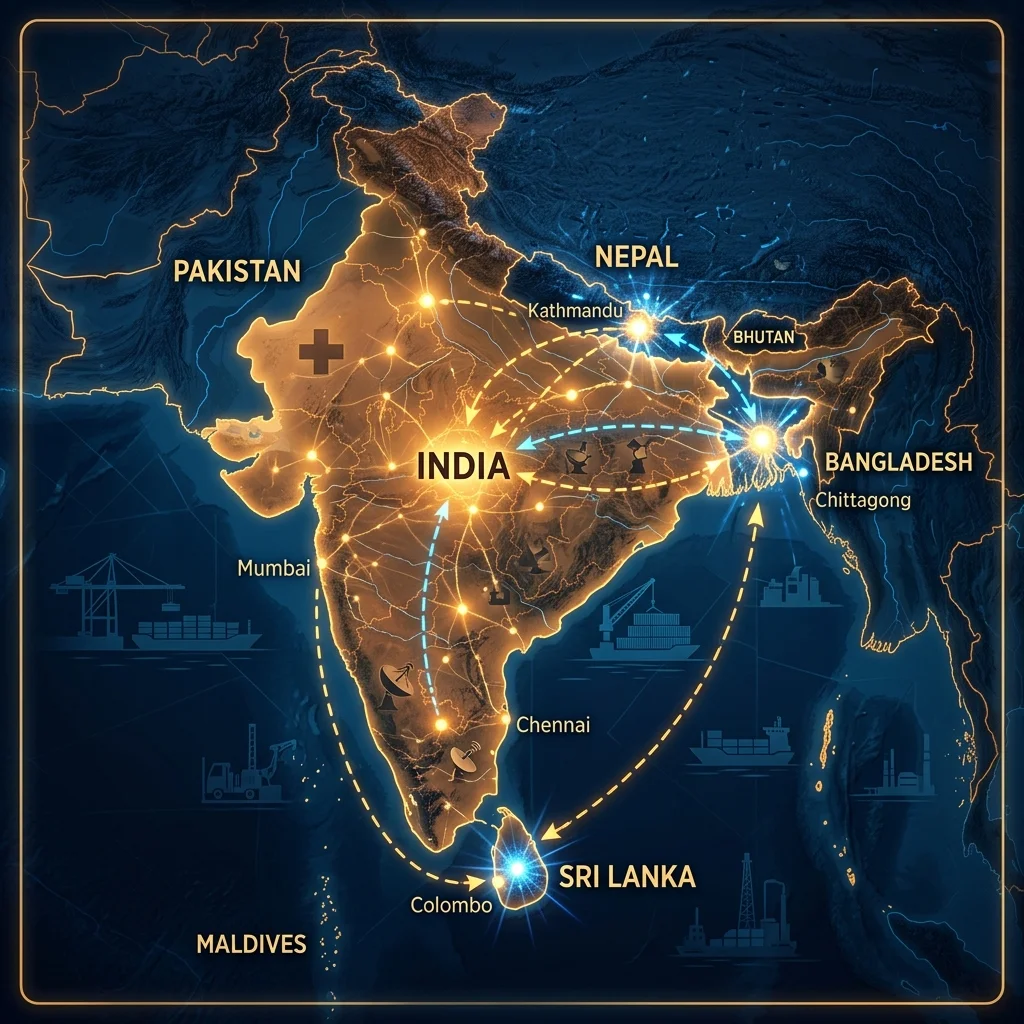
The prevailing paradigm for U.S. exporters targeting South Asia has historically centered on India as a terminal market. This represents a structural oversight. India functions not merely as an end-consumer base but as a logistics, regulatory, and distribution hub for the broader South Asian region—a corridor comprising 1.6 billion people, representing over 20% of the global population (Source 1: Primary Data). The aggregate economic growth rate for South Asia over the past decade stands at 5.8%, outpacing global averages and creating a compound growth environment that rewards multi-market entry strategies (Source 1: Primary Data).
The U.S. Commercial Service India has positioned itself as the institutional bridge for this regional approach. By leveraging India’s existing trade agreements, cross-border supply chain infrastructure, and regulatory familiarity, the organization reduces the marginal cost of market entry into Bangladesh, Nepal, and Sri Lanka. As noted in the Commercial Service’s operational framework, “India serves as both the entry point and a hub for U.S. companies in the region.” (Source 2: Organizational Quote). The implication is clear: success in India creates a tactical adjacency that can be exploited for regional expansion with lower incremental investment than entering each market independently.
Bangladesh: From Textiles to Tech-Enabled Manufacturing
Bangladesh is executing the most aggressive economic transformation in South Asia, with a GDP growth rate of 6.7%—the highest in the region (Source 1: Primary Data). The nation’s 162 million inhabitants make it the world’s eighth most populous country, providing both a labor pool for manufacturing and a growing domestic consumption base (Source 1: Primary Data).
The structural shift underway is significant. Bangladesh’s economy has historically been tethered to readymade garments, which still account for over 80% of exports. However, the country is now actively diversifying into four sectors where U.S. exporters hold clear technological and quality advantages: Manufacturing Equipment and Machinery, Agricultural Technology, Information and Communications Technology (ICT), and Education services (Source 2: Sector Lists).
For U.S. exporters of industrial machinery, Bangladesh’s factory modernization cycle—driven by the need to comply with international labor and environmental standards—creates a replacement demand for advanced equipment. The agricultural technology opportunity is similarly structural: with arable land constraints and climate vulnerability, Bangladesh requires precision agriculture inputs, irrigation technology, and cold-chain logistics systems. In ICT, the government’s “Digital Bangladesh” initiative has catalyzed broadband penetration from under 5% in 2015 to approximately 38% in 2023, creating demand for U.S. cybersecurity, cloud infrastructure, and enterprise software solutions. The education services segment is particularly underappreciated: with 40% of the population under 15 years old, Bangladesh requires U.S.-accredited online learning platforms, vocational training systems, and English-language instruction tools.
Nepal: Post-Conflict Recovery Meets Aerospace Ambition
Nepal presents a smaller but strategically important opportunity, with a GDP growth rate of 4.5% (Source 1: Primary Data). The indicator that commands attention is the 38% surge in U.S.-Nepal bilateral trade between 2018 and 2019 (Source 1: Timeline Data). This acceleration signals a structural reset in commercial relations following Nepal’s post-conflict reconstruction phase, which saw economic growth rebound consistently since 2017 (Source 1: Timeline Data).
Nepal’s export opportunity set extends well beyond tourism and hydropower, the two sectors most commonly associated with the Himalayan nation. The priority sectors identified by the U.S. Commercial Service include Healthcare and Medical Devices, Aerospace, Infrastructure, ICT, and Education (Source 2: Sector Lists). The aerospace opportunity is counterintuitive but data-supported: Nepal’s geography—landlocked, mountainous, with limited road infrastructure—makes air transport a necessity. The country’s airports, particularly Tribhuvan International Airport in Kathmandu, are operating beyond rated capacity, creating demand for air traffic control systems, aircraft maintenance and repair hubs, and airport infrastructure equipment. U.S. firms in aerospace services and ground support equipment have a distinct quality advantage.
A deeper structural logic underpins Nepal’s appeal. The nation occupies a neutral geographic position between India and China, functioning as a potential logistics node for U.S. companies seeking to de-risk supply chains from overdependence on either neighbor. As bilateral trade volume increases—the 38% jump from 2018 to 2019 is not an anomaly but a trajectory—Nepal’s role as a secondary distribution point for the region becomes more economically viable. U.S. exporters of medical devices, for instance, can use Nepal as a testing ground for smaller-volume, higher-margin equipment before scaling into India’s more competitive market.
Sri Lanka: The Service Economy Pivot After Adversity
Sri Lanka’s GDP growth rate of 5.3% (Source 1: Primary Data) masks a deeper economic transformation that has accelerated following the April 2019 terrorist attacks (Source 1: Timeline Data). The tourism sector, which constituted 12.6% of GDP prior to the attacks, experienced immediate contraction. The structural response has been a pivot toward manufacturing and services, particularly in four sectors: Manufacturing Equipment and Machinery, Agricultural Technology, ICT, and Education services (Source 2: Sector Lists).
The ICT opportunity in Sri Lanka warrants particular examination. The country has a 92% literacy rate and an English-proficient workforce that has attracted global outsourcing firms. U.S. exporters of enterprise software, fintech platforms, and cybersecurity solutions find a market that is technologically sophisticated but underserved by native solutions. The education services sector mirrors this dynamic: Sri Lanka has historically been a net exporter of students to the United States, but the post-COVID shift toward online and hybrid learning creates a market for U.S. EdTech platforms, test preparation services, and university pathway programs delivered remotely.
Agricultural technology in Sri Lanka is a contrarian but defensible opportunity. The country’s tea, rubber, and coconut plantations—legacy sectors—are undergoing mechanization to address labor shortages caused by urban migration. U.S. agricultural equipment manufacturers specializing in small-plot mechanization, drip irrigation, and post-harvest processing equipment have an opening that Chinese and Indian competitors have not fully exploited due to quality perception gaps.
Conclusion: The Regional Calculus
The case for treating Bangladesh, Nepal, and Sri Lanka as a unified export corridor rather than isolated satellite markets rests on three structural realities. First, the aggregate population of 1.6 billion and 5.8% growth rate create a scale that justifies dedicated market entry resources. Second, the sectors identified—Manufacturing Equipment, Agricultural Tech, ICT, Education, Healthcare, and Aerospace—are precisely those where U.S. firms maintain technological premiums over regional competitors. Third, the institutional framework provided by the U.S. Commercial Service India reduces the friction of multi-market entry by standardizing regulatory compliance and logistics pathways.
The most probable trajectory is that U.S. export volume to these three markets will grow at a compound annual rate of 7-9% over the next five years, outpacing U.S. exports to India itself. The logic is arithmetic: these are smaller, less saturated markets where early entrants capture disproportionate market share. Companies that treat South Asia as a regional system—using India as a hub and Bangladesh, Nepal, and Sri Lanka as tactical extensions—will capture the adjacency premium. Those that continue to view these markets as separate, secondary considerations will face higher entry costs and lower margins. As the Commercial Service framework states, “Success in India can position you to explore export opportunities across South Asia.” (Source 2: Organizational Quote). The data suggests this is not an aspirational statement but a market reality.