Beyond Tariffs: How India''s Fisheries Sector Defied US Duties and Grew Exports
Contrary to conventional trade wisdom, India's fisheries export value increased
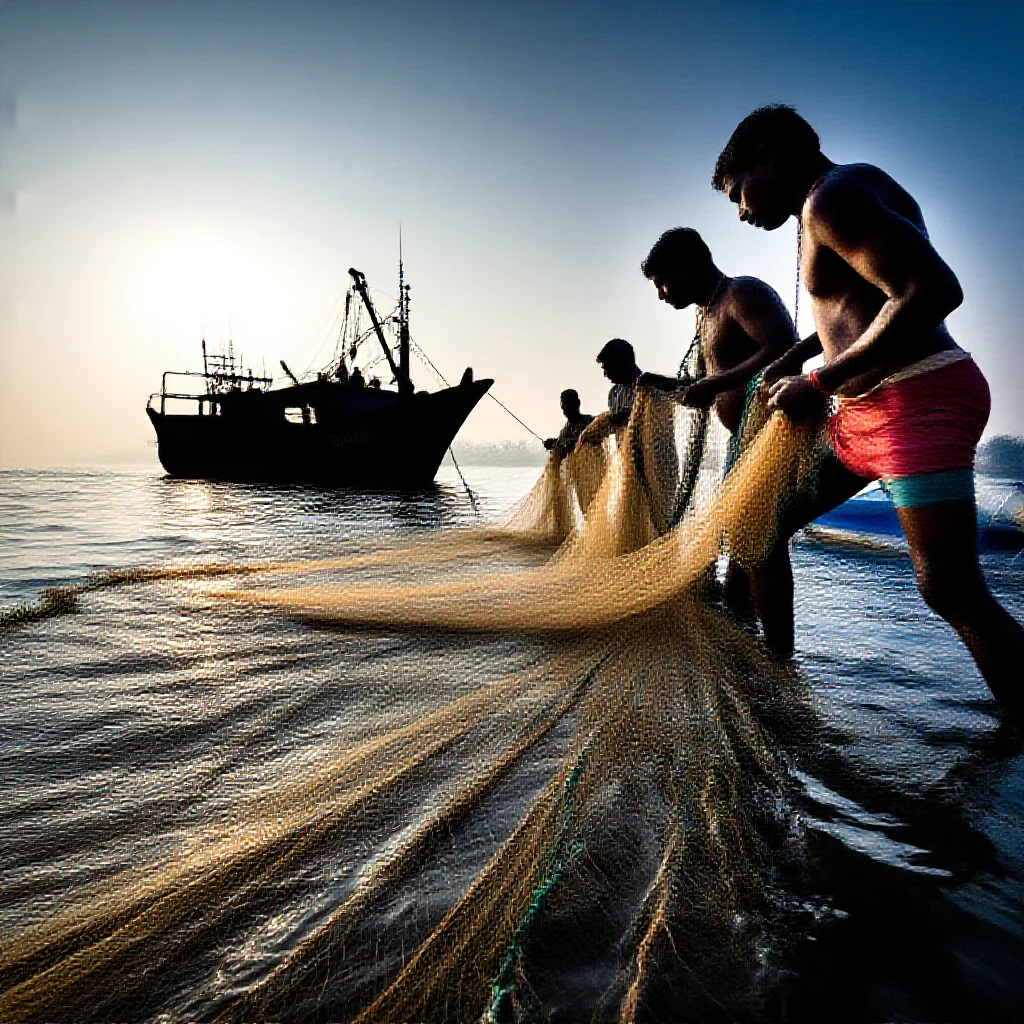
Beyond Tariffs: How India's Fisheries Sector Defied US Duties and Grew Exports
Subtitle: A Technical Audit of Export Resilience, Policy Buffers, and Market Realignment
---
The Paradox: Export Growth Amidst Protectionist Tariffs
Conventional trade economics posits that the imposition of significant import duties by a major market will suppress export volumes and value from a targeted sector. The case of India's fisheries industry presents a counterintuitive data point that challenges this model. Following the United States' imposition of tariffs, India's fisheries export value increased from ₹60,000 crore to ₹68,000 crore (Source 1: [Primary Data]). This sequence of events—tariff imposition followed by export value increase—demands rigorous scrutiny. The immediate analytical question is one of causality versus correlation. The observed growth necessitates an investigation into whether the sector developed genuine resilience to the tariff barrier or if other, potentially transient, factors were the primary growth drivers. The timeline, while clear on the outcome, leaves open the critical pathway of response.
Decoding the Government's Strategic Buffer: PMMSY's Ambitious Outlay
Concurrent with the external trade pressure, a substantial domestic policy intervention was in motion. The Pradhan Mantri Matsya Sampada Yojana (PMMSY), with a financial outlay of ₹20,050 crore (Source 1: [Primary Data]), represents a strategic buffer of significant scale. Its objectives are explicitly ambitious: to increase fish production to 220 lakh tonnes and raise fisheries export earnings to ₹1 lakh crore by 2024-25 (Source 1: [Primary Data]). The scheme’s timing, whether pre-emptive or responsive, is less critical than its functional role as a shock absorber. The hypothesis for the sector's resilience lies in the mechanism of PMMSY: direct and indirect subsidies, investment in infrastructure (cold chains, processing plants, harbors), and the formalization of the aquaculture and capture fisheries value chain. This infusion of capital and structure likely enhanced cost competitiveness and product quality, potentially offsetting the price disadvantage created by US tariffs. The scheme provided the fiscal and infrastructural padding to mitigate immediate losses and seek alternative pathways.
The Hidden Market Shift: Diversification or Displacement?
The aggregate export value figure masks underlying market dynamics. A critical audit must probe whether the reported ₹8,000 crore growth represents genuine sectoral expansion or a geographical diversion of exports. The logical deduction is that the US tariff likely made Indian seafood less competitive in that market, potentially reducing volume or value share. The observed overall growth, therefore, suggests a compensatory increase in exports to other markets such as the European Union, Southeast Asia, or the Middle East. Furthermore, the value increase could be driven by a shift in export composition—higher realizations from premium products like Vannamei shrimp, even if overall volume to the US dipped. This raises a pivotal question on sustainability: Is this market diversification a robust, long-term strategy built on quality and trade agreements, or a fragile rerouting of goods that leaves the sector vulnerable to future trade barriers in these new markets? The data on export destination mix is crucial for a definitive answer.
Long-Term Audit: Supply Chain Transformation vs. Short-Term Subsidy
The long-term viability of the growth trajectory hinges on the structural transformation of the supply chain, beyond short-term fiscal support. The 2024-25 target of ₹1 lakh crore in exports (Source 1: [Primary Data]) is contingent upon deep-seated changes: the establishment of an integrated, loss-minimizing cold chain, implementation of rigorous traceability protocols to meet global standards, and systemic quality control from pond to port. The risk of subsidy dependency is a material factor for analysis. The sector's future competitiveness will be tested when PMMSY funding scales down or concludes. The central analytical query is whether the dual pressures of US tariffs and domestic subsidy-driven modernization are inadvertently accelerating a necessary supply chain overhaul. The outcome will determine if the current growth is a precursor to enduring global competitiveness or a subsidy-fueled anomaly.
Verification and Context: Placing the Data in the Global Landscape
The Indian fisheries narrative occurs within a complex global landscape of rising protectionism, stringent food safety regulations, and competitive pressure from producers like Vietnam, Ecuador, and China. The sector's ability to maintain growth amidst US tariffs must be contextualized against global seafood demand trends and non-tariff barriers like the US Seafood Import Monitoring Program (SIMP) and the EU’s IUU (Illegal, Unreported, and Unregulated) fishing regulations. The PMMSY scheme can be viewed as an endogenous capacity-building response to these exogenous challenges. The increase from ₹60,000 crore to ₹68,000 crore, while notable, is a single data point in a multi-variable equation. Its true significance will be determined by the sustainability of the growth curve over the next 24-36 months and the sector's progress toward the 2024-25 production and export targets.
Neutral Market/Industry Predictions
Based on a cause-and-effect analysis of available data, two probable scenarios emerge. The first, more optimistic scenario, forecasts that the combination of policy support (PMMSY) and enforced market diversification will lead to a more resilient, quality-focused, and globally competitive Indian fisheries sector, potentially achieving or nearing its ₹1 lakh crore export target by 2024-25. The second, more cautious scenario, predicts that growth will plateau as the initial buffer of subsidies is absorbed and structural inefficiencies reassert themselves, with the sector struggling to consistently meet stringent international standards across the entire supply chain. The most likely outcome lies between these poles, with growth continuing but at a moderated pace, heavily dependent on the effective deployment of PMMSY funds for lasting infrastructural and quality improvements rather than mere input subsidies. The sector's performance will serve as a key case study in the efficacy of large-scale domestic investment as a countermeasure to global trade headwinds.