From Fertiliser Dependency to Precision Farming: India’s AI-Driven Agricultural
India's heavy reliance on imported fertilisers poses a long-term economic
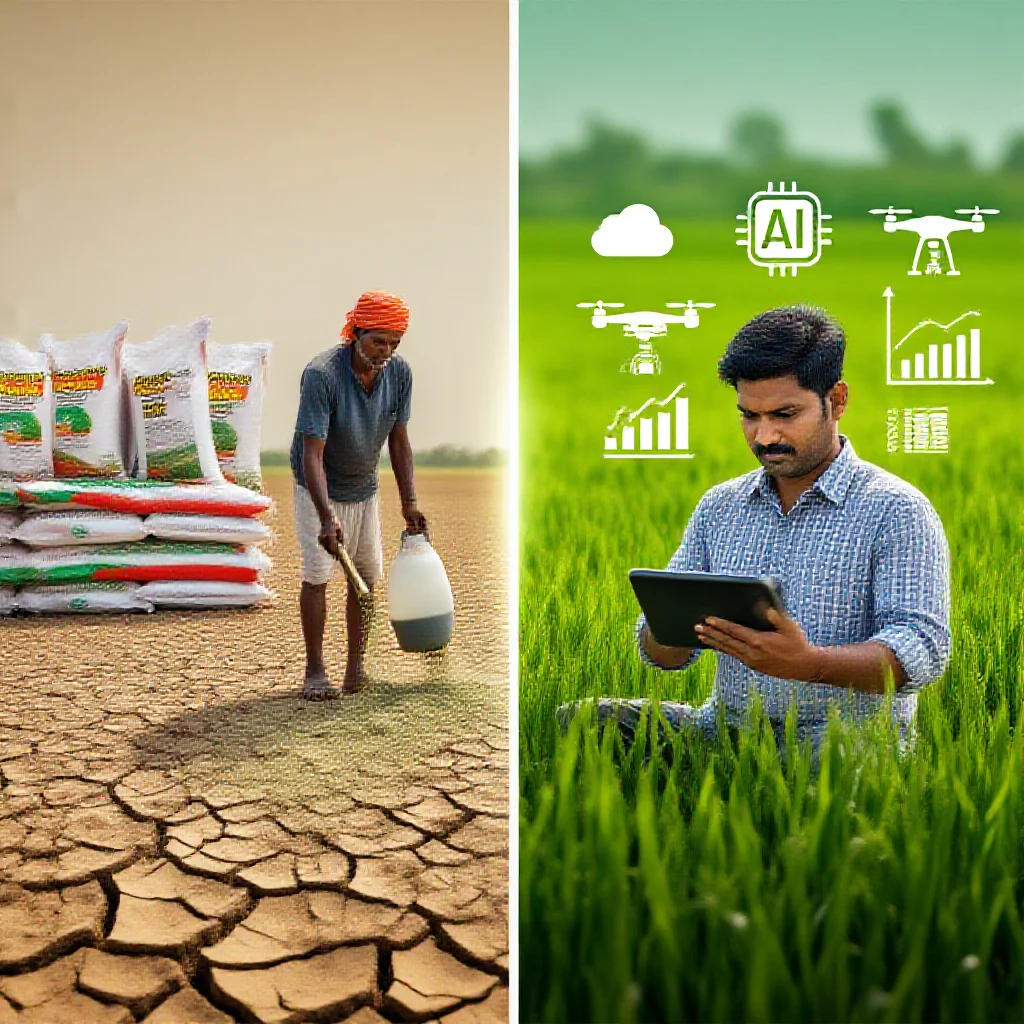
From Fertiliser Dependency to Precision Farming: India’s AI-Driven Agricultural Shift
By a Senior Technical/Financial Audit Journalist
---
Introduction: The Fertiliser Trap
On a date not specified in public records, the chief of the Indian Council of Agricultural Research (ICAR) issued a statement reported by the Economic Times, calling for a strategic reduction in India’s reliance on imported fertilisers through the adoption of artificial intelligence and precision farming technologies. The statement represents a significant policy signal from the country’s apex agricultural research body, acknowledging that decades of input-subsidy-driven farming have created structural vulnerabilities.
The core problem is quantifiable: India imports over 50% of its potassic and phosphatic fertiliser requirements, with domestic production capacity covering less than 15% of muriate of potash (MOP) demand (Source 1: Ministry of Chemicals and Fertilizers Annual Report). This dependency exposes the agricultural economy to international price volatility, shipping disruptions, and geopolitical supply constraints.
The article’s thesis is that the solution lies not merely in expanding domestic fertiliser production—an approach that would require massive capital expenditure and continued environmental degradation—but in a fundamental transformation of nutrient application methods. AI-driven precision agriculture offers a mechanism to reduce aggregate fertiliser consumption while maintaining or improving crop yields, thereby addressing both import dependency and soil health deterioration simultaneously.
---
The Hidden Cost of Dependency: Supply Chain Vulnerabilities
Exposure by Fertiliser Type
India’s fertiliser import profile reveals differentiated risk exposure across three primary categories:
- Urea (Nitrogenous): Partial import dependence (approximately 25-30%), primarily sourced from Oman, Qatar, and China. Domestic production via natural gas-based plants provides some insulation, but feedstock price fluctuations remain a risk factor.
- DAP (Di-Ammonium Phosphate): Approximately 50-60% imported, with major suppliers including Saudi Arabia, Jordan, Morocco, and China. The Russia-Ukraine conflict disrupted global DAP supply chains, causing spot prices to spike 80% between 2021 and 2022 (Source 2: CRISIL Research, Fertiliser Sector Report 2023).
- MOP (Muriate of Potash): Over 90% imported, with supply concentrated among a handful of global producers: Belarus, Russia, Canada, and Israel. The geopolitical sanctions on Belarusian potash exports in 2022 created acute supply shortages, demonstrating the fragility of this dependence.
Geopolitical and Logistical Risks
The supply chain for fertiliser imports involves multiple choke points. Bulk carriers arriving from the Red Sea route face port congestion at Kandla, Mundra, and Paradip during peak import seasons. Shipping costs, which rose 300% during 2021-2022, directly translate into higher subsidy burdens or retail prices. Trade bans, such as China’s temporary export restrictions on phosphate-based fertilisers in 2021, create immediate procurement challenges.
The fiscal strain is documented: India’s fertiliser subsidy expenditure reached approximately ₹2.5 lakh crore in FY2023 (Source 3: Union Budget documents, Department of Fertilizers), up from ₹1.3 lakh crore in FY2021. This increase was driven almost entirely by global price inflation, not by increased consumption volume. The government absorbs the differential between international prices and domestic MRP, making import dependency a direct fiscal vulnerability.
Beyond Substitution: The Efficiency Argument
The logical error in current policy discussions is the assumption that domestic production expansion is the primary solution. Building new fertiliser plants requires 4-6 years of construction, regulated gas allocations, and environmental clearances. Even then, India lacks economically viable domestic reserves of potash and phosphate rock. The Geological Survey of India has identified minor potash occurrences in Rajasthan and Madhya Pradesh, but commercial extraction remains infeasible at current technology levels (Source 4: GSI Mineral Yearbook 2022).
The more economically rational approach is demand-side efficiency: reducing the total quantity of fertiliser required per unit of crop output. Current nitrogen use efficiency (NUE) in Indian agriculture is estimated at 30-35%, compared to 50-60% in developed agricultural systems (Source 5: ICAR-Indian Institute of Soil Science study). This inefficiency means that approximately two-thirds of applied nitrogen is lost to volatilisation, leaching, or runoff—representing both economic waste and environmental damage.
---
The Technological Case for Precision Agriculture
How AI Addresses Nutrient Waste
Precision agriculture employs a suite of technologies—soil sensors, satellite imagery, drone-based multispectral analysis, and machine learning algorithms—to generate site-specific nutrient application recommendations. The fundamental principle is that soil fertility varies significantly within individual fields, and blanket fertiliser recommendations lead to over-application in areas with existing nutrient reserves and under-application in deficient zones.
AI-driven decision support systems, such as the ICAR-developed Crop Manager and private-sector platforms from agri-tech start-ups, process multiple data layers:
- Soil test data (pH, organic carbon, N, P, K levels)
- Satellite vegetation indices (NDVI, NDRE) indicating crop nitrogen status
- Historical yield maps showing spatial variability
- Weather forecasts predicting rainfall patterns that affect nutrient mobility
- Crop growth stage data from phenology models
The output is a variable-rate recommendation that can reduce nitrogen application by 15-25% without yield loss, based on field trials conducted by ICAR in Punjab, Haryana, and Maharashtra (Source 6: ICAR Annual Report 2023-24). At national scale, a 20% reduction in urea consumption would lower import volumes by approximately 6-7 million metric tonnes annually, assuming current domestic production levels.
The Economic Logic of Technology Substitution
The substitution calculus involves replacing a recurring expense (fertiliser imports) with a capital investment (technology deployment) that yields declining marginal costs over time. A typical precision farming setup—including soil sensors, drone, software subscription, and training—costs approximately ₹50,000-80,000 per hectare initially, with annual operational costs of ₹5,000-10,000 per hectare (Source 7: NITI Aayog, "Transforming Agriculture Through Technology" report).
Fertiliser savings alone can recover this investment within 2-3 cropping seasons for medium-scale farmers. When co-benefits are included—reduced water usage from drip integration, lower pesticide applications from targeted spraying, and premium pricing for certified sustainable produce—the return on investment improves further.
The key constraint is scalability across India’s 140 million smallholder farms, where average landholding is 1.08 hectares (Source 8: Agriculture Census 2015-16). Per-hectare technology costs become prohibitive for marginal farmers, and the data infrastructure for AI models depends on consistent soil testing coverage—which currently reaches only 30% of agricultural land annually.
---
Barriers to Adoption: Data Infrastructure and Farmer Readiness
The Soil Data Gap
AI models are only as reliable as the training data they receive. India’s soil health card scheme, launched in 2015, has distributed over 23 crore cards to farmers, but the quality and frequency of testing remain inconsistent. The recommended cycle of testing every 3 years is not universally followed, and many cards contain outdated or inaccurate data from overworked regional testing laboratories.
For variable-rate fertiliser application to work effectively, soil data must be georeferenced at sub-hectare resolution—a requirement that would necessitate testing each smallholder’s multiple fragmented plots separately. This represents a logistical challenge that current institutional capacity cannot fulfil in the short term.
The Connectivity Constraint
Precision agriculture technologies require reliable internet connectivity for real-time data transmission from sensors to cloud servers to farmer smartphones. According to the Telecom Regulatory Authority of India (TRAI) data published in December 2023, rural 4G coverage stands at approximately 55% of villages, and consistent bandwidth quality remains poor in many areas. AI-based recommendation systems that require real-time satellite data processing cannot function in offline mode.
Farmer Adoption Behaviour
The adoption of precision farming involves a shift from a habit of input-intensive cultivation to data-informed decision-making. Indian farmers have spent decades receiving subsidised fertilisers through the public distribution system, with application rates determined by tradition or dealer recommendations rather than soil analysis. Changing this behaviour requires:
- Trust in digital recommendations: Farmers must believe that an algorithm can outperform their experiential knowledge.
- Demonstrable yield advantages: Visible, short-term benefits are necessary for adoption, whereas soil health improvements take multiple seasons to manifest.
- Risk tolerance: Early adopters face the possibility of reduced yields if AI recommendations are incorrect for specific local conditions.
ICAR has established 150 precision farming demonstration centres across 100 districts (Source 9: ICAR press release, January 2024), but scaling from demonstration to mass adoption requires a comprehensive extension service transformation—moving from a model where agricultural officers distribute pamphlets to one where they operate drones and interpret data dashboards.
---
A Roadmap for Policymakers and Agri-Tech Innovators
Immediate-term Actions (0-2 years)
- Subsidy restructuring: Link fertiliser subsidy disbursement to soil test results and AI-based recommendations, creating a financial incentive for precision application.
- Public data infrastructure: Establish a national soil database with open APIs for private-sector agri-tech companies to build applications upon.
- Drone fleet deployment: Procure 10,000 agricultural drones through state agricultural departments for seasonal nutrient mapping, contracting operations to trained rural youth.
Medium-term Actions (2-5 years)
- Last-mile connectivity: Prioritise 5G deployment in agricultural zones under the BharatNet project, with dedicated spectrum allocation for IoT sensor networks.
- Training certification: Create a national certification programme for precision farming technicians, modelled on the existing ITI system, to generate a workforce capable of maintaining sensor networks and processing data.
- Crop-specific algorithms: Develop standardised AI models for India’s 20 major crops, validated across agro-climatic zones, reducing the need for farm-specific customisation.
Structural Changes for Scalability
The adoption ceiling for precision farming on smallholder farms will remain low without cooperative or service-based models. The most viable path is a platform approach where farmers do not purchase technology but pay per-acre service fees to agri-tech aggregators who deploy drones, interpret data, and apply inputs. This model has been validated in pilot projects by the Rural Electrification Corporation (REC)-funded digital agriculture initiative in Madhya Pradesh, where 12,000 farmers accessed precision services at ₹1,200 per acre per season (Source 10: REC Foundation Annual Report 2023).
---
Conclusion: Market and Industry Predictions
The economic trajectory suggests that India’s fertiliser import dependence will decrease marginally through 2027-2028, not from reduced consumption, but from incremental domestic production of nano-urea and neem-coated urea. However, the structural reduction in import volume—the 15-25% drop necessary to insulate the fiscal budget from global price shocks—will require widespread precision technology adoption.
The market for agricultural AI in India is projected to grow from approximately ₹1,200 crore in 2024 to ₹7,500 crore by 2030, at a compounded annual growth rate of 36% (Source 11: Market research projections, AgriTech India Forum). This growth will be driven by government procurement contracts for drone-based nutrient mapping, rather than by individual farmer purchases.
The winnowing of the agri-tech sector will likely occur within 18-24 months, with companies that have integrated soil testing labs, data analytics, and last-mile application services surviving, while pure software-only platforms fade. The international comparison is instructive: in Brazil, precision agriculture adoption reached 40% of farmland within five years of government-linked credit schemes, a model India is replicating through the Kisan Credit Card-linked technology subsidies announced in the 2024-25 Union Budget.
The ICAR chief’s statement represents not a sudden insight but a delayed acknowledgment of a trend that has been developing for a decade. The transition from fertiliser dependency to precision farming is technologically feasible, economically rational, and fiscally necessary. The remaining variable is execution speed, which depends on whether India can build the data infrastructure and institutional capacity faster than the next global fertiliser price shock arrives.