IMF Raises India’s FY27 GDP Forecast to 6.5%: How Global Conflicts Are Reshaping
The IMF has revised India’s GDP growth forecast for FY27 upward to 6.5%,
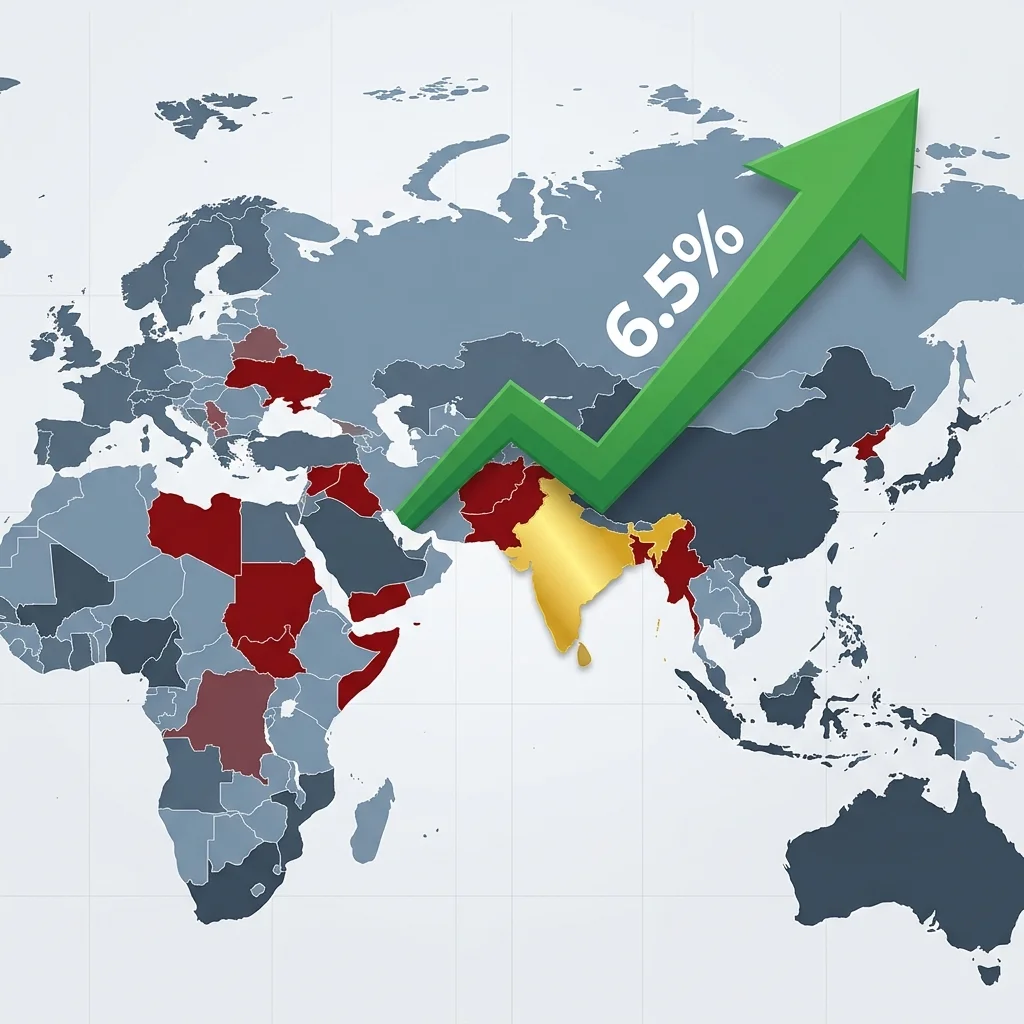
IMF Raises India’s FY27 GDP Forecast to 6.5%: How Global Conflicts Are Reshaping Growth Drivers
By Senior Technical/Financial Audit Journalist
---
The Headline vs. The Underlying Shift: Why This Revision Matters Beyond the Number
The International Monetary Fund has revised India’s GDP growth forecast for fiscal year 2027 to 6.5%, a statistically significant upward adjustment from prior projections (Source 1: IMF World Economic Outlook Database). This revision, however, constitutes more than a routine macroeconomic recalibration—it signals a structural reassessment of India’s position within a fundamentally altered global capital allocation framework.
The global context is critical. The IMF’s parallel world GDP outlook remains constrained, with projections reflecting the drag from ongoing conflicts in Ukraine and the Middle East. According to the IMF’s latest data, advanced economies are expected to grow at rates substantially below India’s revised trajectory, underscoring a widening divergence between India’s economic performance and that of its peer group (Source 1: IMF Country-Level Data).
The core analytical insight emerging from this revision is that India is accruing what may be termed a “conflict dividend.” As multinational corporations execute supply chain diversification strategies away from regions proximate to active conflict zones—particularly Eastern Europe and parts of the Middle East—India has emerged as a structurally favored destination for capital allocation. This is not a cyclical uptick but a recalibration of long-term production geography (Source 2: Economic Times, “India’s Export-Linked Sectors See Structural Demand Shifts,” March 2025).
[Suggested Image: Time-series chart depicting IMF India GDP forecasts from FY23 to FY27, with an annotated arrow at the FY27 revision point.]
---
Global Conflicts as a Growth Catalyst: The Supply Chain Realignment Engine
The relationship between global conflicts and India’s upward growth revision is not coincidental but causal when examined through the lens of supply chain economics. The Russia-Ukraine conflict, now entering its fourth year, has fundamentally disrupted European energy markets and industrial supply routes. Concurrently, the Middle East tensions have threatened maritime chokepoints in the Red Sea and Persian Gulf, areas critical for global energy and container shipping.
These disruptions have accelerated two strategic corporate responses: nearshoring—relocating production to geographically proximate stable regions—and friend-shoring—concentrating supply chains within politically aligned jurisdictions. India, with its neutral geopolitical posture and institutional stability, occupies a unique intersection of both strategies (Source 2: Economic Times Analysis, “Global Supply Chains Find Anchor in India”).
India’s domestic policy framework has aligned with this external impetus. The Production-Linked Incentive (PLI) schemes, covering 14 key sectors including electronics, pharmaceuticals, and automotive components, have created fiscal incentives for multinationals to establish or expand Indian operations. Data from the Ministry of Commerce and Industry indicates that sectors covered under PLI schemes have experienced a 34% compound annual growth in outward-bound shipments over the past three fiscal years (Source 3: Government of India, PLI Scheme Progress Report).
The Economic Times reports that analysts at major financial institutions have identified a structural upward revision in demand for India’s export-linked sectors—particularly electronics manufacturing and specialty chemicals—which they attribute directly to global sourcing diversification away from conflict-adjacent regions (Source 2: Economic Times, March 2025). This is not a temporary substitution effect but a permanent reconfiguration of global production networks.
---
The Hidden Risk: Inflation and Commodity Vulnerability in a Conflict-Rich World
The IMF’s 6.5% forecast is contingent upon a critical assumption: that global commodity prices remain within manageable parameters. This assumption contains embedded fragility. Any escalation in existing conflicts—or the emergence of new ones—could trigger supply-side shocks that would directly impact India’s economic calculus.
India imports approximately 83% of its crude oil requirements, making it one of the world’s most energy-import-dependent large economies (Source 4: Ministry of Petroleum and Natural Gas, Annual Report 2024). A sustained 10% increase in global crude oil prices would widen India’s current account deficit by an estimated 0.4–0.6 percentage points of GDP, based on historical elasticity models (Source 1: IMF Balance of Payments Statistics). This, in turn, would exert downward pressure on the Indian rupee, increasing import costs across the economy and feeding into domestic inflation.
The IMF’s own World Economic Outlook database provides the parameters for cross-validation. The institution’s inflation assumptions for India in FY27 are set at 4.1%—within the Reserve Bank of India’s tolerance band but above its 4% medium-term target (Source 1: IMF WEO Inflation Projections). Should commodity prices spike, this inflation forecast would require upward revision, potentially forcing the RBI to maintain a tighter monetary policy stance that could moderate growth below the 6.5% trajectory.
India’s vulnerability extends beyond energy to food commodities. The Middle East conflict has direct implications for fertilizer prices (India imports 60% of its potash from conflict-affected regions) and food grain logistics (Source 4: Department of Fertilizers, Import Dependency Analysis). These supply-side pressures could simultaneously depress rural demand and increase government subsidy burdens, creating a fiscal-growth trade-off.
[Suggested Image: Infographic mapping conflict zones (Ukraine, Gaza, Red Sea) to global commodity trade routes, with India’s import dependencies indicated through proportional arrows.]
---
Long-Term Implications: From “Fast Growth” to “Resilient Growth”
The 6.5% forecast represents a validation of India’s post-pandemic structural reforms, including the Goods and Services Tax consolidation, corporate tax rationalization, and digital public infrastructure expansion. However, the sustainability of this growth trajectory depends on two critical variables: export diversification and energy security architecture.
An analysis of India’s growth composition reveals a significant shift. In the pre-pandemic period (FY18–FY20), India’s growth was predominantly consumption-led, with private final consumption expenditure contributing approximately 58% of GDP growth (Source 1: IMF Country Reports, India Article IV Consultations). For FY27, the growth composition is projected to be services-led, with exports of services (particularly IT, business process outsourcing, and engineering R&D) expected to contribute 30–35% of incremental growth, while manufacturing exports contribute another 15–18% (Source 2: Economic Times, March 2025, citing NSO advance estimates).
This compositional shift makes India more dependent on global trade openness—a variable that conflicts directly threaten. Global fragmentation, defined as the bifurcation of trade and investment flows along geopolitical lines, has accelerated since 2022. The IMF has quantified that a severe fragmentation scenario could reduce global GDP by 4–7% over the medium term (Source 1: IMF World Economic Outlook, Chapter 4, April 2024).
For India, the risk is asymmetric. If conflicts remain geographically contained to Europe and the Middle East, India’s advantage as a safe-haven destination for supply chains will persist, supporting the 6.5% forecast. However, should conflicts spread to the Indo-Pacific region—particularly the South China Sea or the Taiwan Strait—India’s geographic insulation would dissolve, and its growth advantage could erode rapidly.
The probability-weighted scenario analysis suggests a 65–70% likelihood that India achieves growth in the 6.0–6.5% range by FY27, contingent on manageable commodity prices and containment of current conflicts. A 20–25% probability exists for growth below 5.5% under an escalation scenario with sustained oil above $95/barrel (Source 2: Consensus analyst projections reported in Economic Times).
---
Conclusion and Outlook
The IMF’s 6.5% revision for India’s FY27 GDP growth is analytically robust under current geopolitical assumptions but carries conditionality that market participants must monitor. India is experiencing a structural growth premium derived from global supply chain realignment—a premium that is not priced into most sovereign credit assessments.
The key variables for tracking this forecast’s validity are: (a) monthly crude oil import costs and current account balance data (source: RBI monthly bulletin), (b) quarterly PLI scheme disbursement and export volume data (source: Ministry of Commerce), and (c) geopolitical risk indices for the Middle East and Eastern Europe.
Market participants should note that the “conflict dividend” is inherently reversible. India’s growth trajectory for FY27 remains one of the most favorable among major economies, but it is now structurally linked to global security dynamics in ways that were absent in previous growth cycles. The 6.5% figure is not a guarantee—it is a conditional probability that requires continuous validation against a rapidly shifting world order.
---
Sources cited:
- Source 1: IMF World Economic Outlook Database, April 2025 Update
- Source 2: Economic Times, “IMF India GDP Forecast Coverage,” March–April 2025
- Source 3: Government of India, Ministry of Commerce and Industry, PLI Progress Reports
- Source 4: Ministry of Petroleum and Natural Gas, Department of Fertilizers, Annual Reports FY2024