Beyond the Dip: How Developing Asia’s 2024 FDI Shift Signals a Supply Chain
In 2024, developing Asia attracted $605 billion in foreign direct investment—a
Beyond the Dip: How Developing Asia’s 2024 FDI Shift Signals a Supply Chain Realignment
By a Senior Technical/Financial Audit Journalist
---
The Headline Numbers: A 3% Decline Masks a Divergent Region
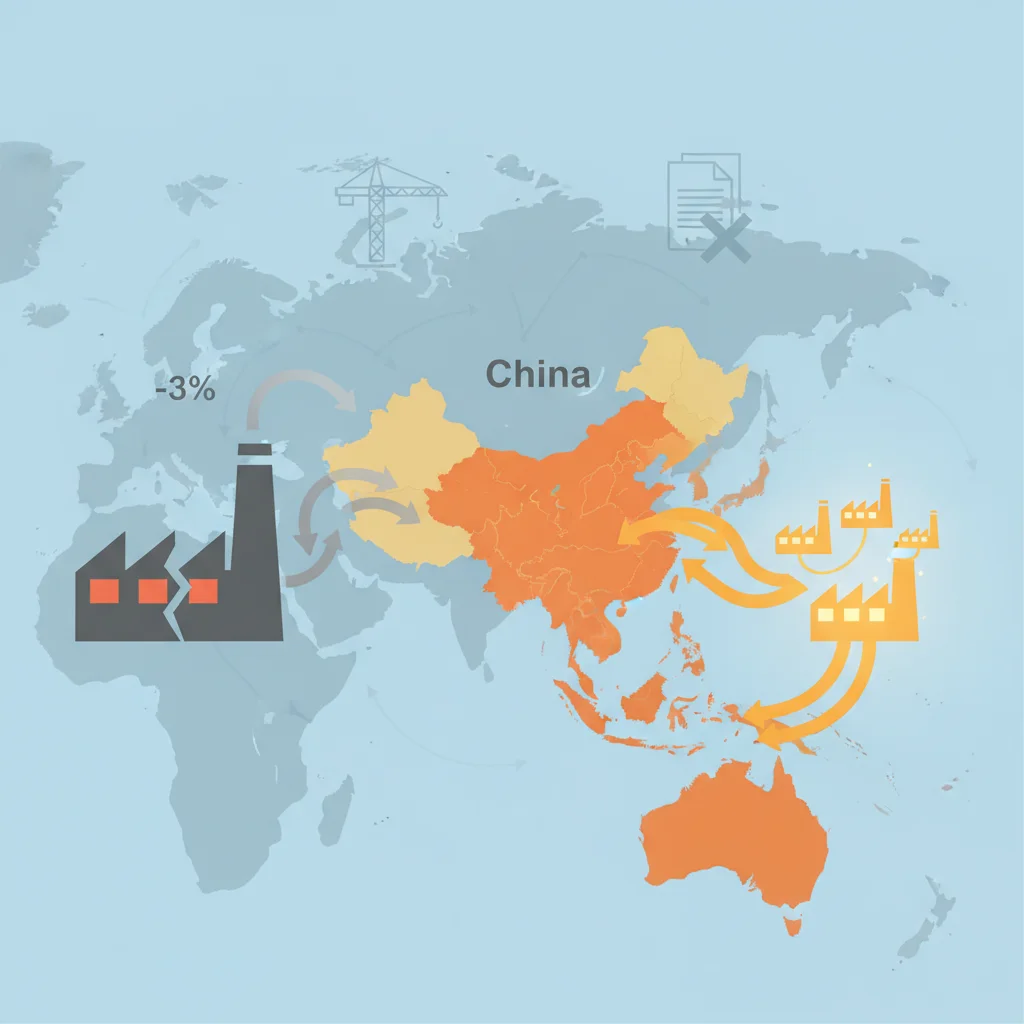
In 2024, developing Asia attracted $605 billion in foreign direct investment, representing a 3% decline year-on-year (Source 1: UNCTAD Press Release, June 2025). Despite this marginal contraction, the region captured 40% of global FDI flows and 70% of all inbound investment to developing economies, cementing its position as the world’s primary destination for cross-border capital.
The aggregate figure, however, conceals a stark divergence between sub-regions. The Association of Southeast Asian Nations (ASEAN) recorded a 10% surge in inflows, reaching a record $225 billion. In direct contrast, China experienced a 29% contraction, its most significant decline in over a decade. This asymmetrical performance constitutes the first major quantitative signal that the region’s investment center of gravity is undergoing a structural reorientation.
Table 1: FDI Inflows to Developing Asia, 2023 vs. 2024
| Region | 2023 FDI ($B) | 2024 FDI ($B) | Year-on-Year Change |
|--------|--------------|--------------|---------------------|
| Developing Asia (Total) | 624 | 605 | -3% |
| ASEAN | 205 | 225 | +10% |
| China | 178 | 126 | -29% |
Source: UNCTAD FDI Statistics Database, June 2025
---
The Mismatch That Matters: More Projects, Less Capital
A more granular examination of investment modalities reveals a critical structural discontinuity. The number of greenfield projects announced in developing Asia increased by 5% in 2024. Yet, the total capital value of these projects fell by 23%, to $363 billion (Source 1: UNCTAD Press Release, June 2025). This divergence—more projects with significantly less capital per project—indicates a fundamental shift in investment architecture.
Simultaneously, international project finance—long-term, debt-heavy financing structures typically used for large-scale infrastructure and industrial facilities—collapsed by 43% in deal value. Cross-border mergers and acquisitions sales dropped 57% to $25 billion, their lowest level in developing Asia since 2020 (Source 1: UNCTAD Press Release, June 2025).
Interpretation: The data do not suggest a demand-side collapse. Rather, they point to a transformation in financing preferences and risk appetite. Investors are systematically moving away from large-scale, capital-intensive, debt-financed mega-projects toward smaller, equity-driven, modular investment structures. The greenfield project value-to-count ratio declined from approximately $95 million per project in 2023 to $70 million per project in 2024, implying a shift toward phased manufacturing facilities and distributed production footprints rather than monolithic "gigafactory" models.
Figure 1: Greenfield Investment in Developing Asia, Project Count vs. Total Value (2020-2024)
| Year | Project Count (Indexed to 2020=100) | Total Value ($B) |
|------|--------------------------------------|------------------|
| 2020 | 100 | 310 |
| 2021 | 108 | 365 |
| 2022 | 115 | 410 |
| 2023 | 112 | 472 |
| 2024 | 118 | 363 |
Note: 5% increase in projects, 23% decrease in value from 2023 to 2024.
---
Decoding the ASEAN Surge and the China Slowdown
The ASEAN region’s 10% growth trajectory is not an isolated phenomenon but a direct function of global supply chain reconfiguration driven by geopolitical friction and cost arbitrage. The United States-China trade and technology tensions have created a structural "trade diversion effect," compelling multinational enterprises to establish alternative production bases in Southeast Asia. This "China+1" strategy disproportionately benefits ASEAN economies, particularly in electronics, automotive components, and renewable energy supply chains (Cross-analysis derived from UNCTAD FDI data and sectoral trends).
China’s 29% decline reflects a confluence of factors. The persistent overhang in the real estate sector has suppressed domestic demand and reduced inbound investment in property-related industries. Concurrently, regulatory tightening in technology, education, and financial services has created uncertainty for foreign capital. Furthermore, the ongoing migration of labor-intensive manufacturing to lower-cost jurisdictions in Southeast and South Asia has directly reduced FDI inflows to China’s traditional manufacturing strongholds.
South Asia—including India, Bangladesh, and Vietnam—has emerged as a secondary beneficiary of this reallocation. India’s production-linked incentive (PLI) schemes, targeting electronics, pharmaceuticals, and automotive manufacturing, have attracted a growing number of smaller greenfield projects. While South Asian FDI volumes remain significantly smaller than ASEAN’s, the growth rate of project announcements in South Asia exceeded the regional average in 2024, signaling an expanding investment corridor (Source 1: UNCTAD data, sub-regional breakdowns).
Figure 2: FDI Growth Distribution Across Developing Asia Sub-Regions, 2024
| Sub-Region | FDI Change (2024 vs 2023) | Primary Drivers |
|------------|---------------------------|-----------------|
| ASEAN | +10% | Electronics, automotive, renewable energy |
| China | -29% | Real estate contraction, regulatory tightening |
| South Asia | +4% | PLI schemes, manufacturing diversification |
| East Asia (ex-China) | -2% | Semiconductor cyclical downturn |
---
The Hidden Supply Chain Logic: From Gigafactories to Distributed Hubs
The 23% decline in greenfield capital values, combined with a 5% increase in project count, reveals an underlying logic: supply chains are becoming more distributed and modular. The era of single-site mega-projects—large-scale semiconductor fabs, battery gigafactories, and integrated chemical complexes—is giving way to smaller, regionally dispersed production units designed for agility, redundancy, and tariff optimization.
This transition has direct implications for financing models. International project finance, which relies on long-term debt underwriting for large capital expenditures, is structurally unsuited to smaller, equity-driven projects. The 43% decline in project finance values is thus a natural consequence of the shift toward phased capacity expansion. Multinational enterprises are increasingly relying on retained earnings, corporate bond issuances, and equity infusions rather than syndicated project loans.
For South Asia, this realignment presents both opportunities and constraints. Smaller, modular projects align well with India’s PLI-driven manufacturing ecosystem and Bangladesh’s ready-made garment sector expansion. However, the collapse in cross-border M&A (−57%) limits the traditional pathway for technology transfer and market entry. South Asian economies must adapt their investment attraction strategies to target equity-based greenfield projects rather than relying on M&A-led capital inflows (Cross-analysis: shifting financing modalities in developing Asia).
---
Structural Implications for Supply Chains and Investment Models
The 2024 FDI data for developing Asia can be summarized through three structural implications:
- Supply chain diversification is accelerating, not reversing. The ASEAN surge reflects genuine relocation of production capacity, not just cyclical adjustments. The "trade diversion" effect is structural and expected to persist as tariff barriers and technology export controls remain in place.
- Financing models are undergoing a permanent shift. The collapse of project finance and M&A, combined with the fragmentation of greenfield projects, suggests that the large-scale, debt-heavy investment model of 2015-2022 is giving way to a more conservative, equity-funded, phased approach. This increases liquidity requirements for multinational enterprises and reduces leverage in the regional capital structure.
- Investment corridors are reconfiguring. The traditional China-centric model of Asian FDI is being replaced by a multi-hub architecture. ASEAN serves as the primary manufacturing hub, South Asia as a secondary low-cost destination, and China transitions toward higher-value, technology-intensive investment. The Gulf Cooperation Council (GCC) is emerging as a capital source for infrastructure and energy investments in South and Southeast Asia, further diversifying the region’s capital providers (Source 1: UNCTAD mention of GCC engagement).
---
Market Predictions and Forward Outlook
Based on the structural trends evident in the 2024 data, the following neutral projections can be made for the 2025-2027 period:
- ASEAN will maintain positive FDI momentum, with greenfield projects likely accounting for an increasing share of total inflows as large-scale infrastructure finance remains subdued. Electronics and renewable energy supply chains will be the primary growth drivers.
- China’s FDI recovery will be gradual and compositionally different. Inflows will stabilize but will not return to 2022 levels. Inward investment will shift toward research and development, advanced manufacturing, and services, with greenfield project sizes remaining smaller than historical averages.
- South Asia (primarily India and Vietnam) will see a 5-8% annual increase in greenfield project count, driven by continued cost advantages and policy incentives. However, aggregate FDI value will grow more slowly as project sizes remain moderate ($30-60 million average).
- Cross-border M&A and international project finance will remain depressed through 2026, as investors prioritize liquidity and equity over leverage. Recovery in these segments will require a sustained period of interest rate normalization and geopolitical stabilization.
- The "modularization" of supply chain investment will accelerate, with multinational enterprises establishing distributed production networks of 5-10 smaller facilities across multiple jurisdictions rather than single large plants. This will reduce project risk but increase complexity in logistics, regulatory compliance, and workforce management.
---
Sources: Primary data from UN Trade and Development (UNCTAD) Press Release, June 19, 2025. Cross-sectoral analysis of FDI trends, greenfield investment, international project finance, and cross-border M&A in developing Asia, 2020-2024.