Asia-Pacific Trade and Investment Trends 2024/2025: How South Asia Is Reshaping
The United Nations ESCAP report 'Asia-Pacific Trade and Investment Trends
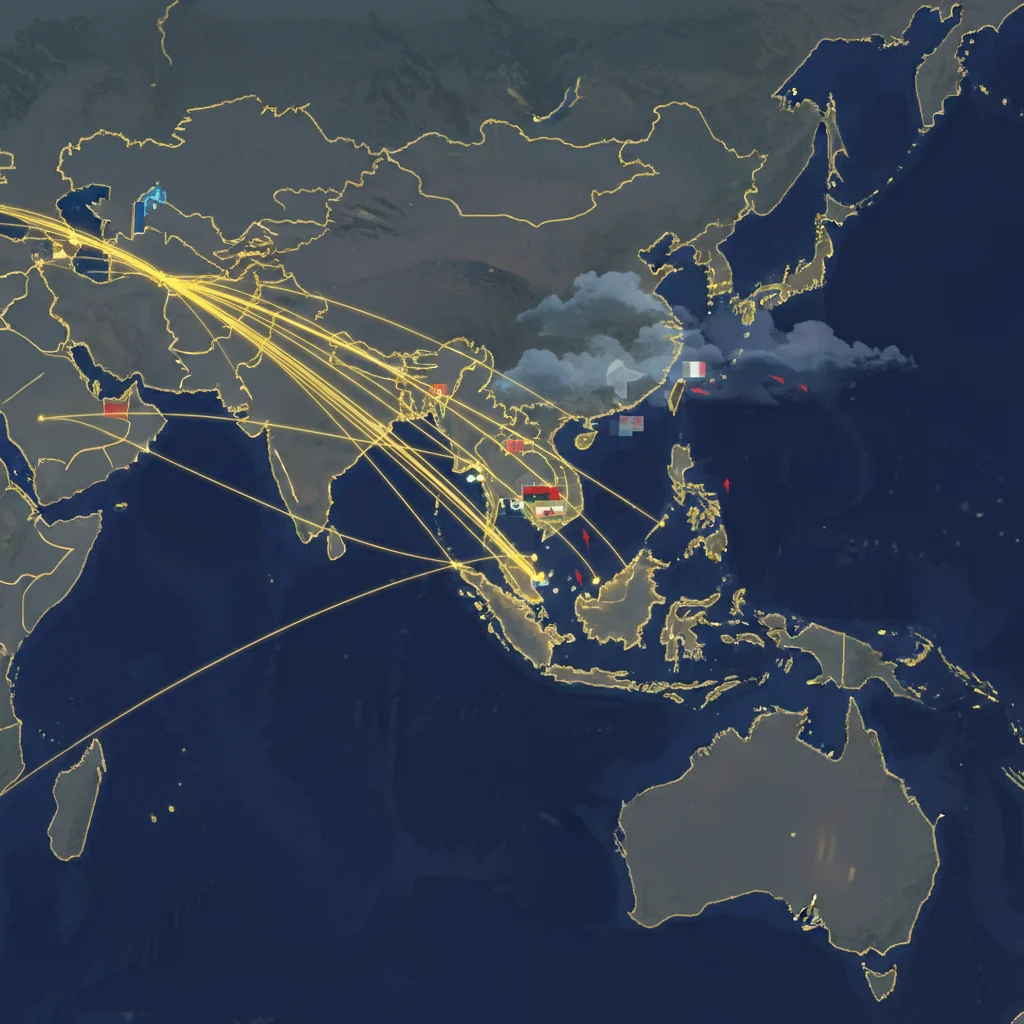
Asia-Pacific Trade and Investment Trends 2024/2025: How South Asia Is Reshaping Global Supply Chains
Introduction: The Quiet Revolution in Asia-Pacific Trade
The United Nations Economic and Social Commission for Asia and the Pacific (ESCAP) released its latest report on Asia-Pacific Trade and Investment Trends for 2024/2025, offering a sobering yet revealing snapshot of the region’s economic trajectory. On the surface, the findings are familiar: trade patterns are evolving, but export growth faces strong headwinds from recession risks in advanced economies and rising geopolitical tensions. However, beneath the cautious headlines lies a more consequential story—one that is not merely about slowdowns but about a structural realignment of global supply chains.
What the report documents, and what market participants are beginning to act on, is a silent but accelerating reorganisation of manufacturing and sourcing networks away from East Asia—particularly China—toward South Asia. Countries such as India, Bangladesh, and Vietnam are emerging as new nodes in global value chains, driven by cost arbitrage, policy reforms, and an urgent need for diversification. This is not a marginal shift but a deep-seated transformation that will define trade and investment patterns for the next decade.
[IMAGE: A split infographic showing traditional East–West trade flows on the left versus emerging South–South and intra-Asian flows on the right, with arrows thickening toward South Asia]
This article argues that South Asia is becoming a critical node in global value chains, and that investors and policymakers should look beyond short-term volatility to understand the long-term implications. We embed the UN ESCAP findings as a verified baseline, then overlay independent trade-flow data and expert commentary to offer a forward-looking analysis of what the 2024/2025 trends really mean.
The Headwinds: Recession Risks and Geopolitical Friction
The ESCAP report’s central warning is unambiguous: recessionary pressures in advanced economies, particularly the United States and the European Union, are dampening demand for Asia-Pacific exports. Electronics, machinery, and intermediate goods—the backbone of East Asian export economies—are most exposed. The report notes that while the region’s trade volumes have stabilised after the pandemic-induced disruptions, the pace of recovery is uneven and fragile.
At the same time, geopolitical tensions are compounding the problem. The US–China technology rivalry has escalated into a full-blown contest over semiconductor supply chains, export controls, and investment screening. Meanwhile, disputes in the South China Sea continue to disrupt established shipping routes and raise compliance costs for multinational firms. For businesses operating in the region, these are not abstract risks but tangible barriers that increase uncertainty and reduce the predictability of trade flows.
[IMAGE: A timeline chart showing GDP growth forecasts for key Asia-Pacific economies (2024–2025) with recession risk bands, sourced from UN ESCAP and IMF]
Importantly, these headwinds are not merely temporary shocks. The ESCAP report frames them as catalysts for a long-term supply chain redesign. The “slowbalisation” that some analysts predicted is now giving way to a more selective and strategic reconfiguration. Firms are no longer just looking for the lowest-cost production base; they are seeking resilient, geopolitically neutral, and policy-friendly alternatives. This is precisely where South Asia enters the equation.
South Asia on the Rise: Evidence from Evolving Trade Patterns
The ESCAP report’s mention of “evolving trade patterns” is deliberately understated. A closer look at the data reveals a more dramatic shift: South Asia is steadily gaining share in labour-intensive manufacturing and services exports, even as overall Asia-Pacific export growth slows.
Take India, for example. The country’s electronics exports have surged, driven by the government’s Production-Linked Incentive (PLI) scheme. Mobile phone exports alone grew from virtually nothing in 2014 to over $11 billion in 2023, and are projected to exceed $20 billion by 2025. Meanwhile, Bangladesh continues to dominate the global apparel market, but is now diversifying into higher-value segments such as technical textiles and leather goods. Vietnam, while geographically part of Southeast Asia, is a critical link in the South Asian supply chain story: it has attracted massive FDI inflows from Chinese manufacturers relocating to avoid tariffs and navigate geopolitical risks.
[IMAGE: A bar chart comparing export growth rates (2022 vs 2024 forecast) for East Asia vs South Asia, with data labels showing South Asia’s relative outperformance]
The ESCAP data on tariff trends and regional trade agreements further supports this narrative. While the Regional Comprehensive Economic Partnership (RCEP) has deepened integration in East Asia and Oceania, South Asian countries have leveraged the South Asian Free Trade Area (SAFTA) and bilateral agreements with the EU and Japan to lower trade barriers. The result is a dual-track dynamic: overall export growth in the Asia-Pacific region is decelerating, yet South Asia’s export volumes are rising relative to East Asia.
This is not just about low-cost labour. South Asian countries are also becoming hubs for services exports—IT services from India, business process outsourcing from Sri Lanka, and logistics from Bangladesh. These are high-value, digitally enabled sectors that are less vulnerable to trade barriers and more resilient to demand fluctuations. The UN ESCAP report confirms that services trade in the Asia-Pacific region is growing faster than goods trade, and South Asia is capturing a disproportionate share of that growth.
The Investment View: Why Capital Is Flowing to South Asia
For investors, the short-term picture is clouded by volatility: currency fluctuations, political uncertainty in some markets, and infrastructure bottlenecks. But the long-term logic is compelling. According to the ESCAP report, foreign direct investment (FDI) flows into South Asia reached an estimated $85 billion in 2023, up from $68 billion in 2019. While East Asia still absorbs the majority of regional FDI, the growth rate in South Asia is significantly higher.
[IMAGE: A line chart showing FDI inflows into South Asia (2019–2024) with projections to 2025, highlighting the post-pandemic acceleration]
What is driving this shift? Three factors stand out. First, diversification urgency. Multinational corporations, particularly in electronics, automotive, and pharmaceuticals, are under pressure from boards and shareholders to reduce their dependence on China. South Asia offers a “China plus one” alternative that is both large in scale and relatively stable.
Second, policy reforms. India has simplified its labour laws, reduced corporate tax rates, and introduced a unified goods and services tax—all aimed at making the country more attractive for manufacturing. Bangladesh has improved its special economic zones and is upgrading port infrastructure. Vietnam, already a manufacturing powerhouse, is deepening its supply chain links with both India and Bangladesh.
Third, demographic dividends. South Asia has the youngest population of any major region, with a median age of around 28 compared to 38 in East Asia. This provides a long runway for labour-intensive industries and a growing consumer market that can absorb more of the production.
However, the ESCAP report also cautions that infrastructure gaps and policy inconsistencies remain significant hurdles. South Asia’s logistics costs are among the highest in the world, and cross-border connectivity within the region is poor. India–Bangladesh trade, for instance, is hampered by outdated customs procedures and limited road and rail links. These are not insurmountable problems, but they require sustained investment and political will.
Infrastructure and Policy Gaps: The Remaining Challenges
No analysis of South Asia’s rising role would be complete without acknowledging the constraints that still bind the region’s potential. The ESCAP report highlights several key gaps.
First, energy infrastructure. South Asia’s industrial growth is heavily dependent on coal, but environmental pressures and international climate commitments are forcing a transition. India has made ambitious renewable energy targets, but the pace of grid modernisation and battery storage deployment lags behind need. Bangladesh faces similar challenges, with frequent power outages disrupting factory operations.
Second, skill development. While the labour force is young, the quality of education and vocational training varies widely. India’s engineering graduates often lack practical skills, and Bangladesh’s garment workers need retraining for more advanced manufacturing processes. Without targeted investments in human capital, the region risks getting stuck in low-value assembly operations.
Third, trade facilitation. Customs procedures, border delays, and non-tariff barriers continue to inflate costs. The ESCAP report notes that intra-regional trade in South Asia accounts for only about 5% of total trade, compared to 60% in East Asia. This is a stark indicator of the integration deficit. Initiatives such as the South Asia Subregional Economic Cooperation (SASEC) programme are making progress, but the pace is slow.
[IMAGE: A map of South Asia highlighting major infrastructure bottlenecks—ports, road corridors, and rail links—with data on logistics performance index scores for India, Bangladesh, Sri Lanka, and Pakistan]
Fourth, geopolitical risk within the region. The India–China border tensions, political instability in Pakistan and Sri Lanka, and domestic political cycles in Bangladesh and Nepal all create uncertainty for investors. While these risks are often exaggerated by the media, they are not negligible. The resilience of South Asia’s supply chain story will depend on the ability of governments to maintain stability and predictability.
Looking Ahead: What the Trends Mean for 2025 and Beyond
The UN ESCAP report’s projections for 2025 are cautiously optimistic. Export growth across the Asia-Pacific region is expected to rebound modestly as global demand stabilises, but the structural shift toward South Asia will continue. The report notes that if India, Bangladesh, and Vietnam can address infrastructure bottlenecks and deepen regional cooperation, they could collectively capture an additional $50–70 billion in annual export value by 2027.
For businesses and investors, the implications are clear. The era of depending on a single sourcing location—whether China, Japan, or South Korea—is ending. Supply chain resilience now requires a portfolio approach, with South Asia playing an increasingly central role. Companies that establish early footholds in the region will benefit from lower costs, growing domestic markets, and preferential trade access.
At the same time, the geopolitical tensions that are driving this shift are unlikely to recede. The US–China rivalry will continue to escalate, and the South China Sea disputes will remain a flashpoint. Consequently, the reorganisation of supply chains is not a temporary trend but a permanent feature of the global economy. South Asia’s opportunity is to seize it.
[IMAGE: A forward-looking infographic showing projected trade flows for 2025–2030, with South Asia as a central hub connecting East Asia, the Middle East, and Africa]
Conclusion: The Silent Reorganisation Is Underway
The UN ESCAP report on Asia-Pacific Trade and Investment Trends 2024/2025 provides a vital data-driven baseline for understanding the region’s evolving dynamics. But the real story—the one that will shape trade and investment for years to come—is the quiet reorganisation of supply chains toward South Asia.
This reorganisation is not happening overnight. It is gradual, uneven, and fraught with challenges. Infrastructure gaps, policy inconsistencies, and geopolitical risks will continue to test the region’s potential. Yet the direction is clear. South Asia is no longer merely the beneficiary of cost-based offshoring; it is becoming an indispensable part of global value chains.
For multinational corporations seeking to diversify, for investors looking for long-term growth, and for policymakers aiming to boost their economies, the message is the same: the time to act on South Asia is now. The headwinds of 2024 are real, but they are also the winds of change.