Beyond the Assembly Line: How AI is Reshaping India''s Manufacturing Ambition
India's goal to boost manufacturing's GDP share from 17% to 25% is colliding
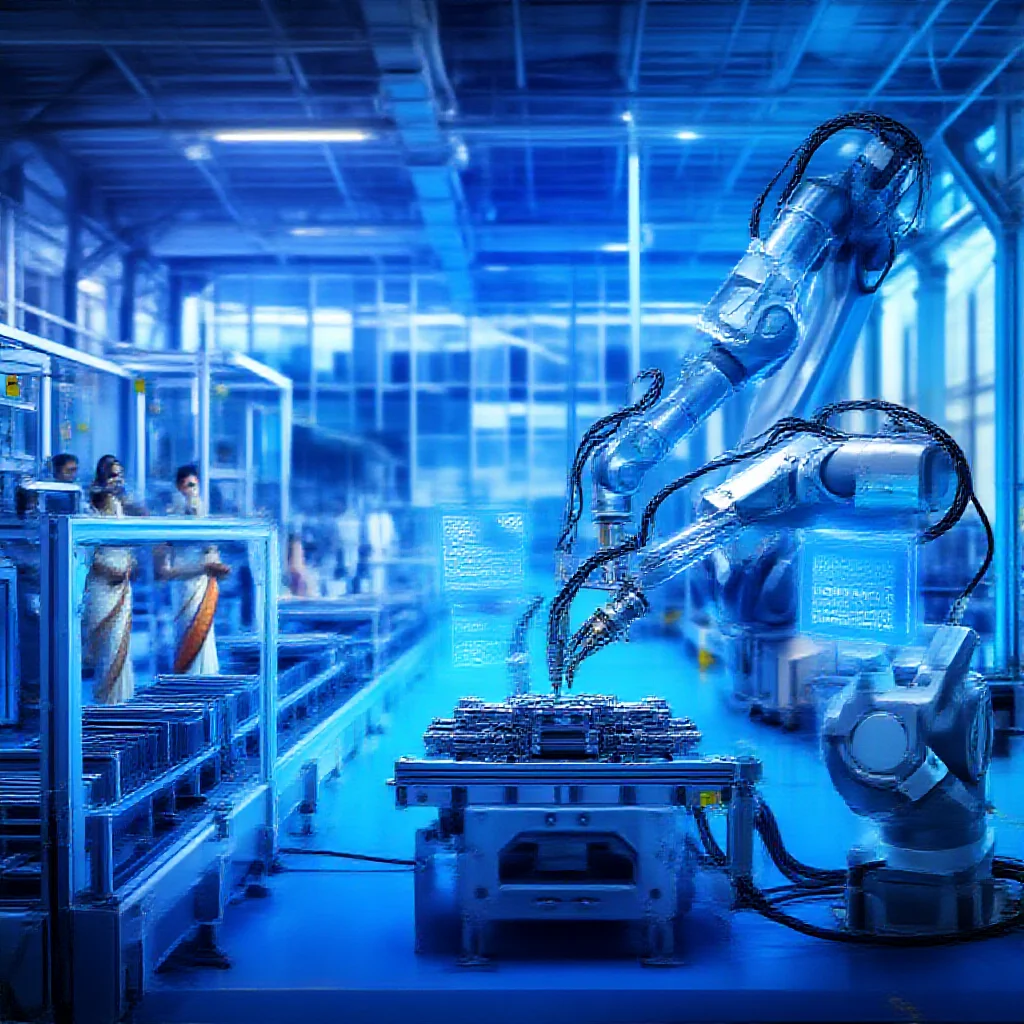
Beyond the Assembly Line: How AI is Reshaping India's Manufacturing Ambition and GDP Trajectory
The 25% Target: More Than a Number, A Structural Challenge
India’s economic architecture presents a distinct profile, with the manufacturing sector contributing approximately 17% to the nation’s Gross Domestic Product (Source 1: [Government Economic Survey]). This baseline lags significantly behind the service sector and contrasts with the historical development paths of several East Asian economies. The stated governmental target of elevating this share to 25% constitutes more than a quantitative expansion of output. It represents a structural challenge requiring a dual transformation: the quantitative creation of more factories and employment, concurrent with a qualitative shift toward higher-value, complex goods manufacturing.Achieving this target introduces a paradox of quality and scale. Scaling low-margin, labor-intensive assembly does not sufficiently alter the GDP calculus or global competitive positioning. Conversely, pursuing high-value manufacturing without the foundational scale and systemic efficiency leads to limited economic impact. The logical deduction posits that artificial intelligence (AI) emerges as the critical operational lever to resolve this paradox, enabling the simultaneous pursuit of quality and scale.
AI on the Factory Floor: Efficiency as the Foundation for Scale
The integration of AI into manufacturing processes is evidenced by focused applications that directly address core constraints to scaling. These applications function as foundational enablers for the broader GDP objective.Predictive maintenance, utilizing sensor data and machine learning algorithms to forecast equipment failures, directly impacts output capacity. By transitioning from scheduled or reactive maintenance to a condition-based approach, unplanned downtime is reduced. This efficiency gain increases the effective utilization of capital-intensive machinery, a prerequisite for scaling production volumes without proportional capital expenditure.
In quality inspection, computer vision systems perform defect detection at speeds and accuracies unattainable through human inspection. The economic logic extends beyond reducing waste. Consistent, high-quality output is a non-negotiable prerequisite for building the "Make in India" brand in stringent global markets. It mitigates the risk of costly recalls and establishes the reliability required for integration into sophisticated global supply chains.
Furthermore, AI-driven process optimization analyzes production data to identify bottlenecks and inefficiencies. This allows for dynamic resource reallocation and faster production cycles. The resultant agility enables factories to handle more complex, variable, and lucrative orders, moving beyond standardized, low-margin production.
The Hidden Economic Logic: AI's Impact on Underlying Supply Chains
The transformative potential of AI extends beyond the individual factory floor to the underlying supply networks, which are critical for holistic sectoral growth. AI’s true economic power lies in creating smarter, more resilient ecosystems.AI-driven demand forecasting and inventory optimization algorithms can significantly reduce capital lock-up in raw materials and finished goods. For small and medium enterprises (SMEs), which form the backbone of manufacturing expansion, this release of working capital is vital for growth and stability. It enhances their ability to participate reliably in larger supply chains.
The long-term structural impact involves value chain elevation. AI-enabled, precision manufacturing attracts and necessitates higher-value component suppliers. This creates a positive feedback loop: as final assembly becomes more sophisticated and reliable, the ecosystem for advanced inputs develops. The logical progression moves the national manufacturing base from basic assembly and fabrication toward integrated design, development, and production of complex systems.
The Dual-Track Reality: Pilots vs. Proliferation
A rational analysis must acknowledge the gap between technological capability and widespread adoption. The current state is characterized by a dual-track reality. Leading-edge AI integration is evident in pilot projects and within large domestic corporations and multinational subsidiaries. These entities possess the capital, data infrastructure, and technical talent to deploy and benefit from AI systems.Conversely, technology penetration across the vast Micro, Small, and Medium Enterprise (MSME) sector remains limited. The constraints are multifaceted: high initial costs, lack of digital infrastructure, data readiness issues, and a scarcity of skilled personnel to implement and manage AI solutions. The proliferation challenge is therefore as significant as the technological one. Bridging this adoption chasm is a prerequisite for AI to have a macro-level impact on the manufacturing GDP share. Solutions may involve standardized, modular AI-as-a-service platforms tailored for SME operational scales and cost structures.
Neutral Market and Industry Predictions
Based on the cause-and-effect analysis of efficiency gains, supply chain optimization, and adoption barriers, several neutral predictions can be formulated.In the near term (3-5 years), AI adoption will remain concentrated in larger firms and specific high-value sectors such as automotive, pharmaceuticals, and electronics. Measurable productivity gains and quality improvements in these sectors will be documented, but the aggregate effect on manufacturing GDP contribution will be incremental.
The medium-term trajectory (5-10 years) will be defined by the rate of technology diffusion to the MSME sector. The emergence of affordable, scalable AI solutions will be a critical determining factor. Successful diffusion could trigger a non-linear acceleration in sector-wide productivity, making the 25% GDP target more feasible.
The long-term structural prediction involves a gradual but definitive shift in India’s position within global supply chains. AI-enabled manufacturing efficiency and quality control will make the country a more competitive location not just for cost-sensitive assembly, but for the manufacturing of precision components and complex products. This would represent the qualitative transformation required to sustain an elevated share of GDP, moving beyond quantitative expansion alone. The integration of AI, therefore, is not merely an operational upgrade but a fundamental recalibration of the sector’s economic logic and potential.