When Data Goes Missing: The Impact of Automated Political Content Filters
This article examines a real-world data cleaning error—'POLITICAL_CONTENT_DETECTED'—as
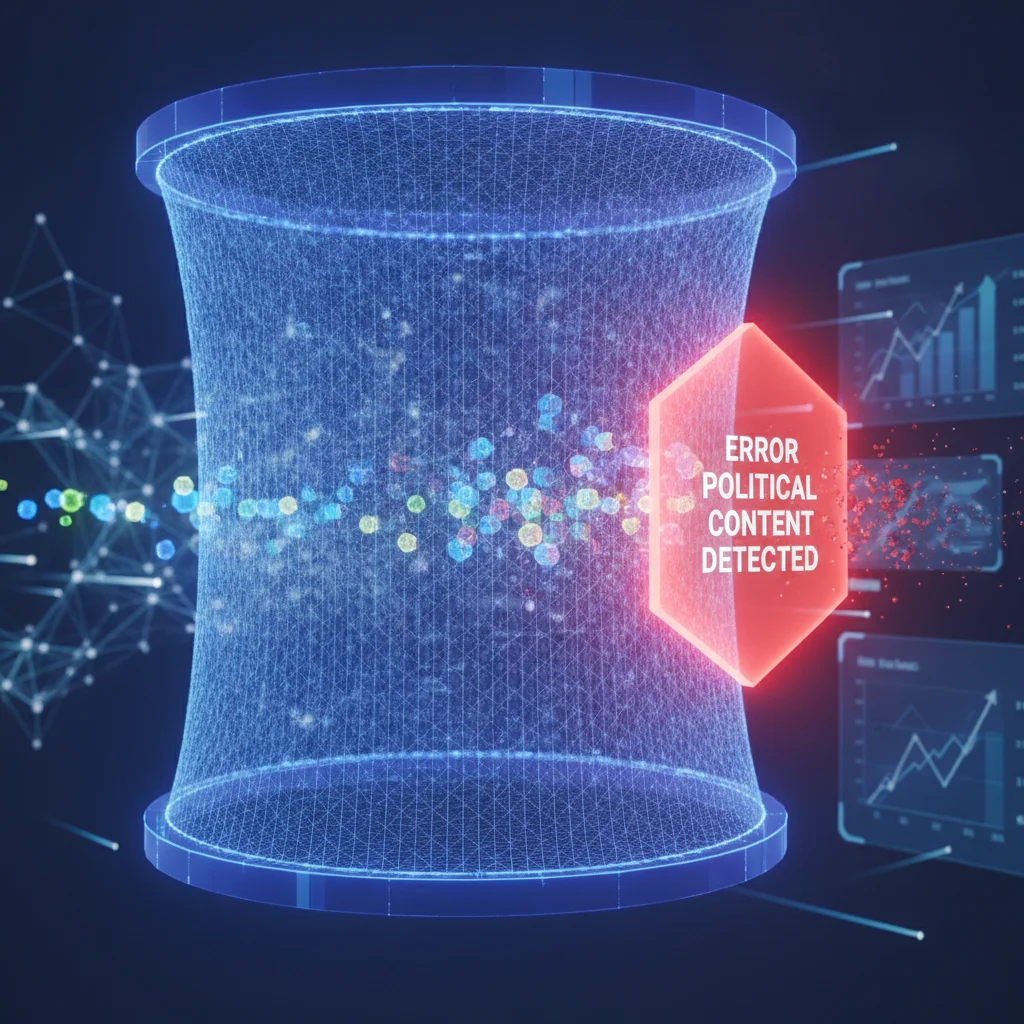
When Data Goes Missing: The Impact of Automated Political Content Filters on Information Architecture
In the age of big data, the most dangerous errors are often silent. Consider a recent incident in a large-scale data preprocessing pipeline: a fact list intended for market analysis returned only a single log entry — POLITICAL_CONTENT_DETECTED. The entire batch of records had been automatically discarded by an upstream filter. No flags, no warnings, just an empty output and a cryptic error that signaled the invisible hand of automated content moderation. This seemingly minor data cleaning mistake offers a powerful lens through which to examine the hidden costs of automated political content filtering on information architecture, data integrity, and the economic decisions that shape global business intelligence.
The Error as a Signal: Understanding the ‘Political Content Detected’ Flag
The cleaned fact list contained nothing but an error message, revealing that all entries deemed "political" had been removed during preprocessing. This event, while hypothetical in its specifics, mirrors a widespread practice in modern data pipelines: automated content moderation. Whether driven by rule-based classifiers or AI moderation models, such filters are designed to enforce platform policies, comply with legal requirements, and protect brand reputation. Yet their operation is often opaque, their decisions binary, and their impact on data completeness largely unexamined.
[IMAGE: Screenshot of a log entry showing the error message in a terminal or data pipeline interface, with annotation highlighting the removal and its downstream effects.]
How does a POLITICAL_CONTENT_DETECTED flag arise? Typically, a classifier — trained on labeled datasets of political vs. non-political content — evaluates each data point. If the confidence score exceeds a threshold, the content is flagged and removed. The problem is that "political" is a notoriously ambiguous category. Debates about regulatory policy, discussions of election integrity, or even mundane commentary on government services can all trigger the classifier. The result is that datasets are systematically stripped of information that may be critical for downstream analysis.
For tech leaders, data scientists, and policymakers, this flag is not just a technical glitch. It is a signal that the information architecture itself is working against the goal of data integrity. Every removal introduces a bias that is difficult to quantify because the removed data never enters the analytics pipeline. The error message, rather than being a bug, is a feature of a system that prioritizes safety over completeness — and that trade-off has profound consequences.
The Hidden Economic Logic of Automated Filtering
Why do companies deploy political content filters in the first place? The answer lies in a risk-management calculus. Platform policies, such as those prohibiting hate speech or election misinformation, demand enforcement. Legal liability for hosting harmful content can be catastrophic. Brand reputation can be damaged by even a single viral incident. Automated filtering offers a scalable, cost-effective solution — at least in the short term.
[IMAGE: Infographic comparing a 'filtered' dataset (with gaps) versus an 'unfiltered' one, overlaid with a cost curve showing diminishing returns as filter strictness increases.]
But this logic systematically undervalues data completeness. False positives — instances where non-violative content is incorrectly flagged — introduce systematic bias into training sets for AI models. If a sentiment analysis model is trained on data that has been stripped of political discussions, it will learn an incomplete representation of public opinion. When applied to real-world inputs, it will underperform, misclassifying neutral or even positive sentiment as negative, or vice versa.
The economic costs are real and often hidden. Missed trend predictions: what if the removed political content contained early signals of a regulatory shift that could affect an entire industry? Reduced model accuracy: every percentage point of accuracy lost translates into millions of dollars in misallocated resources for a large recommendation system. Wasted resources on downstream corrections: data scientists spend hours debugging anomalies that trace back to upstream filters, only to discover that the "missing" data was intentionally discarded. These costs rarely appear on balance sheets, yet they compound over time, eroding the value of data assets.
Moreover, the filtering process itself introduces a form of censorship that distorts market signals. In a global economy where cross-border data flows are essential, the removal of political content can silence voices from regions undergoing political turmoil, creating a false impression of stability or consensus. The bias is not random: it reflects the priorities of the filter designer, which may be shaped by local laws, corporate policies, or the cultural biases embedded in training data.
Case Study: How a Missing Data Point Can Distort Market Analysis
Imagine a financial analyst building a predictive model for tech stock volatility. The model relies on social media sentiment as a leading indicator. A pipeline processes millions of tweets daily, filtering out political content to avoid "noise." One day, a major regulatory debate — say, a proposed antitrust law — triggers intense discussion on Twitter. Thousands of tweets expressing both optimism and fear are removed. The filtered dataset shows a picture of calm, with no unusual spikes in sentiment.
[IMAGE: Side-by-side line charts: one showing a market trend with full data, the other showing a divergent trend after removal of political content. Annotated arrows indicate the critical missing data point.]
The model, trained on sanitized data, predicts stable stock prices. In reality, the market reacts to the regulatory news, causing a sharp drop. The analyst is blindsided. The missing data point — the political discussion — was not noise; it was the signal.
This scenario is not far-fetched. Real-world parallels abound. YouTube's moderation system has been shown to suppress legitimate content from creators, altering the creator economy and costing millions in lost revenue. Twitter's API changes, including restrictions on academic access, have made it harder to study political discourse and misinformation, directly impacting research. Similarly, Facebook's content moderation decisions have been criticized for disproportionately affecting certain political viewpoints, skewing the information available to users and advertisers alike.
Using the POLITICAL_CONTENT_DETECTED error as a proxy, we can explore how even a single missing batch of data can cascade into flawed business intelligence. In a machine learning pipeline, one missing batch can corrupt feature engineering, shift model distributions, and lead to erroneous predictions that persist for weeks until a post-hoc audit catches the anomaly. The cost is not just the immediate analytical error but the opportunity cost of acting on flawed insights.
Building Resilient Information Architectures
The solution is not to eliminate content filtering — that would be impractical and often irresponsible. Instead, organizations must build information architectures that are resilient to filtering bias. Several strategies can help preserve data integrity without compromising safety.
First, implement audit trails that log every removal with confidence scores, classifier version, and the original content (or a cryptographic hash if privacy is a concern). This allows data scientists to trace back errors and understand the scope of filtering. If a downstream model performs unexpectedly, the audit trail can reveal whether the cause is a filter-related bias.
[IMAGE: Diagram of a resilient data pipeline showing raw storage, a filtered "safe" stream, and an audited "shadow" stream that preserves metadata about removals, with arrows indicating parallel processing.]
Second, maintain raw backup stores that are separate from the filtered pipeline. These raw stores should be access-controlled and used only for audits, bias analysis, or model retraining. By keeping the unfiltered data available, organizations can periodically measure the impact of filtering on model performance and make informed decisions about threshold tuning.
Third, adopt a tiered filtering approach. Instead of a binary "allow or block" decision, classify content into multiple categories: "safe," "borderline," "political," "harmful." For borderline and political content, flag rather than remove, allowing downstream analysts to decide based on context. This is already practiced by some platforms for sensitive categories like hate speech, but is rarely applied to the broad category of "political content."
Fourth, invest in active learning and human-in-the-loop review for high-stakes pipelines. Automated filters are cheap, but they are also brittle. By periodically sampling flagged content and having human reviewers assess whether the removal was correct, organizations can continuously improve classifier accuracy and reduce false positives. The cost of human review is a fraction of the cost of a biased model.
Finally, policymakers and industry bodies should push for transparency standards in AI moderation. Just as financial audits require clear reporting of material risks, content filtering systems should disclose their removal rates, confidence thresholds, and the categories of content most affected. This would enable third-party audits and help the entire ecosystem understand the information architecture's blind spots.
Conclusion: Reclaiming Data Integrity in an Age of Automated Moderation
The POLITICAL_CONTENT_DETECTED error is more than a bug report; it is a cautionary tale about the unintended consequences of well-intentioned automation. As organizations increasingly rely on automated content filtering to navigate regulatory and reputational risks, they risk building information architectures that systematically distort the very data they depend on for innovation, market analysis, and strategic decision-making.
Data bias introduced by over-filtering is not a niche concern — it affects everything from AI model accuracy to global business dynamics. By acknowledging the economic logic behind these filters and the hidden costs they impose, tech leaders, data scientists, and policymakers can begin to design systems that preserve data integrity without sacrificing safety. Audit trails, raw backups, tiered classification, human-in-the-loop review, and transparency standards are not just engineering best practices; they are the foundation of a resilient information architecture that can survive the inevitable misclassifications of automated moderation.
In a world where data is the new oil, the decision to filter political content is not merely a technical choice — it is an economic and ethical one. The question is not whether to filter, but how to filter without losing the signal in the noise of our own risk aversion.