South Asia at a Crossroads: Why Industrial Overreach and AI Disruption Are
The World Bank’s April 2026 South Asia Economic Update reveals a stark paradox:
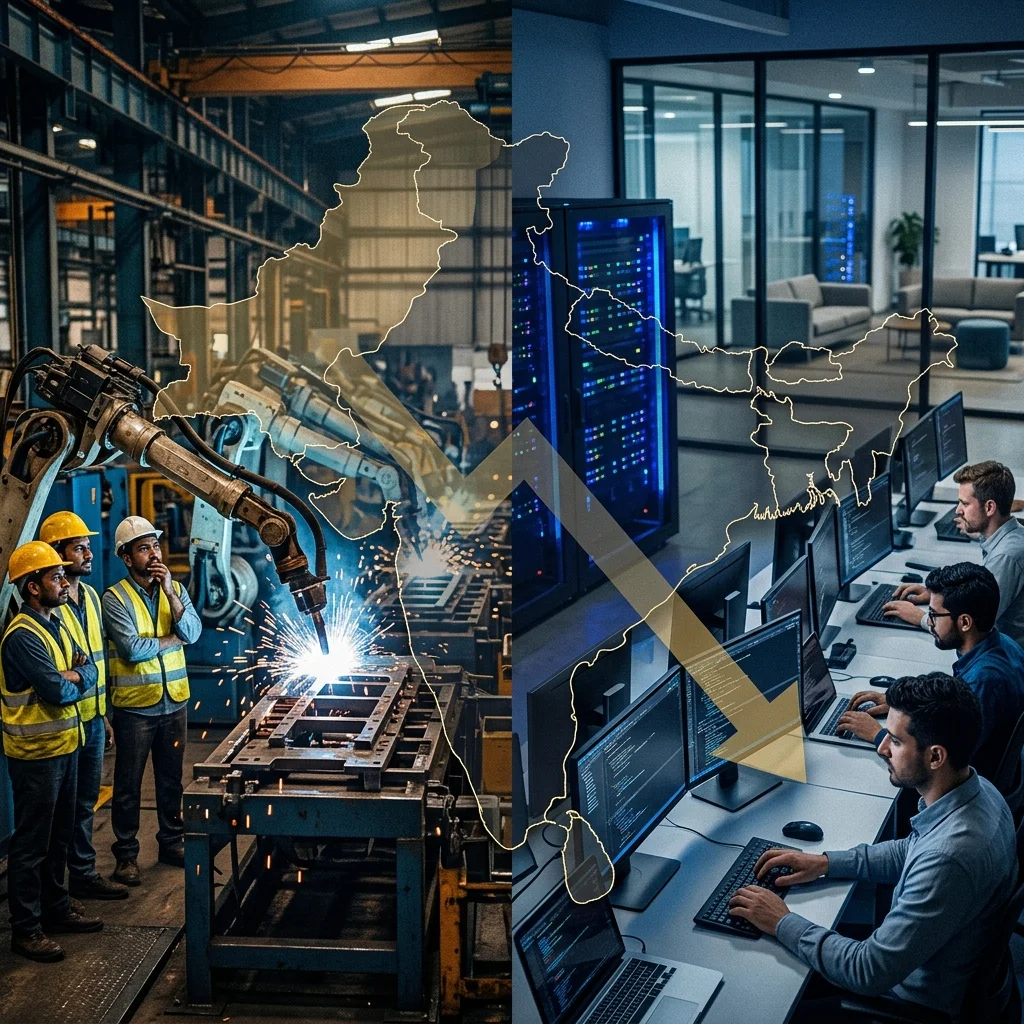
South Asia at a Crossroads: Why Industrial Overreach and AI Disruption Are Slowing the Region’s Growth Engine
By a Senior Technical/Financial Audit Journalist
The 6.3% Ceiling: Why South Asia’s Growth Is Hitting a Structural Wall
The World Bank Group’s April 2026 South Asia Economic Update projects regional growth will decelerate to 6.3% in 2026, marking a measurable decline from recent higher trajectories (Source 1: World Bank Group, April 2026). The deceleration is attributed to global energy market disruptions and heightened financial uncertainty that have cascaded through supply chains and investment channels.
While the region retains its designation as “one of the fastest-growing” globally, this headline obscures a deteriorating growth composition. Import restrictions have demonstrably suppressed trade volumes, and export promotion policies have failed to generate the anticipated revenue uplift (Source 1: World Bank Group). The structural architecture of South Asia’s growth model—heavily reliant on protected domestic markets—is generating diminishing returns. Growth is occurring, but its quality and sustainability are eroding.
The 6.3% ceiling is not a cyclical trough but a structural limit. Energy price spikes compress fiscal space, financial uncertainty curbs capital formation, and the absence of competitive export sectors prevents the region from offloading these pressures externally. Without a reconfiguration of the growth model, the trajectory points toward further erosion rather than recovery.
The Industrial Policy Paradox: Twice the Intervention, Half the Result
South Asia deploys industrial policies at approximately twice the rate of other emerging market regions (Source 1: World Bank Group). These interventions are overwhelmingly oriented toward manufacturing, reflecting a policy consensus that industrial production remains the primary escalator for economic development.
The empirical results contradict this assumption. Import restrictions have successfully reduced imports, but this reduction has not translated into improved export performance. Export promotion policies have not significantly boosted export volumes (Source 1: World Bank Group). The causal mechanism is straightforward: import restrictions deprive domestic manufacturers of competitively priced inputs, intermediate goods, and capital equipment. The resulting output is less competitive in international markets, neutralizing the intended export stimulus.
This represents a misallocation of policy capital. The intensity of intervention—double the global emerging market average—has not generated proportional returns in export growth or industrial upgrading. By contrast, East Asian economies achieved export-led growth through precisely the opposite approach: unrestricted access to imported inputs combined with targeted support for specific export sectors. South Asia’s current trajectory replicates the errors of earlier import-substitution regimes, not the successful export-led models of the late 20th century.
The opportunity cost is substantial. Fiscal resources devoted to industrial policy could have been redirected toward infrastructure investment, skills development, or service-sector modernization—areas the World Bank identifies as underfunded (Source 1: World Bank Group).
AI’s Silent Reshaping: The Emerging Threat to South Asia’s Labor Market
The World Bank report notes that artificial intelligence is “beginning to affect employment in certain sectors” (Source 1: World Bank Group). This understated observation masks a structural vulnerability of significant magnitude.
Services remain the primary driver of non-agricultural job growth across South Asia (Source 1: World Bank Group). This sector—spanning IT services, business process outsourcing, customer support, and financial services—is also the most exposed to AI-driven automation. Large language models, automated reasoning systems, and generative AI tools are functionally capable of displacing mid-skill service workers in tasks ranging from code generation to call center operations. The technology is already deployed at scale in global markets; South Asian service hubs face direct competitive pressure.
The policy environment is mismatched to this threat. Industrial policy disproportionately favors manufacturing, which cannot scale employment quickly enough to absorb displaced service workers. Manufacturing is capital-intensive, requires specialized infrastructure, and faces longer ramp-up cycles. The protected manufacturing sectors that receive policy preference also lack the cost competitiveness to expand into global markets rapidly.
The consequence is a looming labor market trap. Services—the sector that currently absorbs labor—face AI-driven contraction. Manufacturing—the sector receiving policy support—cannot substitute as an employment alternative. Local labor market disparities, already documented in the report as persistent, will widen (Source 1: World Bank Group). Workers in automated service hubs face wage stagnation or displacement, while manufacturing corridors lack the capacity to offer compensating opportunities.
Policy Pivot Required: From Protectionist Manufacturing to Balanced Growth Architecture
The World Bank recommends a balanced approach: trade reforms, infrastructure investment, skills development, and targeted industrial policy aimed at correcting specific market failures (Source 1: World Bank Group). This prescription represents a structural departure from current practice, not an incremental adjustment.
Trade reforms are the most urgent component. Removing import restrictions would restore access to competitive inputs, enabling export sectors to regain competitiveness. The empirical evidence is unambiguous: import suppression has not generated export expansion. Unwinding this policy would reduce costs for manufacturers, increase the quality of domestic output, and create conditions for genuine export growth.
Infrastructure investment requires redirection away from industrial parks toward multimodal logistics, energy reliability, and digital connectivity. The current infrastructure bias toward manufacturing zones reflects the same policy distortion that overemphasizes industrial policy. Service-sector growth requires different infrastructure—reliable power, high-bandwidth connectivity, and urban transport systems for knowledge workers.
Skills development must address the AI vulnerability directly. Reskilling programs should target service-sector workers in occupations most exposed to automation, shifting toward roles that require human judgment, creativity, and interpersonal interaction—areas where AI augmentation rather than replacement remains the dominant paradigm. This is not a speculative recommendation; it is a risk mitigation imperative given the speed of AI deployment globally.
Targeted industrial policy should focus on market failures—coordination problems, information asymmetries, and public goods provision—rather than blanket manufacturing protection. The World Bank specifically cites industrial parks and workforce development as appropriate tools (Source 1: World Bank Group). These instruments address genuine bottlenecks without creating the distortionary incentives generated by import restrictions and blanket subsidies.
Market and Policy Predictions
Three structural outcomes are probable over the medium term if current policy configurations persist.
First, South Asia’s growth rate will continue to converge toward the global average rather than maintain its premium. The current 6.3% projection already represents compression; further declines are likely as energy volatility and AI disruption compound.
Second, labor market bifurcation will intensify. Service hubs in India, Bangladesh, and Sri Lanka will experience wage divergence between workers in AI-augmented roles and those displaced by automation. This will generate political pressure for protectionist responses, which would replicate the errors of current industrial policy in a different sector.
Third, trade liberalization will become more difficult as protectionist constituencies consolidate. Sectors benefiting from import restrictions will resist reform, and displaced service workers will demand defensive policies. The window for balanced reform is narrowing as these constituencies entrench.
The World Bank’s April 2026 update provides a diagnostic framework, not a forecast. Whether policymakers act on this diagnosis will determine whether South Asia escapes the growth trap or descends further into it. The data supports only one conclusion: the current trajectory is unsustainable, and the cost of inaction will compound with each year of delay.