Malaysia Q1 2026 Economic Indicators: GDP Growth Slows Despite Strong Exports
Malaysia''s Q1 2026 economic data presents a mixed picture: exports surged
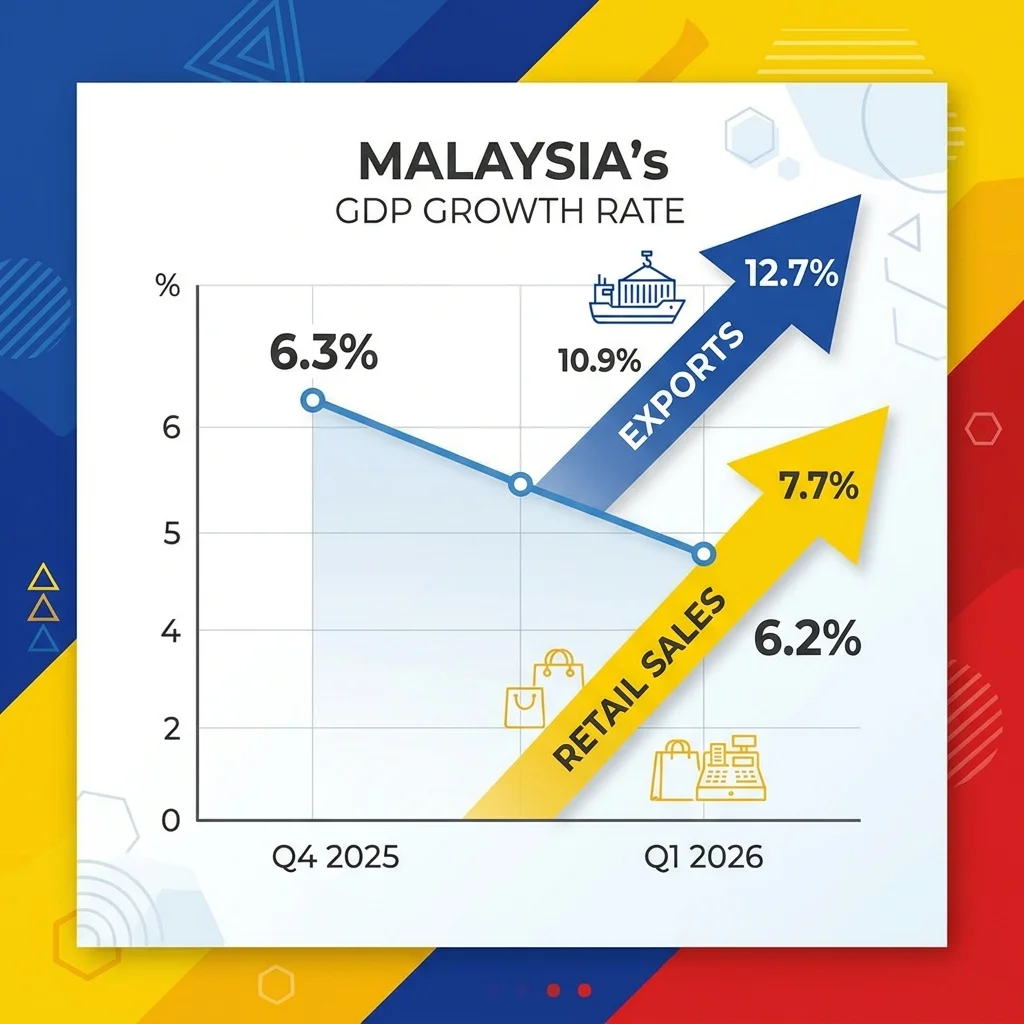
Malaysia Q1 2026 Economic Indicators: GDP Growth Slows Despite Strong Exports and Retail Sales
Malaysia’s first-quarter economic data for 2026 has delivered a puzzle that is drawing intense scrutiny from analysts, investors, and policymakers alike. While headline export growth accelerated to 12.7% in February and retail sales surged to 7.7%, real GDP growth is forecast to decelerate from 6.3% in Q4 2025 to 5.3% in Q1 2026. This divergence between booming external and consumer-facing indicators on one hand and moderating aggregate output on the other raises critical questions about the underlying composition of Malaysia’s economy. The Country Risk team at Fitch Solutions is closely watching the official GDP release scheduled for the week of May 11–15, 2026, which will provide the definitive breakdown and clarify whether this is a temporary statistical anomaly or a signal of structural shifts. This analysis explores the forces behind the contradiction, the implications for supply chains, and the key metrics that investors should monitor in the weeks ahead.
---
The Divergence Puzzle: Growth Slows Amid Robust Trade & Consumption
The most striking feature of Malaysia’s Q1 2026 economic landscape is the clear disconnect between the headline GDP trajectory and the strength of two of its most visible drivers: exports and retail sales. According to the latest available data, Malaysia’s real GDP is expected to ease from 6.3% year-on-year in Q4 2025 to 5.3% in Q1 2026. At the same time, export growth accelerated from 10.9% in January to 12.7% in February, while retail sales climbed from 6.2% in January to 7.7% in February. On the surface, this combination appears contradictory: how can an economy that is selling more goods abroad and experiencing stronger consumer spending be growing more slowly?
The answer likely lies in forces operating beyond the scope of domestic demand and trade volumes. A GDP reading captures the total value of goods and services produced, which includes not only consumption and net exports but also investment, government spending, and inventory changes. One plausible explanation is that Malaysia experienced a surge in imports—particularly of capital goods and intermediate inputs for new manufacturing capacity—that offset the positive contribution from exports. If imports grow faster than exports, net exports can be a drag on GDP even when gross export growth is robust. Another possibility is a significant inventory drawdown after a period of rapid restocking in Q4 2025. Companies may have built up inventories in the final quarter of last year in anticipation of strong demand, only to find that actual sales did not keep pace, leading to a reduction in production in Q1 2026. Finally, weakness in sectors such as construction (still constrained by elevated interest rates) or services (beyond retail) could be pulling down the aggregate figure.
The key uncertainty will be resolved when Bank Negara Malaysia and the Department of Statistics release the official Q1 GDP numbers in mid-May. The release will include expenditure-side components, allowing analysts to pinpoint exactly which categories—private investment, government consumption, net exports, or inventory changes—drove the deceleration.
[IMAGE: Side-by-side bar chart comparing Q4 2025 vs Q1 2026 for GDP, exports, and retail sales growth rates. GDP bar shows 6.3% and 5.3%, exports show 10.9% and 12.7%, retail sales show 6.2% and 7.7%.]
---
Decomposing the Slowdown: Which Sectors Are Dragging?
To understand the GDP slowdown, it is necessary to move beyond aggregate growth rates and examine the sectoral composition of Malaysia’s economy. The strong export performance—driven largely by global semiconductor demand, electronics, and commodity exports—suggests that the external sector remains a pillar of strength. However, the net contribution of trade to GDP depends on the balance between exports and imports. In recent months, Malaysia’s imports have been rising sharply, partly due to increased purchases of machinery and equipment for new manufacturing plants, particularly in the electrical and electronics (E&E) cluster and the expanding data center sector. If import growth outpaces export growth, net exports become a drag.
Retail sales, meanwhile, have been buoyant, reflecting resilient domestic consumption supported by stable employment, a recovering tourism sector, and the disbursement of year-end bonuses in early 2026. Yet consumption is only one component of GDP. The other components—investment, government spending, and net exports—may be weighing on growth. Investment spending, especially in construction and property development, has been sluggish due to high interest rates and cautious lending. The construction sector, which accounts for roughly 5% of GDP, has been particularly weak, with activity constrained by elevated borrowing costs and a slowdown in major infrastructure projects. Government consumption, while generally stable, is unlikely to provide a large boost in an election-neutral year.
Another factor is the fading of base effects. The very strong Q4 2025 GDP reading of 6.3% was partly inflated by a recovery from the previous year’s low base. As that base effect normalizes, the year-on-year growth rate naturally moderates. Additionally, the possibility of a temporary inventory correction cannot be dismissed. Many Malaysian manufacturers reported rapid inventory accumulation in Q4 2025 as supply chains normalized and businesses prepared for strong year-end demand. If that demand turned out to be weaker than expected—or if companies overestimated—Q1 2026 may have seen a deliberate destocking that reduced production even as final sales remained healthy.
[IMAGE: Pie chart of Malaysia's GDP components (consumption, investment, government, net exports) with hypothetical percentage shifts comparing Q4 2025 and Q1 2026, showing consumption and net exports stable but investment and inventories declining.]
---
Why Exports and Retail Are Booming: Regional and Structural Factors
The strength of Malaysia’s exports and retail sales in early 2026 is not accidental; it reflects both cyclical tailwinds and deeper structural trends in the Southeast Asian region. Export growth accelerated to 12.7% in February, driven primarily by robust global demand for semiconductors, memory chips, and electronic components—areas where Malaysia has a well-established manufacturing base. The global chip shortage has eased, but demand remains elevated as AI-related hardware, electric vehicles, and 5G infrastructure continue to expand. Moreover, improved trade ties with China and other ASEAN partners, as well as the ongoing diversification of supply chains away from China (the “China+1” strategy), have funneled additional manufacturing orders to Malaysia.
On the domestic side, retail sales jumped from 6.2% in January to 7.7% in February, indicating that household spending remains a bright spot. This is supported by a stable labor market—unemployment has remained below 3.3%—and a recovery in tourism arrivals, which boosts spending in retail, hospitality, and transportation. The disbursement of annual bonuses and salary adjustments in the first quarter also provided a one-time boost to disposable income. Furthermore, consumer confidence, while not at peak levels, has held up reasonably well, partly due to a period of stable inflation and manageable household debt.
However, it is important to recognize that both exports and retail sales are lagging or coincident indicators that may not yet reflect the slowdown in broader economic activity. If the GDP deceleration in Q1 2026 is confirmed, businesses may begin to adjust their expectations. Retailers, seeing slower overall demand, could reduce orders from suppliers, and exporters may face a softening in new orders as global demand moderates in Q2. The risk is that the strong February data could be the peak before a gradual cooling.
[IMAGE: Map of Malaysia's major export partners (China, Singapore, US, Japan, ASEAN) with growth arrows indicating percentage changes from Q4 2025 to Q1 2026. Alternatively, a scatter plot showing retail sales growth vs. consumer confidence index over the past four quarters.]
---
What This Means for Investors and Supply Chains
The mixed signals from Malaysia’s Q1 2026 economic indicators carry significant implications for investors and supply chain managers operating in the region. For investors, the data suggests that the “Goldilocks” environment that prevailed in late 2025—strong growth without overheating—may be transitioning to a more moderate phase. A GDP growth rate of 5.3% is still healthy by regional standards, but it marks a clear deceleration from the 6.3% pace of Q4. This could lead to a more balanced monetary policy stance from Bank Negara Malaysia, which has held its policy rate steady at 3.00% since mid-2025. If the slowdown persists, there may even be room for a modest rate cut later in the year, which would be supportive for bond prices and interest-sensitive sectors such as property and banking.
Equity markets, particularly in sectors tied to domestic consumption (retail, consumer goods, and financials), may already be pricing in the deceleration. The key risk is that if official GDP data reveals a sharper-than-expected slowdown—say below 5.0%—sentiment could sour quickly. On the other hand, if the composition shows that the slowdown is driven mostly by temporary inventory adjustments rather than a weakening in final demand, the market reaction could be muted.
For supply chain managers, the most immediate concern is inventory behavior. If the GDP slowdown is confirmed as being partly due to destocking, companies should prepare for a reduction in raw material imports in Q2 2026. This could affect suppliers of commodities, intermediate goods, and logistics services. The strong export orders seen in early 2026 may also begin to taper if global demand softens, particularly in the electronics sector, which is experiencing a cyclical peak. Companies that rely on just-in-time inventory models should closely monitor new export orders and purchasing managers’ indices (PMIs) for signs of a shift. Malaysia’s manufacturing PMI, which has remained in expansion territory above 50, will be a critical indicator to watch in the months ahead.
Finally, investors conducting Southeast Asia market analysis should compare Malaysia’s trajectory with that of its peers. Thailand, Indonesia, and Vietnam have also shown signs of slowing growth in Q1 2026, although the drivers differ. Malaysia’s reliance on electronics exports and its relatively open capital account make it more sensitive to global trade cycles and interest rate expectations in advanced economies. The Fitch Solutions Malaysia forecast currently projects full-year 2026 GDP growth at around 5.0%–5.5%, but this outlook depends heavily on whether the Q1 deceleration is a one-off or the beginning of a sustained trend.
[IMAGE: Line chart showing Malaysia's manufacturing PMI, export orders, and import volumes over the past six months, with a forecast for Q2 2026. Highlighting the potential turning point in March or April 2026.]
---
Conclusion: Patience Until the Official Numbers
The divergence between Malaysia’s strong exports and retail sales on one hand and slowing GDP growth on the other is a classic case of “the devil in the details.” Until the official Q1 2026 GDP release in mid-May, analysts and investors must rely on partial data and plausible hypotheses. The most likely scenario is a combination of higher imports, inventory normalization, and a fading base effect, rather than a fundamental weakening of the economy. However, the risk of a more structural slowdown—particularly in investment and construction—should not be dismissed.
For now, the prudent approach is to maintain a watchful stance. Key indicators to monitor include the March trade data (due in late April), the manufacturing PMI readings, and business sentiment surveys. If those continue to show strength, the GDP disappointment may prove temporary. If they begin to soften, the Q1 deceleration could be the first sign of a broader cooling. Either way, the May GDP release will be the decisive moment for Malaysia’s economic narrative in 2026.