Ather''s Surge vs. Legacy Slump: Decoding the EV Inflection Point in India''s
A recent 8% rally in Ather Energy''s shares, contrasted with simultaneous
Ather's Surge vs. Legacy Slump: Decoding the EV Inflection Point in India's Two-Wheeler Market
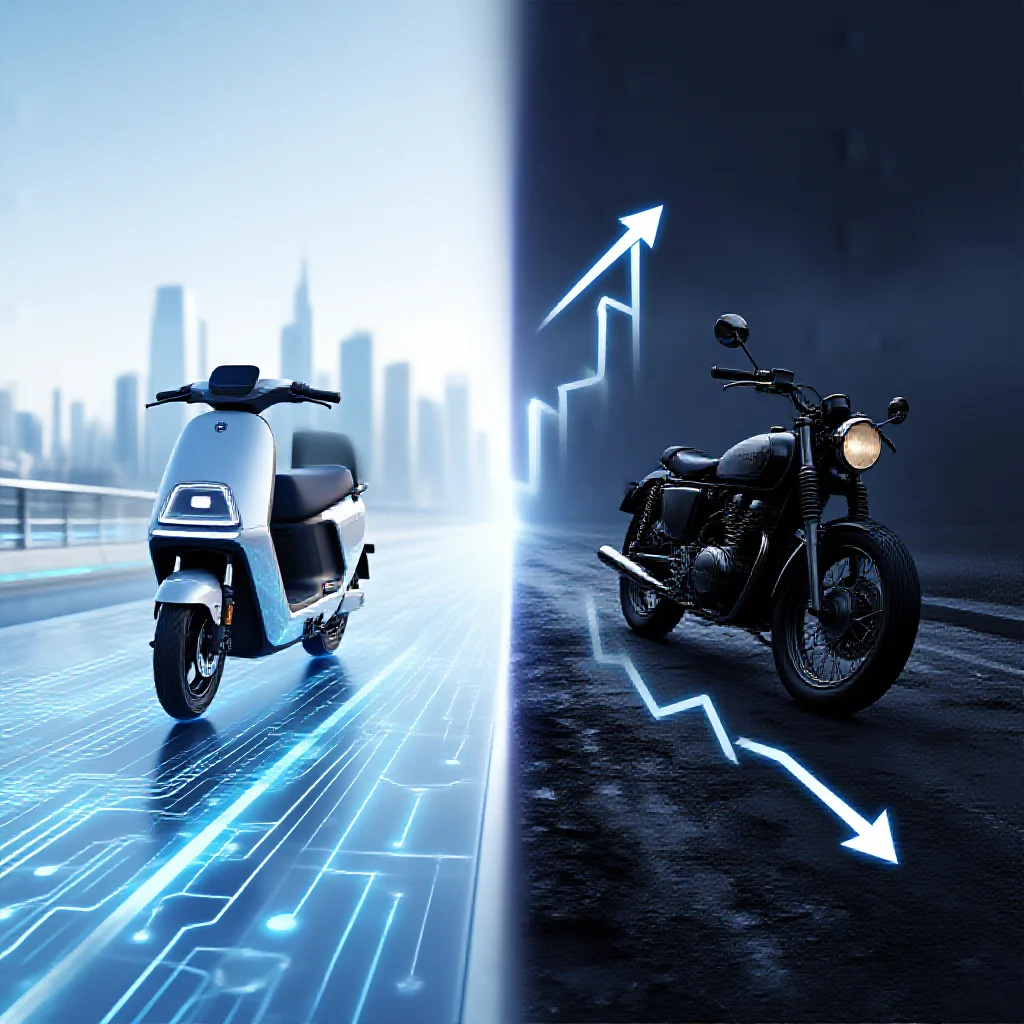
A recent market session presented a stark divergence in automotive fortunes. Shares of electric vehicle (EV) manufacturer Ather Energy rallied 8%, while legacy internal combustion engine (ICE) giants Eicher Motors and Hero MotoCorp each declined by approximately 4% (Source 1: [Primary Data]). This correlated movement, occurring outside of any major company-specific announcements, suggests a sector-wide narrative is taking hold. The central analytical question is whether this represents a short-term market anomaly or a leading indicator of a fundamental repricing of assets within India's massive two-wheeler industry.
The Data Point: Ather's Rally vs. Legacy Decline
The core data is unambiguous. Ather Energy, a pure-play electric scooter OEM, experienced significant positive momentum. Concurrently, two of India's most established two-wheeler and motorcycle manufacturers, Eicher Motors (Royal Enfield) and Hero MotoCorp, saw equivalent downward pressure on their valuations. This inverse correlation is atypical for routine trading and points to a thematic driver overshadowing individual corporate performance metrics. The synchronous nature of these movements indicates capital is reacting to a unified sector thesis rather than isolated operational news.
Beyond the Headline: The Hidden Logic of Capital Reallocation
This event is interpreted as a potential capital allocation inflection point. Investor sentiment appears to be pricing in the long-term structural risk associated with ICE technology. The valuation mechanism is operating on a dual track. Pure-play EV companies like Ather are being valued on growth potential and future addressable market share in a transitioning landscape. In contrast, incumbent OEMs are facing increased discounting of their future ICE cash flows due to transition risk, effectively applying a "conglomerate discount" as their core ICE assets are re-evaluated as potential liabilities.
The concept of stranded assets becomes relevant. Manufacturing plants, tooling, and supply chains dedicated solely to ICE components—pistons, transmissions, exhaust systems—face the risk of devaluation before the end of their useful economic life. Capital is beginning to anticipate this shift, flowing away from businesses heavily tied to these assets and towards entities built around the new core technologies of batteries, electric motors, and digital drivetrains.
The Deep Entry Point: Ripple Effects on the Underlying Supply Chain
This shift in investor sentiment is a precursor to a coming realignment within the automotive supply chain. The component ecosystem faces a bifurcation. Legacy suppliers specializing in mechanical ICE parts will encounter intensifying margin pressure and reduced order visibility as OEMs manage the decline of ICE portfolios. Simultaneously, a new supply chain for battery cells, battery management systems (BMS), motor controllers, and power electronics is forming and attracting dedicated investment.
This creates a strategic dilemma for incumbent manufacturers. They must fund the capital-intensive R&D and production scaling for their EV divisions while simultaneously managing the profitable, but potentially sunsetting, ICE business that currently generates the cash for that transition. The efficiency of this capital redeployment will be a critical determinant of long-term competitiveness.
Verification & Context: Separating Signal from Noise
To isolate the signal, broader market context must be examined. Analysis of the Nifty Auto index performance for the corresponding session is required to confirm the moves were sector-specific and not driven by broader market sentiment (Source 2: [Contextual Market Data Required]). Furthermore, these price movements align with observable macro-trends: increasing regulatory pressure for cleaner mobility, rising consumer acceptance of EV technology, and government policy frameworks like the FAME II scheme that are designed to accelerate adoption.
The movements are not a verdict on the immediate financial health of Eicher or Hero, which remain profitable and dominant in volume terms. Instead, they reflect a forward-looking adjustment in risk assessment. The market is beginning to weigh the future costs of transition—including potential carbon taxes, compliance investments, and brand relevance—against the current earnings from ICE vehicles.
Conclusion: A Leading Indicator of Industry Transformation
The divergent stock performance between Ather Energy and the legacy OEMs is assessed as a leading indicator, not a conclusive endpoint. It signifies that sophisticated capital is starting to price in a non-linear transition within India's two-wheeler market. The immediate future will likely see heightened volatility as the market seeks equilibrium between the diminishing present value of ICE cash flows and the uncertain but growing potential of EV market share.
The competitive landscape will evolve from a competition between products to a competition between business models and supply chain architectures. Success will depend on the ability to master software-defined vehicle platforms, new retail and service models, and the management of a dual-track technological and manufacturing transition. This single day's market data provides a quantitative glimpse into the beginning of that multi-year recalculation.