Unlocking South Asia''s $67 Billion Trade Potential: The Role of Maritime
Despite $73 billion in ongoing port development, South Asia's intraregional
Unlocking South Asia's $67 Billion Trade Potential: The Role of Maritime Ports and Infrastructure Investment
On January 23, 2025, the 20th OneSouthAsia Conversation will convene port CEOs from Bangladesh, India, Sri Lanka, Maldives, and Malaysia alongside senior officials from the World Bank and the U.S. Commercial Law Development Program. The central question on the agenda: why does South Asia—home to some of the world’s busiest maritime chokepoints and over $73 billion in ongoing port development—see intraregional trade stuck at a mere 5% of total trade? For context, the Association of Southeast Asian Nations (ASEAN) enjoys 25% intraregional trade. The gap is not just a statistic; it represents an estimated $44 billion in unrealized annual trade, a figure that could rise to $67 billion if port efficiency and connectivity were optimized.
This article draws on World Bank findings, the Colombo Port case study, and emerging challenges like the green transition and digitalization to unpack the paradox of massive infrastructure investment versus stagnant trade integration. It reveals how improving port efficiency could slash maritime costs by up to 8.8%, boost exports by 7%, and unlock the full potential of South Asia's maritime trade.
---
The Event and the Ecosystem: OneSouthAsia Conversation and the CEO Roundtable
The upcoming livestream event, co-hosted by the World Bank and the U.S. Commercial Law Development Program, is not a one-off dialogue. It builds directly on the inaugural South Asia Ports CEO Roundtable held in September 2024, which brought together top executives from the region’s leading container terminals. The January session will feature port CEOs from Bangladesh, India, Sri Lanka, Maldives, and—for the first time—Malaysia, signaling a broader recognition that maritime connectivity must transcend geopolitical boundaries. The Australian Department of Foreign Affairs and Trade, through the South Asia Regional Infrastructure Connectivity (SARIC) program, is also providing organizational support.
This sustained institutional focus is itself a data point: South Asia’s governments and multilateral development banks are increasingly aware that building ports alone does not guarantee trade. The conversation aims to translate hardware (dredged channels, new cranes, expanded terminals) into software (efficient customs, digital trade platforms, seamless intermodal links). The event will address the specific bottlenecks identified in the September roundtable, including regulatory fragmentation, lack of data-sharing protocols, and inconsistent tariff regimes.
[IMAGE: A stylized map of South Asia with major port locations (Colombo, Chittagong, Mumbai, Karachi, Male) and trade routes connecting to Southeast Asia, with callouts showing container throughput volumes.]
---
The Investment Paradox: $73 Billion in Port Projects vs. $528 Billion in Exports
Consider the numbers. As of 2023, South Asia’s five largest economies—Bangladesh, India, Pakistan, Sri Lanka, and Maldives—combined for $528 billion in merchandise exports. Simultaneously, infrastructure data tracked by the World Bank and regional development partners show $73 billion in port projects at various stages, from planning to construction. That is a ratio of roughly 14 cents of port investment per dollar of exports—a figure that, on paper, suggests ample capacity.
Yet the disconnect is stark. Most of these investments are siloed by country, focused on domestic capacity expansion rather than regional interoperability. India is building the mega-port at Vadhavan and upgrading its east coast terminals; Bangladesh is deepening the river approaches to Chattogram and developing Matarbari deep-sea port; Sri Lanka is expanding Colombo’s capacity and developing the Hambantota and Trincomalee complexes; Pakistan is investing in Karachi Port Trust’s modernization and Gwadar. Many of these projects compete for the same transshipment cargo, often from overlapping hinterlands. Few are designed as nodes in an integrated South Asian network.
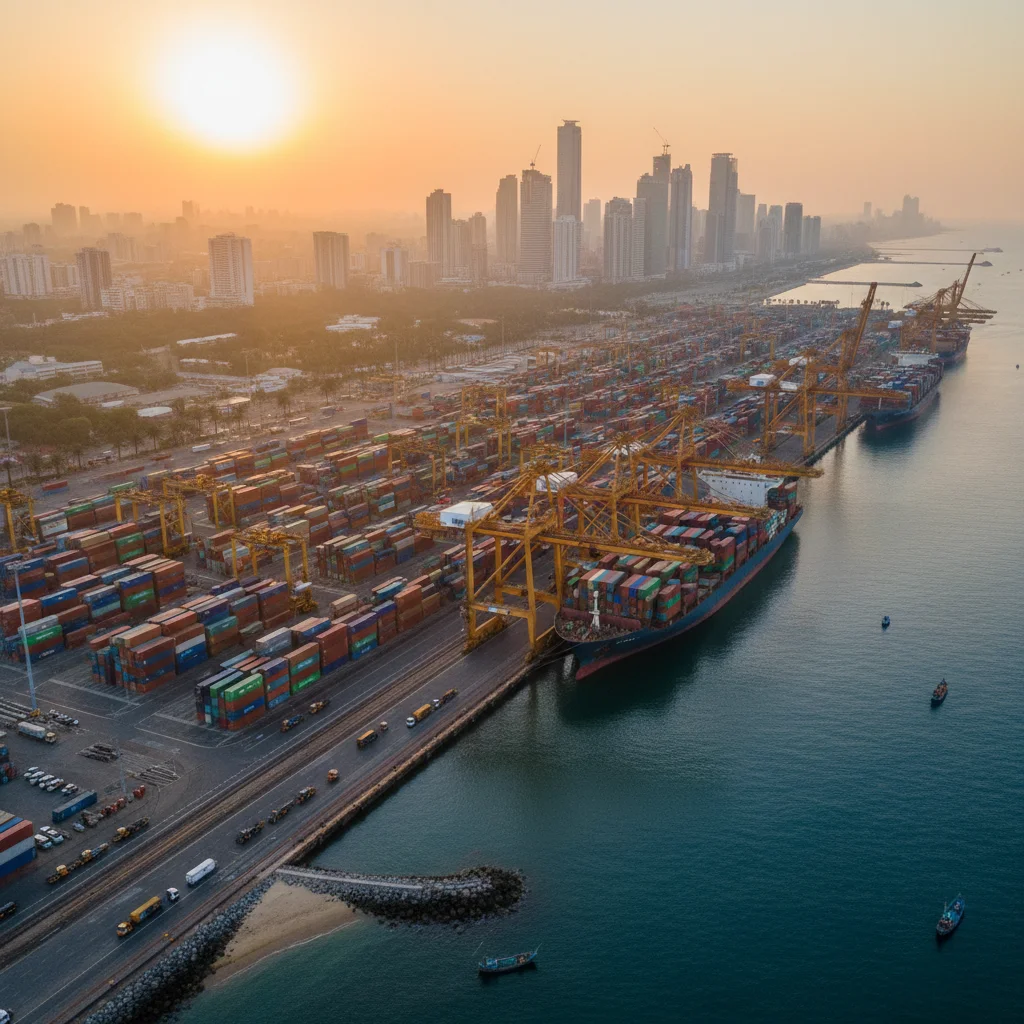
The Colombo Port remains a bright spot, handling approximately 15% of South Asia’s transshipment volume. Its strategic location along the main east-west shipping lane and its operational efficiency make it the region’s premier hub. However, even Colombo’s success is constrained by limited feeder connectivity to smaller ports in Bangladesh, Myanmar, and the eastern Indian coast. The much-touted "Colombo–Tuticorin" connection, for instance, still faces cargo consolidation and customs harmonization challenges that prevent the hub’s full potential from trickling down to intraregional trade.
[IMAGE: Bar chart comparing port investment by country (Bangladesh: $8B, India: $45B, Sri Lanka: $12B, Pakistan: $6B, Maldives: $2B) vs. 2023 merchandise export values, with a vertical axis split showing the mismatch.]
---
Efficiency as the Missing Link: What the World Bank Report Reveals
A 2016 World Bank study—still the most comprehensive benchmarking of South Asian port efficiency—offers a sobering diagnosis. The report found that if all South Asian ports matched the regional best performer (Colombo) in terms of container handling time, vessel turnaround, and customs clearance, maritime shipping costs could fall by an average of 8.8%. That reduction, applied across the region’s trade flows, would translate into a 7% increase in exports. Crucially, the benefits are not uniform: landlocked countries would gain proportionally more, making efficiency improvements a powerful tool for inclusive growth.
Why does efficiency matter more than capacity? In global supply chains, time is money. A day of delay at a port effectively adds a 0.6% tariff equivalent on traded goods. For South Asia, where documentation processes are often manual, port call durations average 3–5 days, compared to 1–2 days in best-in-class Southeast Asian ports. Inefficiencies compound: a ship delayed at Colombo means missed connections at Singapore; a container held up at Chittagong means empty shelves in Dhaka’s garment factories. The economic cost is not just wasted ship time but lost export orders and broken supply chain contracts.
The report also highlighted that port efficiency is not solely a port authority issue. Customs automation, pre-arrival processing, single-window systems, and bonded trucking all play a role. The "efficiency gap" is as much about inter-agency coordination as it is about crane productivity. This insight has driven several recent reforms: Sri Lanka has rolled out an electronic data interchange system at Colombo; Bangladesh has operationalized a National Single Window for trade; India’s "Port Community System" is being expanded to include private terminals. Yet adoption remains patchy.
---
The Green and Digital Transitions: New Challenges, New Opportunities
The conversation on January 23 will also address two emerging forces reshaping global maritime trade: decarbonization and digitalization. South Asia’s ports are among the most exposed to climate risks—rising sea levels, cyclones, and extreme heat—yet they are also heavy emitters of diesel and bunker fuel. The International Maritime Organization’s revised 2023 strategy mandates at least a 40% reduction in carbon intensity by 2030, forcing ports to invest in shore power, energy-efficient equipment, and alternative fuel bunkering. Colombo, for instance, has launched a pilot to test onshore power supply for container vessels. But across the region, less than 5% of berths are equipped with shore power hookups.
Digitalization offers a parallel path. The World Bank's "Port Reform Toolkit" emphasizes that digital platforms can reduce port dwell times by 20–30%, accelerate cargo release, and enhance transparency. South Asia lags: a 2023 survey by the South Asian Association for Regional Cooperation (SAARC) found that only 40% of regional ports have fully digitized customs submissions. The "paperless trade" gap is particularly acute for intraregional cargo, where multiple national documents are required for the same container.
Yet digitalization also carries risks. As ports become more connected, they become more vulnerable to cyberattacks. The 2021 ransomware attack on Colombo Port’s terminal operating system caused a 12-hour shutdown, delaying thousands of containers. The CEO Roundtable will discuss a proposed "South Asia Port Digital Trust Framework" to standardize cybersecurity protocols and enable secure data sharing between terminals, customs, and logistics providers.
[IMAGE: Split visual showing a traditional port gantry crane with visible diesel exhaust on one side, and a solar-paneled terminal with electric cranes on the other, with overlays showing emission reductions and cost savings.]
---
From 5% to 25%: The Path to $67 Billion
The World Bank’s 2016 estimates remain the best available baseline: South Asia’s intraregional trade stood at $23 billion at the time. If port efficiency improvements, reduced non-tariff barriers, and better connectivity could push the region toward ASEAN-level integration (25% of total trade), that figure could rise to $67 billion—nearly three times the current level. This is no technocratic fantasy: The South Asia Free Trade Area has been in place since 2006, but utilization rates are below 5% due to restrictive rules of origin and lack of port-to-port cargo consolidation. What is missing is not the legal framework but the operational infrastructure to make trade frictionless.
The January 20th OneSouthAsia Conversation will test a concrete action plan: a "South Asia Port Efficiency Compact" that sets measurable targets for vessel turnaround time, dwell time, and digital clearance adoption, with annual peer reviews. Participating port CEOs have already agreed in principle to share monthly performance data, enabling benchmarking and competition. The World Bank has committed technical assistance for implementing electronic cargo tracking systems across the region.
The stakes are high. If South Asia can achieve even half the efficiency gains projected by the World Bank study, the $44 billion untapped trade potential becomes a realistic target. That would mean more jobs in Bangladesh’s ready-made garment corridor, lower logistics costs for India’s exporters of pharmaceuticals and automobiles, and new opportunities for Sri Lanka’s logistics sector to serve as a regional hub. The ports are built; now the logic must catch up.
[IMAGE: Infographic showing a progressive arrow: Current intraregional trade $23B → Potential with port efficiency $44B → Potential with full integration $67B, with icons representing cost reduction (8.8%), export boost (7%), and port call time reduction (2 days).]
---
Conclusion: Beyond Hardware, Toward Ecosystem
The paradox of $73 billion in ports yet only 5% intraregional trade is not a failure of investment but a failure of integration. South Asia’s maritime infrastructure is increasingly world-class in hardware—deep-water berths, high-capacity cranes, automated stacking—but it operates within a fragmented policy and regulatory ecosystem. The Colombo Port proves what is possible when efficiency meets connectivity, but its impact remains localized.
The January 23 conversation and the broader OneSouthAsia initiative signal a shift: from building ports as national trophies to designing them as nodes in a regional network. The next phase of South Asia’s trade story will be written not in concrete and steel, but in data-sharing agreements, customs reforms, and cross-border logistics partnerships. The $67 billion prize is real—and it is within reach, if the region can connect the dots.