Beyond Infrastructure: How UK-Funded Urban Projects in Southeast Asia Are
The Global Future Cities programme, backed by the UK Foreign, Commonwealth
Beyond Infrastructure: How UK-Funded Urban Projects in Southeast Asia Are Redefining Social Inclusion and Resilient Growth
Introduction: A New Paradigm for Infrastructure as Social Leverage
The Global Future Cities programme, administered by the UK Foreign, Commonwealth & Development Office (FCDO) with Mott MacDonald and UN-Habitat as delivery partners, encompasses 13 infrastructure projects across nine cities in six Southeast Asian countries, directly benefiting an estimated 27 million residents (Source 1: Programme Data, FCDO). The participating nations—Indonesia, Malaysia, Myanmar, Philippines, Thailand, and Vietnam—represent a cross-section of the region’s most rapidly urbanizing economies.
Traditional infrastructure development follows a predictable pattern: capital-intensive investment in physical assets such as roads, bridges, and utilities, with social outcomes treated as secondary externalities. This programme operates on a fundamentally different premise. The primary metric for success is not kilowatt hours generated or lane-kilometers constructed, but measurable advancement in social inclusion, measured against the binding frameworks of the UN Sustainable Development Goals (SDGs) and the UK International Development Act 2002 (Source 2: Programme Compliance Documentation).
The operational insight is that infrastructure functions as systemic leverage—a point of intervention where physical investment can simultaneously address structural inequality and climate vulnerability. By embedding gender equality and social inclusion (GESI) criteria from the design phase, the programme treats the built environment as an instrument of institutional change rather than merely a delivery mechanism for concrete and steel.
The Three Pillars: Urban Planning, Transport, and Resilience—With a Social Lens
The programme is structured around three operational pillars: urban planning, transport, and resilience. Each pillar incorporates GESI criteria as a binding constraint rather than an optional overlay.
Cebu City: Data-Driven Social Mapping
The Cebu City project exemplifies this methodological shift. The strategy for urban planning is supported by social data systems designed to map housing shortages and identify informal settlements situated in flood-prone zones (Source 1: Project Documentation). The intervention does not simply produce a land-use masterplan; it generates a data infrastructure capable of guiding resettlement policy and land-use regulation over time.
The causal chain operates as follows: social data reveals which populations occupy the highest-risk zones. This information informs zoning revisions and infrastructure placement. The resulting policy framework directs investment toward areas where it yields the highest social return—reducing displacement risk for the most vulnerable households while optimizing public expenditure on flood defenses and utilities.
Yangon: Streetscape as Social Infrastructure
In Yangon, the programme developed a strategy for revitalizing streetscapes with explicit focus on pedestrian safety and access for marginalized groups (Source 1: Project Documentation). The intervention treats street design not as a traffic engineering problem but as a question of equitable access to public space and economic opportunity.
The logic is self-reinforcing: pedestrian improvements reduce accident rates among low-income commuters who rely on walking and public transport. Improved street lighting and walkability increase women's mobility and labor force participation. Commercial corridors become more accessible to informal vendors. Each metric feeds into a broader calculus of urban productivity that standard road-expansion projects fail to capture.
Case Study Deep Dive: New Clark City – From Masterplan to Institutional Change
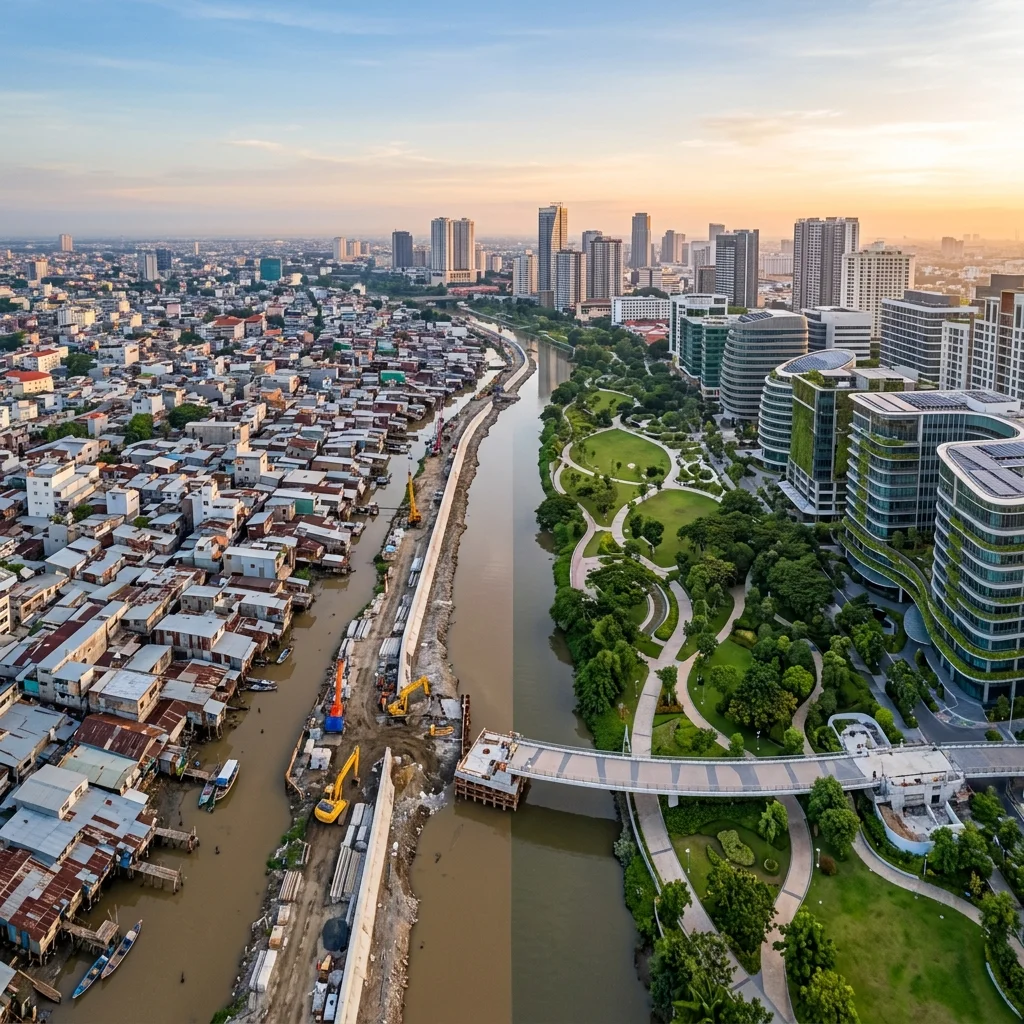
The New Clark City project in the Philippines represents the programme's most ambitious integrated intervention. The centerpiece is a 45-hectare central park—one of the largest public parks constructed in the Philippines in the past 50 years (Source 1: Project Documentation). This intervention formed part of the Philippines' post-pandemic green recovery plan, positioning public green space as an economic catalyst rather than an amenity.
The park's scale and location serve a deliberate economic function. New Clark City is designed as a new economic corridor, intended to decongest Metro Manila while attracting investment to Central Luzon. The central park functions as an anchor asset: it increases adjacent land values, attracts mixed-use development, and provides the environmental quality necessary to lure corporate tenants and skilled workers.
However, the programme's most significant legacy may be institutional, not physical. The project established a sustainability unit embedded within the city government—a permanent institutional mechanism for monitoring environmental and social outcomes beyond the programme's lifecycle (Source 1: Project Documentation). This unit operates as a knowledge repository and enforcement mechanism, ensuring that GESI criteria are applied to future development decisions.
The affordable housing masterplan and concept architecture further integrate social inclusion into the economic corridor model. Rather than relegating low-income households to peripheral settlements, the design integrates affordable housing within the new city's fabric, ensuring that the economic benefits of the corridor are accessible to the workforce that will sustain it.
How Data and Measurement Drive Inclusive Outcomes
The programme's accountability structure is anchored in two binding frameworks: the UN SDGs and the UK International Development Act 2002. These are not aspirational guidelines but compliance obligations that dictate project design, monitoring, and reporting protocols.
Data management systems deployed across the projects track social impact over time—measuring indicators such as access to public transport by gender, informal settlement density changes, and flood vulnerability reductions among low-income households (Source 2: Programme Data Systems Documentation). This creates a feedback loop: real-time data enables course correction, while longitudinal data generates evidence for policy advocacy.
A project spokesperson stated: "Measuring and advancing gender equality and social inclusion was central to our work: we considered it from the very beginning of each intervention and aimed to embed transformative change in local communities" (Source 1: Programme Statement). This statement reflects a procedural commitment rather than mere rhetoric. By requiring GESI analysis at the concept stage, the programme architecture prevents social inclusion from being retrofitted as an afterthought—a common failure in conventional infrastructure projects.
The economic logic is clear: infrastructure that fails to account for differential access patterns will underperform its productivity potential. A transport corridor that women cannot use safely, or a flood defense system that protects commercial districts while leaving informal settlements exposed, represents inefficient capital allocation. The programme's measurement framework treats social inclusion as a proxy for long-term infrastructure return on investment.
Market Implications: The Replicability Problem
The programme's scale—13 projects across six countries—provides a substantial evidence base, but its replicability depends on several structural factors. First, the institutional capacity to generate and maintain social data is non-trivial; many municipal governments lack the technical infrastructure or political will to sustain such systems. Second, the programme's funding structure (bilateral aid with implementation partners) is not directly transferable to purely commercial or domestic public finance models.
The most promising pathway for replication lies in the institutional units established within city governments. These units, if maintained, can enforce GESI criteria on future projects funded through other sources—domestic budgets, multilateral development banks, or private investment. The New Clark City sustainability unit model, in particular, suggests a mechanism for embedding inclusive design requirements into municipal governance structures without ongoing external funding.
Future Trends: From Physical Assets to Systemic Capacity
The Global Future Cities programme signals a broader shift in development finance: away from discrete physical assets and toward systemic capacity building. The programme's emphasis on data systems, institutional units, and compliance frameworks suggests that the most durable infrastructure investment may be the information infrastructure that governs future decision-making.
For the 27 million beneficiaries, the measurable outcomes will include reduced flood displacement risk, improved access to public space, and more equitable land-use policies. For the development finance sector, the programme provides a test case for whether infrastructure investment can be evaluated not by construction milestones but by social inclusion metrics—and whether such an approach yields better long-term economic returns.
One programme official summarized the operational thesis: "If infrastructure investment is delivered holistically and focused on social outcomes, there is a great opportunity here to create sustainable, inclusive growth that benefits all sections of society" (Source 1: Programme Statement). The data from these 13 projects will determine whether that opportunity translates into a replicable model—or remains a case study in what is possible when infrastructure is designed as a social instrument rather than a physical product.