Beyond the Buddha’s Birthplace: Unpacking the Economic Logic of South Asia’s
This article explores the South Asia Tourism Infrastructure Development Project’s
Beyond the Buddha’s Birthplace: Unpacking the Economic Logic of South Asia’s Tourism Infrastructure Project
Introduction: The Pilgrimage Economy as a Regional Infrastructure Catalyst
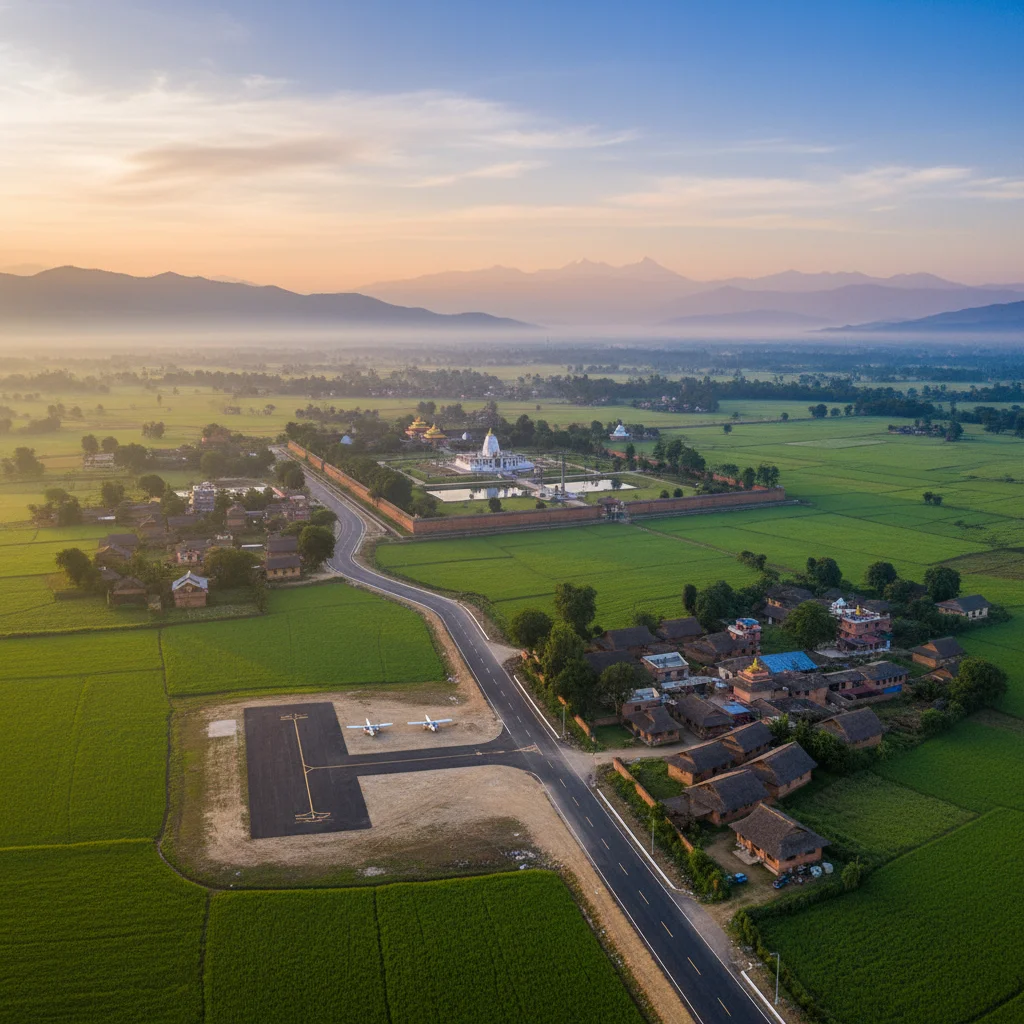
On May 19, 2014, the Asian Development Bank committed $50.71 million to a project that officially aimed to improve infrastructure around tourist and cultural sites in Bangladesh, India, and Nepal. The project, now closed, upgraded airports, roads, water supply, sanitation, and solid waste management systems centered on Lumbini, Nepal—the birthplace of Gautama Buddha. While the mandate appeared narrow, the underlying architecture reveals a strategic model for regional economic integration that extends far beyond tourism promotion.
The core analytical insight from this closed project is that cultural tourism infrastructure functions as a low-friction entry point for cross-border supply chains, labor mobility, and energy-efficient development. By anchoring investment in a pilgrimage site that draws visitors from three neighboring countries, the project effectively used “soft” tourism spending as a wedge for “hard” regional connectivity infrastructure—roads, air links, and sanitation systems that serve both pilgrims and local economic actors. This pattern carries implications for how South Asian nations can advance integration without the political friction associated with standalone trade corridor projects.
Project Anatomy: A $50 Million Model for Multi-Sector Leverage
The financing structure reveals deliberate multi-sectoral design. The Asian Development Fund provided $30 million, the Government of Nepal contributed $17.71 million, and the Clean Energy Fund supplied $3 million (Source 1: ADB Project Data). The inclusion of a dedicated clean energy component—$3 million from a fund specifically targeting sustainable energy—distinguishes this project from conventional tourism infrastructure investments. This allocation embedded energy efficiency into what might otherwise have been purely transport and sanitation upgrades.
The project’s key outputs included upgrading the Lumbini Development Area, enhancing connectivity to and from Lumbini, and strengthening community capacity and participation in Nepal (Source 1: Project Documentation). Critically, these outputs were not implemented in isolation. The air and road links that connect Bangladesh, India, and Nepal were expanded simultaneously with local water supply, sanitation, and solid waste management systems. This bundling created a one-stop logistical upgrade for a single geographic zone, eliminating the sequencing delays that plague multi-ministry, multi-country infrastructure programs.
The total cost of $50.71 million—modest by infrastructure standards—was allocated across sectors that typically fall under different government agencies and funding streams. By consolidating these under a single tourism umbrella, the project achieved what pure transport or sanitation projects rarely accomplish: simultaneous delivery of hard infrastructure and soft institutional capacity building.
Hidden Economic Logic: Why Tourism Infrastructure Is the Trojan Horse for Supply Chain Integration
The project’s framing around tourism masks a deeper economic rationale. Pilgrimage and cultural tourism routes are politically easier to fund than pure transport corridors, yet they deliver similar connectivity gains. The Lumbini project explicitly expanded air and road links connecting Bangladesh, India, and Nepal (Source 2: ADB Project Description). These links serve dual functions: moving pilgrims from Dhaka, Kolkata, and Kathmandu to Lumbini, while simultaneously reducing transport friction for local goods and labor.
The evidence for this hidden logic emerges from the project’s reported impacts. Approximately 2.4 million people across the three countries benefited through increased income, jobs, improved health and local environmental conditions, and reduced travel times (Source 2: Project Impact Assessment). About 270,000 people gained new job opportunities, and at least 5,000 others secured expanded livelihood options (Source 2: Project Impact Data). These figures suggest the infrastructure upgrades did not merely facilitate tourism—they reshaped the local economic geography for broad-based commercial activity.
The mechanism works as follows: Pilgrimage routes create predictable, recurring demand for transport services. Airlines and bus operators establish regular schedules to serve religious tourism. These same routes then become available for business travelers, seasonal workers, and perishable goods that require reliable transit. Road upgrades that reduce travel time for pilgrims simultaneously lower logistics costs for small and medium enterprises. Sanitation and water improvements that serve tourist facilities also benefit adjacent residential and commercial zones. The tourism label provides the initial political and financial justification; the economic spillovers extend across multiple sectors.
This pattern represents what can be termed “low-friction entry points”—using tourism to test cross-border infrastructure before scaling to heavy freight and formal trade corridor development. The Lumbini project allowed Nepal, Bangladesh, and India to coordinate airport standards, road specifications, and customs procedures in a low-stakes environment where failure would not disrupt critical supply chains. The knowledge gained from this pilot can be applied to larger, higher-volume regional transport initiatives under frameworks such as the South Asia Subregional Economic Cooperation (SASEC) program (Source 3: SASEC Secretariat Documentation).
The Energy-Sustainability Linkage: Clean Energy Fund as Structural Anchor
The $3 million Clean Energy Fund allocation deserves particular scrutiny. In most tourism infrastructure projects, energy components are limited to backup generators for hotels and airports. The Lumbini project embedded energy efficiency into its core design, suggesting an attempt to decouple tourism-driven growth from fossil fuel consumption patterns that have historically accompanied infrastructure expansion in South Asia.
The integration of clean energy into tourism infrastructure creates a structural anchor for sustainability. When roads, water supply, and sanitation systems are designed from inception to operate on efficient energy systems, the carbon trajectory of the entire corridor is locked in at lower levels. This contrasts with the more common approach of building conventional infrastructure first and retrofitting efficiency measures later—a process that is more expensive and less effective.
This design choice aligns with broader trends in development finance. The Asian Development Fund has increasingly mandated climate-resilient infrastructure in its lending portfolio. The Clean Energy Fund component signals that even “soft” sector projects—tourism, cultural heritage, community development—cannot escape the decarbonization requirements that now govern multilateral infrastructure finance (Source 1: ADB Financing Documentation).
Economic Multipliers: From Pilgrimage to Production
The project’s impact on 2.4 million people through income generation, health improvements, and travel time reductions requires unpacking. Reduced travel times are not merely a convenience metric; they directly correlate with labor market integration. When travel time between rural communities and urban markets decreases, workers can commute to higher-productivity jobs, agricultural produce reaches markets before spoilage, and families maintain social ties across longer distances.
The creation of 270,000 job opportunities (Source 2: Project Impact Data) suggests the infrastructure investments generated multiplier effects beyond direct tourism employment. Construction of roads and sanitation systems creates temporary jobs; operation and maintenance create permanent positions. The expanded livelihood options for at least 5,000 people (Source 2: Project Impact Data) likely reflect the emergence of ancillary services—transport, accommodation, food processing, handicrafts—that cluster around upgraded transport nodes.
These multipliers are geographically concentrated around Lumbini, but their effects ripple across the broader Nepal-India-Bangladesh corridor. Pilgrims traveling from Bangladesh through India to Nepal generate demand for fuel, food, and lodging at multiple stops along the route. Each stop creates economic activity that may not register as “tourism” in official statistics but nonetheless contributes to regional economic integration.
Comparative Analysis: Tourism Infrastructure vs. Traditional Transport Corridors
Traditional transport corridor projects in South Asia—highways, railways, border crossing upgrades—typically face political hurdles due to security concerns, land acquisition disputes, and bilateral trade imbalances. The Lumbini project demonstrates an alternative path: anchor infrastructure investment in a cultural site with cross-border appeal, then extend connectivity outward from that node.
Table 1 compares the characteristics of the Lumbini model versus traditional transport corridor investment:
| Dimension | Lumbini Tourism Model | Traditional Transport Corridor |
|-----------|----------------------|-------------------------------|
| Political risk | Low (cultural heritage framing) | High (trade/security framing) |
| Stakeholder alignment | High (religious/cultural common ground) | Mixed (competitive advantage disputes) |
| Infrastructure bundling | Multi-sector (roads, water, energy, sanitation) | Single-sector (typically road or rail) |
| Beneficiary base | Broad (tourists, locals, businesses) | Narrower (freight, formal traders) |
| Sustainability integration | Embedded (Clean Energy Fund) | Often retrofitted |
The lower political risk profile is the decisive advantage. No government in South Asia can oppose investment in a UNESCO World Heritage site with religious significance across multiple faiths and nations. This political cover allows project planners to bundle infrastructure components that would face separate review processes and potential rejection if proposed independently.
Forward Projections: Beyond Lumbini
The Lumbini project’s closed status means its data is now available for post-hoc analysis. Several projections emerge from this case study for future infrastructure investments in the region:
First, the model is replicable. Other pilgrimage sites in South Asia—Bodh Gaya, Sarnath, Kushinagar in India; Kapilavastu in Nepal; major Buddhist and Hindu temple complexes in Bangladesh—offer similar opportunities for bundled infrastructure investment. The SASEC Secretariat, which coordinates regional economic cooperation among Bangladesh, Bhutan, India, Maldives, Nepal, and Sri Lanka, has already signaled interest in extending tourism corridor approaches (Source 3: SASEC Transportation Documentation).
Second, the clean energy component will likely expand. As multilateral development banks tighten their climate finance requirements, future tourism infrastructure projects will face pressure to incorporate renewable energy generation, electric vehicle charging infrastructure, and energy-efficient building standards as baseline requirements rather than optional add-ons.
Third, the labor mobility benefits of tourism corridors will become increasingly explicit. The project’s 270,000 job creation metric suggests that future proposals will emphasize employment generation as a primary justification, reducing the need to frame projects purely around tourism promotion.
Fourth, cross-border data collection will improve. The current project’s impact assessment relied on aggregated figures for three countries. Future iterations will likely require country-disaggregated data, enabling more precise analysis of how benefits distribute across participating nations—a prerequisite for scaling the model to larger investments.
Conclusion: The Infrastructure Beneath the Pilgrimage
The South Asia Tourism Infrastructure Development Project’s additional financing, now closed and evaluated, offers a case study in how infrastructure investment strategies can achieve multiple objectives through careful sectoral bundling. By anchoring $50.71 million in upgrades to a religious pilgrimage site, the project simultaneously advanced transport connectivity, water and sanitation access, energy efficiency, and regional economic integration—all under a politically palatable tourism mandate.
The 2.4 million beneficiaries, 270,000 new jobs, and cross-border air and road links represent measurable outcomes. The less visible achievement is the institutional precedent: proof that cultural sites can serve as nodes for multi-country infrastructure coordination, testing connectivity approaches before they scale to higher-volume corridors.
For investors, policymakers, and development finance institutions monitoring South Asian infrastructure, the Lumbini model suggests a pragmatic pathway through the region’s well-documented political and logistical barriers to integration. The pilgrimage economy, it turns out, is not merely about faith—it is a functional vehicle for building the connective tissue that Bangladesh, India, and Nepal require for deeper economic interdependence. The question for future projects is not whether the model works, but which pilgrimage route will serve as the next entry point.