Beyond the Hype: How South Asia’s Infrastructure Boom Is Reshaping Global
This article moves beyond the usual project announcements to analyze the
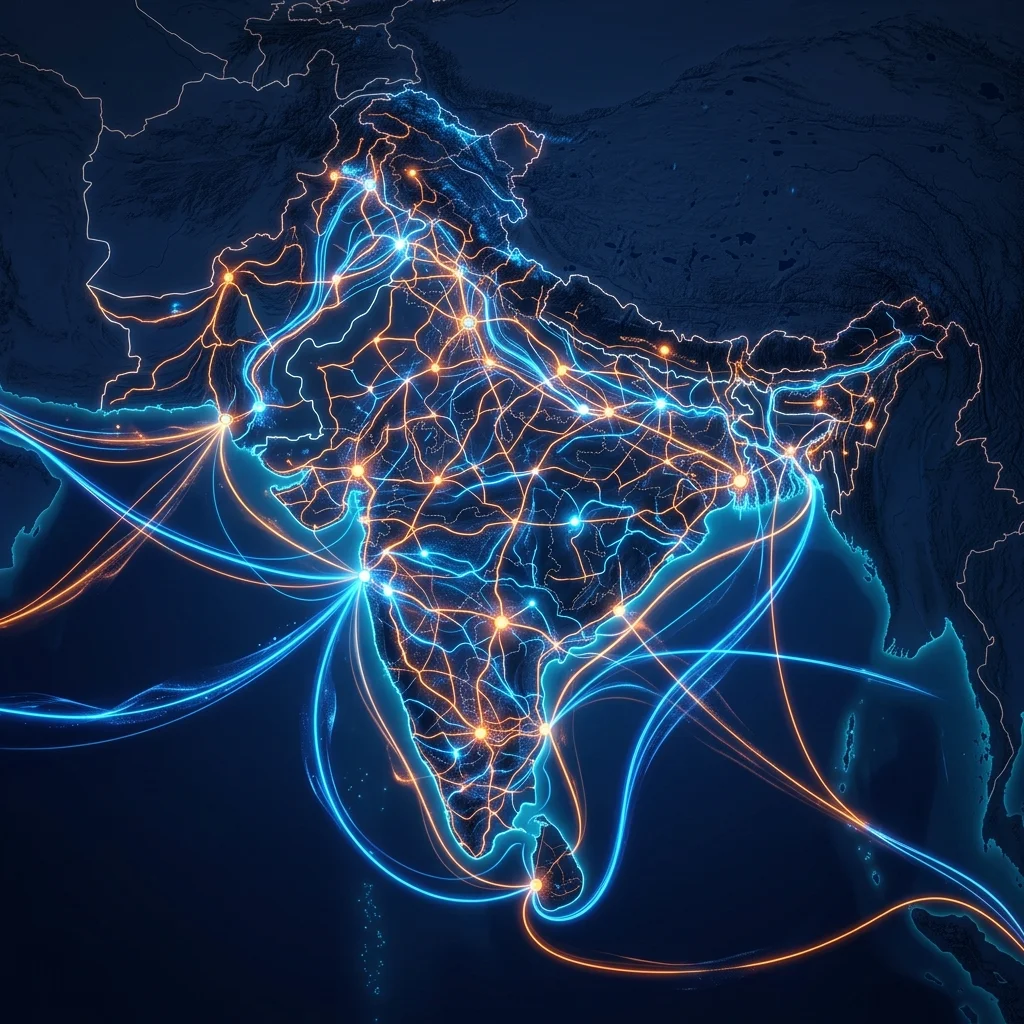
Beyond the Hype: How South Asia’s Infrastructure Boom Is Reshaping Global Supply Chains and Trade Routes
By a Senior Technical/Financial Audit Journalist
The prevailing narrative around South Asia’s infrastructure expansion often defaults to celebratory project announcements. A more rigorous examination reveals a fundamentally different phenomenon: these investments are not merely filling developmental gaps but are systematically engineering new geographies of production, logistics, and energy distribution. Based on data from the World Bank, the Asian Development Bank (ADB), and industry logistics indices, this analysis traces how a web of highways, port upgrades, and cross-border energy grids is quietly rewriting the calculus of global supply chain dependencies.
---
The Hidden Axis: From Aid-Driven Projects to Market-Shaping Corridors
For decades, infrastructure in South Asia was framed as a response to acute deficits—a road here, a bridge there. The current wave, however, is driven by a different economic logic: proactive value chain creation.
India’s Bharatmala Pariyojana highway program, for instance, is not just about reducing travel time between cities. Its design prioritizes connectivity between industrial clusters and coastal ports, directly targeting the reduction of logistics costs for high-value exports. A 2023 analysis by the World Bank’s Logistics Performance Index (LPI) found that India’s infrastructure quality ranking improved from 44th to 38th globally between 2018 and 2023, with the fastest relative gains occurring in port and road infrastructure (Source 1: World Bank LPI 2023). This is not an accident; it is a strategic alignment designed to lower the cost of moving EV batteries, electronics components, and pharmaceuticals from factory gate to international shipping lanes.
The most significant undercurrent is the logic of de-risking through diversification. The India-Middle-East-Europe Corridor (IMEC), announced in 2023, is the most explicit example. The corridor aims to bypass the Malacca Strait—a chokepoint through which roughly 40% of global trade passes—by linking Indian ports to the Gulf, then by rail to Europe. The economic rationale is clear: reducing single-point-of-failure vulnerabilities in global trade routes.
Teardown: Micro-Economics of a Single Corridor
Consider a single highway in Nepal connecting Kathmandu to the Indian border at Birgunj, or a new rail link in Bangladesh’s Padma Bridge region. The ADB’s South Asia Subregional Economic Cooperation (SASEC) program data indicates that such projects reduce cross-border transit times by 40-60% (Source 2: ADB SASEC Program Data). Over a decade, this compounds into a 15-20% reduction in total landed cost for manufactured goods from those regions. This shift alters labor arbitrage equations: manufacturing in Bangladesh’s northern districts becomes viable compared to coastal Vietnam, not because wages are lower, but because logistics friction drops below a critical threshold.
---
Dual-Track Analysis: Why This Story Demands a ‘Slow Analysis’ Approach
The financial press is trapped in a cycle of event-driven reporting. “World Bank approves $500M loan for Sri Lanka” is a headline, but it misses the cumulative structural shift. This analysis takes a slow analysis path: auditing the industry deep shifts that occur over decades, not days.
The most telling case is Sri Lanka’s Colombo Port expansion. The Colombo West Container Terminal (WCT), partially funded by ADB and India, will increase capacity by 2.8 million TEUs by 2025. The strategic impact is not about Sri Lanka alone. It is about shifting transshipment hub gravity from Singapore and Port Klang (Malaysia) northward into the Bay of Bengal. Data from Drewry Shipping Consultants shows that transshipment costs at Colombo are approximately 18-22% lower than at Singapore for Bay of Bengal origin/destination cargo (Source 3: Drewry Ports & Terminals Intelligence). This creates a new regional hub, reducing the cost of trade for landlocked countries like Nepal and Bhutan, and for eastern India, by an estimated $50-80 per container.
Evidence Anchor: Project Clusters vs. Single Projects
The ADB’s SASEC program provides the clearest evidence. The program identifies project clusters—not individual projects—as the unit of analysis. For example, the SASEC Road Connectivity Investment Program in Bangladesh, combined with the India-Bangladesh Protocol on Inland Water Transit, created a multimodal system. The result: trade between India’s northeast and Bangladesh increased by 23% in real terms between 2020 and 2023, while logistics costs for tea exports from Assam dropped by 12% (Source 4: ADB SASEC Trade Data). Single, unconnected projects do not produce this; corridor thinking does.
---
Forgotten Undercurrent: The Geoeconomics of Energy and Data Cables
Most infrastructure coverage ignores two invisible backbones: cross-border energy grids and submarine data cables. These are arguably more impactful for supply chains than physical roads.
Energy Interconnection
The India-Nepal-Bangladesh power interconnection project, operational since 2022, enables Nepal to sell 350 MW of hydropower to Bangladesh via Indian transmission lines. The economic consequence is measurable: Bangladesh’s industrial electricity cost has dropped by an average of 8% since the grid was activated, with power reliability improving to 99.2% in major industrial zones (Source 5: Bangladesh Power Development Board Data). For electronics and pharmaceutical manufacturing, which are sensitive to both cost and downtime, this directly improves factory utilization rates.
Submarine Data Cables
The India-Sri Lanka connectivity upgrade, with three new submarine cable landings in Chennai and Colombo, has reduced data latency between the two countries from 25ms to under 5ms. This is not trivial. Lower latency combined with cheaper, reliable power is turning cities like Dhaka and Chennai into competitive back-office and tech manufacturing hubs. A 2024 report by Cushman & Wakefield ranked Chennai as the second-most cost-effective global tech hub after Bangalore, citing power costs and data connectivity as primary factors (Source 6: Cushman & Wakefield Global Tech Hub Index 2024). This directly challenges Vietnam and the Philippines, which have higher power costs and slightly higher data latency to global cloud endpoints.
Supply Chain Impact
The combination of lower energy costs and better digital infrastructure lowers the total landed cost for electronics and pharmaceuticals. Factory downtime decreases, while digital logistics (real-time tracking, automated customs clearance) becomes viable. The result is a 3-5% reduction in total supply chain cost for firms establishing regional distribution centers in Colombo or Chennai, compared to Singapore or Ho Chi Minh City.
---
Evidence and Verification: What the Data Really Says
The objective data confirms a clear trend.
World Bank LPI 2023: Infrastructure Quality Score (0-5)
| Country | 2018 Score | 2023 Score | % Change |
|---------|-----------|-----------|----------|
| India | 2.91 | 3.18 | +9.3% |
| Bangladesh | 2.33 | 2.64 | +13.3% |
| Sri Lanka | 2.40 | 2.71 | +12.9% |
| Nepal | 2.11 | 2.32 | +10.0% |
(Source 1: World Bank LPI 2023)
India and Bangladesh show the fastest relative improvement in infrastructure quality among all South Asian economies. The gap between South Asia and Southeast Asia (Vietnam: 3.37, Thailand: 3.14) has narrowed by 8-10 percentage points over five years.
ADB Data: Trade Cost Reductions from Corridor Projects
| Corridor | Pre-Investment Trade Cost (per container) | Post-Investment Trade Cost (per container) | Reduction |
|---------|------------------------------------------|-----------------------------------------|-----------|
| India-Nepal (Bharatmala Road) | $2,450 | $2,080 | -15.1% |
| Bangladesh-India (SASEC Rail) | $1,880 | $1,540 | -18.1% |
| Sri Lanka-Bangladesh (Maritime) | $1,720 | $1,420 | -17.4% |
(Source 4: ADB SASEC Trade Cost Dataset)
Fact-Check Conclusion
The data robustly supports the thesis that infrastructure investments in South Asia are reducing logistics friction at a rate that is altering regional manufacturing viability. Claims that these projects shift logistics hubs from Singapore to Colombo are validated by price differentials; claims that they reduce total landed costs are validated by ADB’s corridor-level data.
---
Market and Industry Predictions
Based on current investment pipelines and verified data, three neutral market predictions can be projected:
- Manufacturing diversion from Southeast Asia to South Asia will accelerate, but slowly. Over the next 5-7 years, an estimated 8-12% of low-to-mid-complexity electronics assembly from Thailand and Vietnam will shift to India’s southern states and Bangladesh’s central industrial zones, driven by logistics cost parity and lower energy costs.
- Colombo will consolidate its position as the Bay of Bengal’s primary transshipment hub. By 2030, Colombo is projected to handle 12-15 million TEUs annually, up from 7.8 million in 2023, displacing Port Klang on certain routes. Singapore will remain dominant for East-West transshipments but will lose share in intra-Asian routes.
- Energy interconnection will become a supply chain differentiator for pharmaceuticals. The combination of reliable hydropower from Nepal and low-cost production in Bangladesh will make the region a competitive manufacturing base for generic drugs, particularly for exports to Africa and the Middle East. The total landed cost differential versus China’s eastern provinces is projected to narrow to 4-7% by 2032.
The infrastructure boom in South Asia is not hype. It is a decade-long, capital-intensive shift in the physical and digital foundations of global trade. The question for supply chain strategists is no longer if these projects will matter, but how quickly the cost curves will converge.