South Asia Infrastructure Investment Projects: The $2 Trillion Challenge
South Asia is the fastest-growing region in the world, yet it suffers from
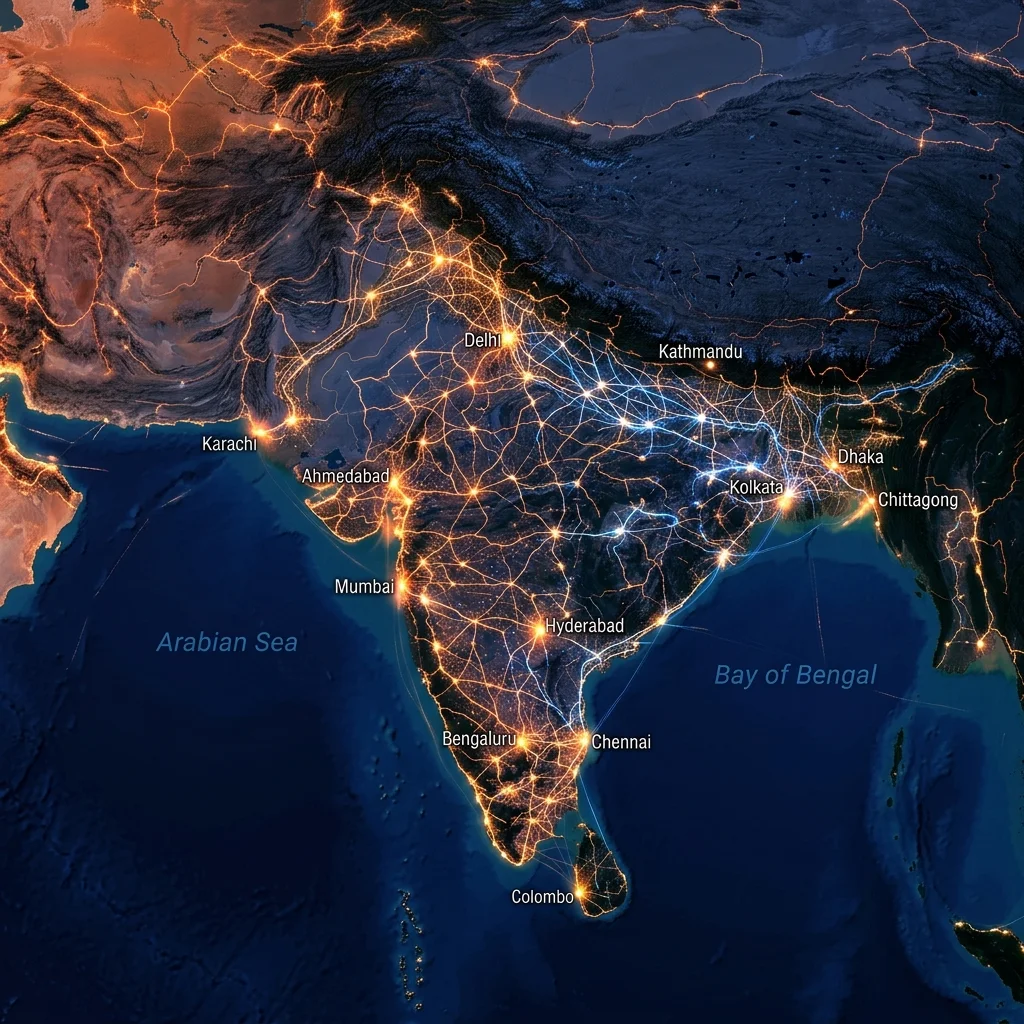
South Asia Infrastructure Investment Projects: The $2 Trillion Challenge
The Growth Paradox: Fastest Growth, Weakest Infrastructure
South Asia has recorded GDP growth rates exceeding 6% annually for much of the past decade, making it the fastest-growing region in the world. Yet the quality of its infrastructure—roads, ports, power grids, and digital networks—ranks among the lowest in developing Asia. A working paper published by the Asian Development Bank (ADB) in September 2018, authored by Shikha Jha and Rosa Mia Arao, warns that this trajectory is unsustainable without a fundamental shift in infrastructure investment (Source 1: ADB Working Paper, Publication Stock No. WPS189514-2, ISSN 2071-7202).
The paper presents a stark central finding: South Asia must invest almost 9% of its gross domestic product (GDP) on infrastructure development over the period 2016–2030. This requirement is higher than for any other Asian subregion—East Asia invests roughly 5% of GDP, Southeast Asia approximately 6%—underscoring the disproportionate deficit South Asia carries. The paradox is clear: the region has grown rapidly on weak foundations, but those foundations are now cracking under the weight of continued expansion.
The ADB study provides the most comprehensive public-sector analysis of the region’s infrastructure financing needs. It does not rely on aspirational targets but on baseline economic modeling that accounts for existing asset depreciation, population growth, and urbanization trends. The conclusion is that without addressing the infrastructure gap, South Asia’s growth will decelerate as supply-side constraints—energy shortages, port congestion, inadequate road connectivity—become binding.
---
The $2 Trillion Price Tag: Breaking Down the 9% GDP Requirement
Translating the 9% GDP figure into absolute terms yields a financing requirement of approximately $2 trillion over 15 years, based on 2016 GDP levels (adjusted for inflation, the figure is substantially higher today). The ADB paper disaggregates this investment across four primary sectors:
- Transport: Roads, railways, ports, and airports account for the largest share, driven by the need to improve intra-regional connectivity and reduce logistics costs that are 2–3 times higher than in East Asia.
- Energy: Power generation, transmission, and distribution require massive capital, particularly to address chronic shortages in Pakistan, Nepal, and Bangladesh, and to integrate renewable energy sources.
- Water and Sanitation: Rapid urbanization has overwhelmed existing networks; investment in water treatment and piped supply is a prerequisite for public health and industrial use.
- Digital Infrastructure: Broadband and data center capacity are increasingly critical for manufacturing competitiveness and service-sector growth.
The comparative analysis within the ADB paper shows that South Asia’s required investment-to-GDP ratio is not merely a function of low starting stock. Even after controlling for current infrastructure quality, the region needs to invest more per unit of GDP than East Asia did during its own high-growth phase (Source 1: ADB Working Paper, Table 3). This reflects the compounded effect of low initial coverage, high population density, and climate vulnerability.
---
Public vs. Private: Who Pays for the Gap?
Public budgets in South Asia are constrained by high fiscal deficits. India’s central government fiscal deficit hovered near 3.5% of GDP in 2018; Pakistan’s exceeded 6%; Bangladesh faced revenue-to-GDP ratios below 10%. These constraints mean that state-led investment alone cannot meet the 9% target. The ADB paper examines the role of both public and private sector financing mechanisms, including public-private partnerships (PPPs), development partner concessional loans, and multilateral guarantees.
Private capital, however, remains hesitant. The paper identifies three structural deterrents:
- Regulatory uncertainty: Frequent changes in tariff regimes, land acquisition laws, and environmental clearance procedures create project delays and cost overruns.
- Currency risk: Foreign investors face depreciation exposure, as infrastructure revenues are typically denominated in local currencies while debt servicing is often in dollars.
- Weak project pipelines: Few infrastructure projects in South Asia reach financial close because feasibility studies are incomplete or lack bankable structures.
Multilateral development banks—the ADB, World Bank, and Asian Infrastructure Investment Bank—provide concessional finance but cannot bridge the gap alone. The ADB paper argues for innovative risk-sharing instruments: partial credit guarantees, foreign exchange hedging facilities, and blended finance structures that reduce the cost of capital for private investors (Source 1: ADB Working Paper, Section 4). Without such mechanisms, the region will remain heavily reliant on public debt, which is already elevated.
---
The Hidden Bottleneck: Project Preparation and Institutional Capacity
A critical finding of the ADB working paper is that the financing gap is not solely a funding problem—it is a preparation problem. The region lacks sufficient institutional capacity to develop bankable projects. Feasibility studies are often inadequate; environmental and social impact assessments are delayed; land acquisition processes are mired in legal disputes. These bottlenecks increase project costs by 20–40% and extend timelines by years.
The paper highlights the role of project preparation facilities (PPFs) supported by development partners. Countries such as India have established dedicated agencies like the National Investment and Infrastructure Fund (NIIF), but smaller nations like Nepal and Sri Lanka lack equivalent institutions. The result is that available capital—both domestic and foreign—cannot be deployed efficiently.
The authors recommend three institutional reforms:
- Establishing centralized project development units within ministries to standardize feasibility reports and due diligence.
- Pre-investing in land acquisition and environmental clearance before seeking private sector bids.
- Improving procurement transparency to reduce the cost of bidding and attract a wider pool of international contractors.
Without these reforms, even a doubling of multilateral lending will yield diminishing returns, as the pipeline of ready-to-finance projects remains thin.
---
Infrastructure Constraints and Regional Integration: The Supply Chain Impact
Infrastructure deficits directly impede South Asia’s manufacturing competitiveness and regional trade integration. The ADB paper notes that intra-regional trade accounts for only about 5% of South Asia’s total trade, compared to 25% in East Asia. Poor road and rail connectivity, cumbersome customs procedures, and inadequate port facilities raise logistics costs. A container shipped from Delhi to Dhaka costs more than shipping the same container from Delhi to Singapore.
The supply chain consequences extend beyond trade volumes. Manufacturing firms in the region operate with higher inventory buffers due to unreliable power and transport networks, eroding profit margins. The paper argues that infrastructure investment can unlock significant efficiency gains—reducing logistics costs by 30–50% in corridors such as the Delhi–Mumbai Industrial Corridor or the Bangladesh–Bhutan–India–Nepal (BBIN) road network.
Digital infrastructure is emerging as a new bottleneck. As South Asian economies shift toward services and digital manufacturing, broadband penetration and data center reliability become critical. The working paper’s framework includes digital infrastructure as a separate category, anticipating that the investment requirement will grow post-2020—a prediction validated by the post-pandemic surge in remote work and e-commerce.
---
The Path Forward: From Research to Implementation
The ADB working paper provides a diagnostic, not a prescription. Its value lies in quantifying the magnitude of the challenge and identifying the structural factors that differentiate South Asia from other fast-growing regions. The 9% GDP investment target remains an estimate, but subsequent data from the ADB and other institutions confirm that actual infrastructure spending in the region has hovered between 5% and 7% of GDP from 2016 to 2023—a persistent shortfall.
Three market-level predictions emerge from the analysis:
- Increased reliance on multilateral and bilateral development finance will continue, but the share of concessional loans will decline as countries like India and Bangladesh graduate to higher income brackets. Blended finance structures will grow, combining concessional capital with commercial debt.
- Private sector participation will remain concentrated in energy and telecommunications, where revenue models are more predictable than in transport or water. PPPs will succeed only in jurisdictions with independent regulators and transparent arbitration mechanisms.
- Project preparation will become a distinct asset class. Dedicated funds focused on feasibility studies, land acquisition, and early-stage development will attract institutional capital, especially from sovereign wealth funds and pension funds seeking long-term, inflation-linked returns.
The infrastructure vision for South Asia—a web of energy grids, multimodal transport corridors, and digital networks—is technically feasible but institutionally demanding. The ADB paper, published in September 2018, remains the most rigorous baseline for measuring progress. The region’s success will depend not on the amount of capital available but on whether its governments can build the systems to deploy that capital efficiently.
(Source 1: ADB Working Paper, “Infrastructure Financing in South Asia,” by Shikha Jha and Rosa Mia Arao, September 2018, Publication Stock No. WPS189514-2, ISSN 2071-7202 (print), 2218-2675 (electronic). Licensed under Creative Commons Attribution 3.0 IGO.)