Building Tomorrow: How Climate Investment Funds Are Reshaping South Asia’s
This article explores the hidden economic logic behind Climate Investment
Building Tomorrow: How Climate Investment Funds Are Reshaping South Asia’s Infrastructure and Rural Economy
Introduction: The Unseen Engine of Climate-Smart Development
Asia is the most populous and most densely populated region in the world, with a rural economy fundamentally dependent on agriculture (Source 1: Primary Data). The region’s demographic trajectory is defined by rapid urbanization and concurrent economic development, both of which demand massive infrastructure expansion. Within this context, the Climate Investment Funds (CIF) have emerged not merely as a financing mechanism but as a strategic framework that explicitly links climate resilience to infrastructure modernization.
The core question confronting policymakers is whether CIF investments in South Asia can generate durable economic infrastructure capable of withstanding both the pressures of urbanization and the shocks of a changing climate. The evidence from programs in Bangladesh and Cambodia suggests a definitive structural shift: from reactive disaster relief toward proactive, infrastructure-led adaptation that repositions rural economies as assets rather than liabilities.
The Economic Logic: From Rural Agriculture to Resilient Supply Chains
Traditional agricultural systems in South Asia exhibit high vulnerability to climate events—cyclones, saltwater intrusion, erratic rainfall, and temperature extremes directly threaten crop yields and farmer incomes. CIF investments in regenerative forestry and coastal resilience function as protective infrastructure for this foundational economic sector.
The economic logic operates on three interconnected levels. First, by stabilizing agricultural productivity, these investments preserve the rural economic base that supplies labor to urban industrial centers. Second, climate-proofed infrastructure—including water management systems and transport networks—reduces supply chain disruptions that historically cascade through regional economies. Third, demonstrable reductions in climate risk attract complementary private investment, creating a compounding effect on local economic activity.
In Bangladesh, CIF’s Pilot Program for Climate Resilience (PPCR) explicitly targets food and fresh water security (Source 1: Primary Data). These are not humanitarian interventions but strategic infrastructure investments: secure food systems stabilize labor costs for urban manufacturers, while reliable freshwater access reduces operational risks for industrial facilities. The program simultaneously strengthens coastal community resilience, effectively creating a buffer that absorbs climate shocks before they can propagate through the broader economy.
Cambodia’s PPCR takes a parallel approach by climate-proofing water-management systems, agriculture, and physical infrastructure (Source 1: Primary Data). When irrigation canals withstand drought and roads survive flooding, the cost of doing business declines. Supply chain continuity becomes a quantifiable economic advantage, positioning Cambodia as a more reliable destination for export-oriented manufacturing and agro-processing investments.
Case Study 1: Bangladesh – Coastal Resilience as Infrastructure Asset
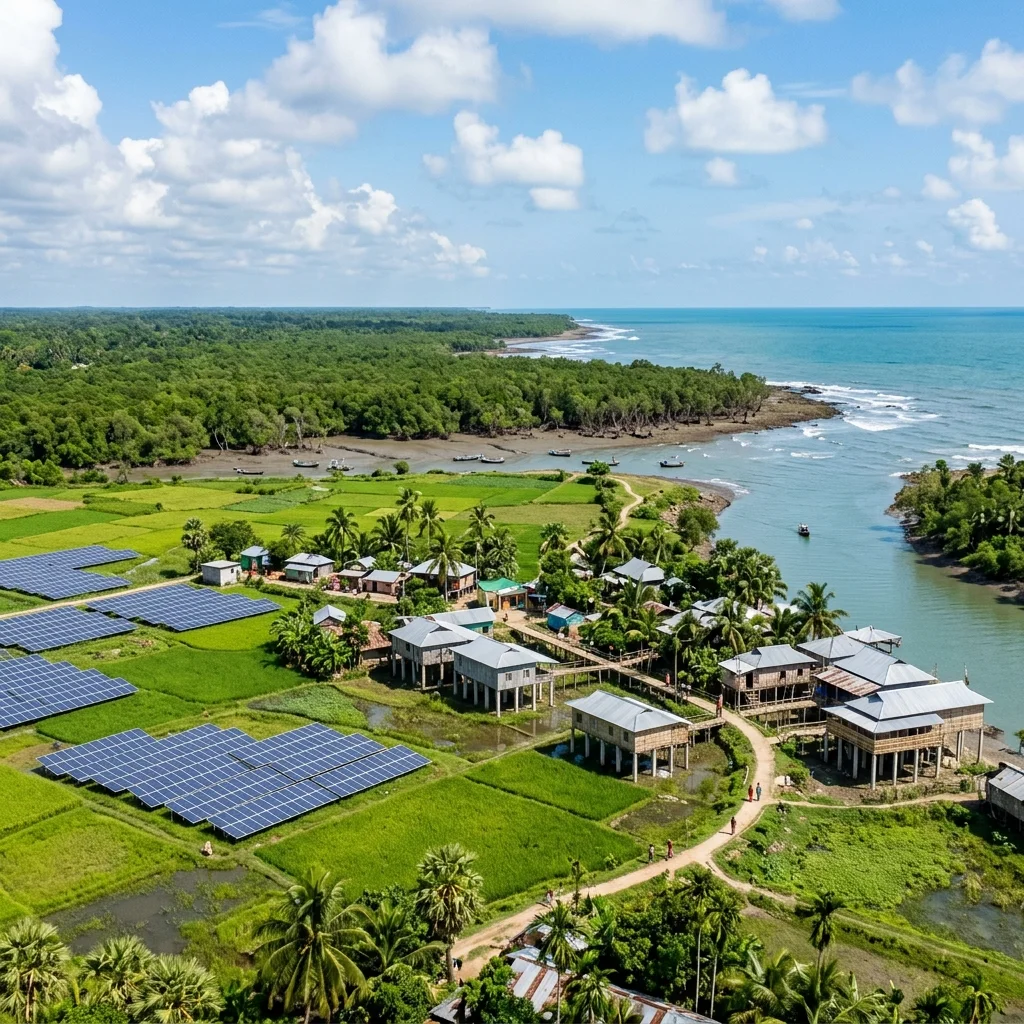
Bangladesh occupies a unique position in climate adaptation economics: a densely populated delta nation with rapid industrialization facing existential coastal threats. The PPCR programs address this by building coastal community resilience through raised homes, cyclone shelters, and solar-powered community infrastructure (Source 1: Primary Data).
These investments function as infrastructure assets with measurable economic returns. Stabilized coastal livelihoods reduce the rate of climate-induced rural-to-urban migration, which in turn lowers pressure on Dhaka’s overburdened urban infrastructure. The result is a multiplier effect: each dollar invested in coastal resilience reduces future urban infrastructure costs, maintains agricultural productivity, and preserves the rural hinterland as a productive economic zone rather than a depopulated liability.
The strategic implication is clear: coastal resilience infrastructure in Bangladesh does not merely protect against storms—it underpins the entire national urbanization trajectory. Without this buffer, rapid industrialization would face escalating labor shortages, food price volatility, and infrastructure strain that would erode Bangladesh’s competitive advantage in global textile and manufacturing markets.
Case Study 2: Cambodia – Institutional Capacity and Renewable Energy Leapfrogging
Cambodia presents a different but equally instructive model. The CIF’s PPCR here focuses on building institutional capacity for climate resilience—embedding climate risk assessment into national development planning (Source 1: Primary Data). This institutional infrastructure is arguably as important as physical assets: it ensures that future investments systematically account for climate variables rather than treating them as external shocks.
Simultaneously, Cambodia’s Scaling Up Renewable Energy in Low Income Economies Program advances solar-energy development and a biomass power project (Source 1: Primary Data). The biomass project rests on a roadmap for sustainable forest management, creating a circular economy where forestry waste generates electricity. This represents a deliberate strategy: renewable energy infrastructure reduces dependence on imported fossil fuels, lowers long-term energy costs for manufacturers, and positions Cambodia to attract green industrial investments.
The combination of institutional capacity and renewable energy infrastructure constitutes a structural transformation of Cambodia’s rural economy. Agricultural communities that previously operated at subsistence levels now have access to reliable electricity, enabling small-scale processing, cold storage, and digital market access. The biomass power model further incentivizes sustainable forest management, creating revenue streams from carbon sequestration and timber that did not exist a decade ago.
The Hidden Pattern: Infrastructure as a Climate Hedge
Across both Bangladesh and Cambodia, a consistent pattern emerges: CIF investments are creating infrastructure that functions simultaneously as climate adaptation and economic development assets. This dual-use characteristic is the hidden economic logic of the programs.
Coastal resilience investments in Bangladesh serve as hedges against the most probable climate scenarios while directly supporting industrialization. Cambodia’s renewable energy transition hedges against fossil fuel price volatility while building a foundation for green manufacturing. Regenerative forestry across both nations hedges against carbon pricing regimes while generating sustainable biomass energy and preserving agricultural watersheds.
For small island developing states in Asia—the Marshall Islands, Samoa, and Nauru, the world’s third-smallest nation—the stakes are existential (Source 1: Primary Data). These nations cannot afford the luxury of separate adaptation and development budgets. CIF programs that embed resilience into every infrastructure decision represent the only economically viable pathway.
Market Predictions and Investment Implications
The trajectory is clear: climate-smart infrastructure will increasingly become the default standard for South Asian development finance, not a niche category. Three observable trends support this conclusion:
First, the demonstrated multiplier effects of integrated resilience investments—where one dollar of adaptation spending reduces three dollars of future urban infrastructure costs—will drive replication across the region. Governments that initially viewed climate programs as environmental obligations will increasingly treat them as fiscal optimization strategies.
Second, private capital will follow public de-risking. As CIF programs demonstrate reduced climate-related supply chain disruptions, institutional investors will allocate more capital to South Asian infrastructure projects that incorporate climate resilience specifications.
Third, renewable energy infrastructure in countries like Cambodia will generate competitive advantages in global supply chains. Manufacturers facing carbon border adjustment mechanisms in Europe and North America will preferentially source from jurisdictions with demonstrated low-carbon energy grids.
The most significant medium-term outcome will be a revaluation of rural assets. Land currently discounted for climate vulnerability will appreciate as resilience investments materialize. Agricultural supply chains that were dismissed as too risky will attract investment. The CIF model, by proving that climate adaptation and economic development are not competing priorities but complementary investments, offers a replicable blueprint for the world’s most densely populated region.
South Asia’s infrastructure future will not be built on the old model of defending urban centers from rural decline. It will be constructed on the recognition that resilient rural economies are the necessary foundation for sustainable urbanization—and that climate investment funds have already begun building that foundation, one coastal village and one solar panel at a time.