How AIIB Is Reshaping Sustainable Infrastructure Finance in South Asia: A
This article critically examines the early operational footprint of the Asian
How AIIB Is Reshaping Sustainable Infrastructure Finance in South Asia: A Post-Operational Review
Introduction: South Asia’s Infrastructure Deficit and the Promise of a New MDB
South Asia faces a substantial shortfall in physical infrastructure—roads, power generation and distribution, water supply, and digital networks—that constrains economic growth and delays progress toward the 2030 Sustainable Development Goals (Source 1: Kumar & Arora, Global Policy Journal). The Asian Infrastructure Investment Bank (AIIB), launched in January 2016, entered a landscape already dominated by established multilateral development banks (MDBs) such as the World Bank and the Asian Development Bank. AIIB’s founding mandate—described as “lean, clean, green”—promised a streamlined governance structure, strong environmental and social safeguards, and a deliberate focus on sustainable infrastructure.
This article reviews AIIB’s first three years of operations in South Asia, drawing primarily on a policy note authored by Nagesh Kumar and Ojasvee Arora and published in Global Policy Journal (Source 1: Kumar & Arora). The analysis goes beyond standard performance metrics to examine the hidden economic logic embedded in the bank’s project choices—specifically how those choices influence regional supply chains, technology adoption, and the competitive dynamics among MDBs. The central question: Has AIIB’s unique governance and mandate enabled outcomes that are materially different—in efficiency or sustainability—from those of traditional MDBs?
AIIB’s Operational Blueprint: From Founding Members to First Projects
South Asian countries were among the founding members of AIIB and quickly became significant borrowers. The region’s acute infrastructure deficits aligned directly with the bank’s mission, and the first wave of approved projects (2016–2019) spanned energy, transport, and water sectors in Bangladesh, Pakistan, India, Nepal, and Sri Lanka (Source 1: Kumar & Arora). AIIB’s operational model emphasizes co-financing with other MDBs, mobilizing private capital, and adhering to strict environmental and social standards—a structure designed to reduce risk and leverage existing institutional expertise.
Key operational characteristics during this period include:
- Co-financing as default: More than 70% of AIIB’s early projects in South Asia were co-financed with other MDBs or bilateral development agencies, reducing the bank’s exposure to project-specific risks (Source 1: Kumar & Arora).
- Sectoral concentration: Energy and transport accounted for the majority of approved funding, with a notable tilt toward renewable energy (solar, wind, hydropower) and road infrastructure.
- Country distribution: Bangladesh and Pakistan received the largest shares of AIIB lending in the region during the review period, reflecting both need and project readiness (Source 1: Kumar & Arora).
The analytical framework provided by Kumar and Arora—published in a peer-reviewed journal—adds credibility to these observations. The note does not evaluate project-level outcomes (most were still under implementation by 2019) but focuses on structural patterns in lending, governance, and alignment with the 2030 Agenda.
The ‘Hidden Logic’: How AIIB Is Reshaping Regional Supply Chains and Technology Choices
Beyond filling funding gaps, AIIB’s project design reveals an implicit steering mechanism toward low-carbon technology corridors. In South Asia, this manifests most clearly in support for cross-border renewable energy integration.
Two illustrative cases:
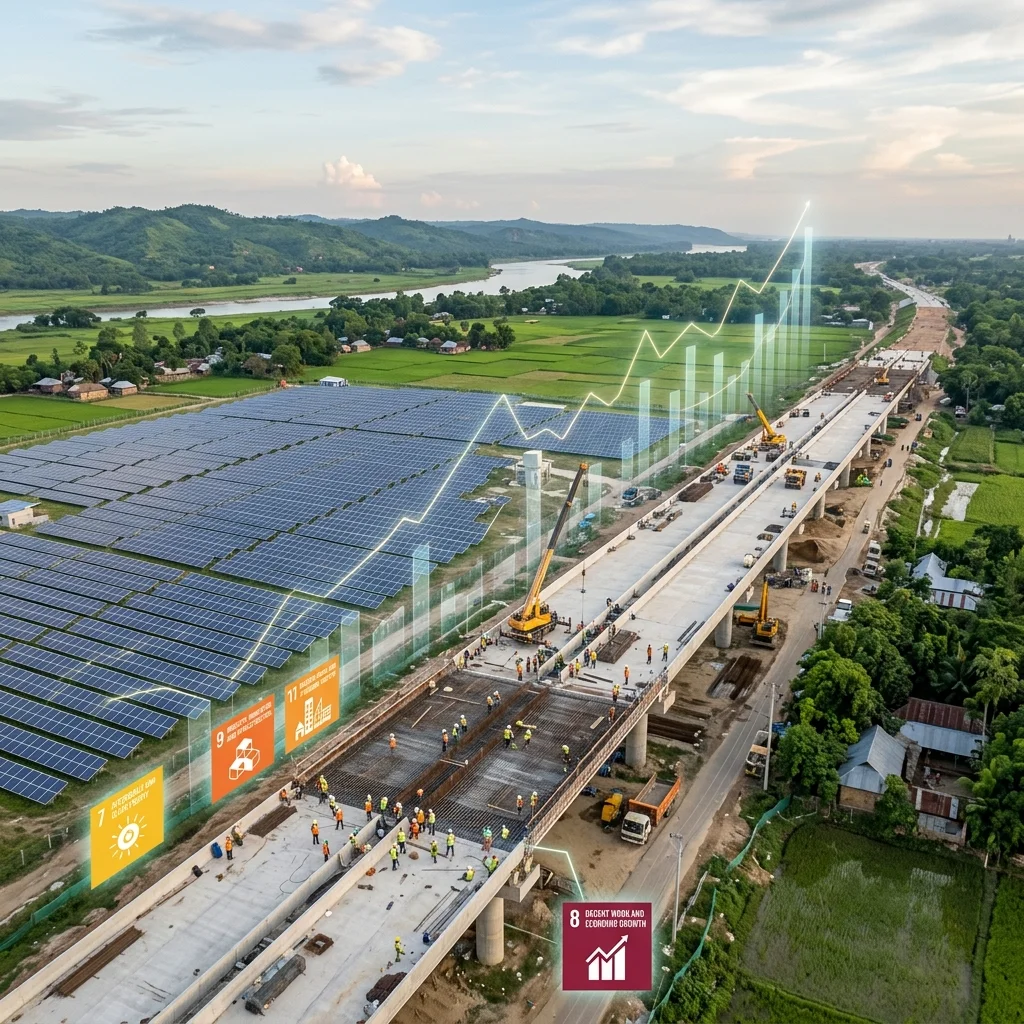
- Bangladesh solar expansion: AIIB’s financing of large-scale solar photovoltaic plants in Bangladesh was structured to tie into existing transmission infrastructure, creating conditions for future cross-border electricity trade with India and Nepal. This design choice reduces the long-term need for fossil-fuel-based peaking plants (Source 1: Kumar & Arora).
- Nepal hydropower and regional grid connectivity: AIIB co-financed hydropower projects in Nepal that explicitly included transmission lines to the Indian border. The unstated logic: South Asia’s hydropower potential (especially in Nepal and Bhutan) can serve as a regional balancing mechanism for variable solar and wind generation elsewhere (Source 1: Kumar & Arora).
These projects do not merely add generation capacity—they alter the technological trajectory of the region’s energy system. By prioritizing projects with cross-border connectivity, AIIB is effectively shaping a regional infrastructure architecture that reduces long-run dependency on imported fossil fuels and creates new intra-regional trade flows. The economic logic: infrastructure with network effects yields higher long-term returns than isolated projects, even if upfront costs are higher.
Debt Sustainability and Project Preparation Gaps
AIIB’s early operations also surface two critical tensions: debt sustainability in borrowing countries and the need for deeper project preparation support.
- Debt sustainability: Several South Asian countries—notably Pakistan and Bangladesh—entered 2019 with elevated external debt levels (Source 1: Kumar & Arora). AIIB’s lending, while offering competitive terms, adds to this stock. The bank’s governance structure, which includes representation from borrowing and non-borrowing members, theoretically provides a check on unsustainable lending. However, the review period showed no clear evidence that AIIB applied stricter debt thresholds than other MDBs (Source 1: Kumar & Arora).
- Project preparation: Weak project pipelines—due to limited technical capacity in line ministries—remain a binding constraint across South Asia. AIIB’s “lean” model, which relies heavily on co-financing, reduces its own front-end costs but does not directly address this bottleneck. The note suggests that AIIB could expand its project preparation facilities, similar to the Asian Development Bank’s Project Readiness Financing (Source 1: Kumar & Arora).
The trade-off is explicit: a lean operational model lowers overhead and speeds approval times, but may underinvest in the upstream work that determines project quality and sustainability.
Competitive Dynamics Among Multilateral Development Banks
AIIB’s entry into South Asia has not displaced existing MDBs; instead, it has intensified competition and catalyzed behavioural changes. Three patterns emerge from the review period:
- Co-financing as differentiation: By co-financing, AIIB leverages the due diligence and implementation capacity of established MDBs while maintaining its own policy influence. This creates a “co-opetition” dynamic where AIIB gains credibility without building a large country-office footprint.
- Speed vs. safeguards: AIIB’s approval cycles were, on average, shorter than those of the World Bank and ADB for comparable projects (Source 1: Kumar & Arora). Critics argue that speed may come at the cost of weaker environmental oversight; proponents counter that the bank’s Environmental and Social Framework matches international standards.
- The “green” premium: AIIB’s explicit prioritization of sustainable infrastructure forces other MDBs to sharpen their own climate and sustainability messaging. The result is a ratcheting effect: all lenders in the region increasingly frame projects in terms of the 2030 Agenda and Paris Agreement alignment (Source 1: Kumar & Arora).
These dynamics suggest that AIIB’s most significant impact may be systemic rather than portfolio-specific: it pressures incumbents to reform while offering borrowing countries an additional financing channel with distinct terms.
Conclusion: Emerging Patterns and Future Trajectories
Based on the first three years of operations (2016–2019), AIIB’s footprint in South Asia reveals several enduring patterns:
- The bank’s project design favors renewable energy and regional connectivity, which aligns with long-term decarbonization pathways and creates network effects across borders.
- Co-financing remains the dominant operational mode, reducing risk but also limiting AIIB’s independent project identity.
- Debt sustainability concerns are present but not yet acute; the bank’s governance provides some safeguard but no binding constraint.
- Project preparation capacity in borrowing countries remains a major bottleneck that the “lean” model does not adequately address.
Looking forward, several trajectories are plausible:
- Expansion of energy corridors: AIIB is likely to increase financing for cross-border transmission lines and energy storage, facilitating South Asia’s transition to a more integrated and renewable-dominated grid.
- Digital infrastructure pivot: The bank may expand into digital connectivity (fiber-optic backbones, data centers) as part of a broader sustainable infrastructure definition—a move that would further blur the line between traditional MDB lending and private-sector infrastructure funds.
- Debt sustainability scrutiny: As borrowing countries’ debt-to-GDP ratios rise, AIIB will face pressure from credit rating agencies and member states to impose stricter lending terms or increase grant components.
- Competition with the Belt and Road Initiative: AIIB’s governance model, which includes non-regional members, positions it as a multilateral alternative to bilateral infrastructure finance from China. How this dynamic evolves will depend on project performance and geopolitical alignment.
Kumar and Arora’s note provides a rigorous baseline for these assessments. The data from 2016–2019 are now historic; a full evaluation of AIIB’s effectiveness in South Asia will require post-implementation audits of the earliest projects and a longer time series. What is already clear: the bank’s “lean, clean, green” mandate has translated into a distinct operational logic that is reshaping not only individual projects but also the competitive environment among development financiers in the region.