South East Asia Social Media Habits: The Hidden Engine Behind Attention, Commerce,
This article examines how social media habits in South East Asia are shaped
South East Asia Social Media Habits Reflect a Commerce and Community Infrastructure
Social platforms in the region do more than entertain
In South East Asia, social media habits are shaped by a practical logic that goes beyond leisure. Mobile-first communication, community-based discovery, and the steady expansion of social commerce have turned platforms such as Facebook, Instagram, TikTok, WhatsApp, and YouTube into everyday infrastructure. People use them to keep in touch, follow creators, compare products, coordinate work, and make purchases.
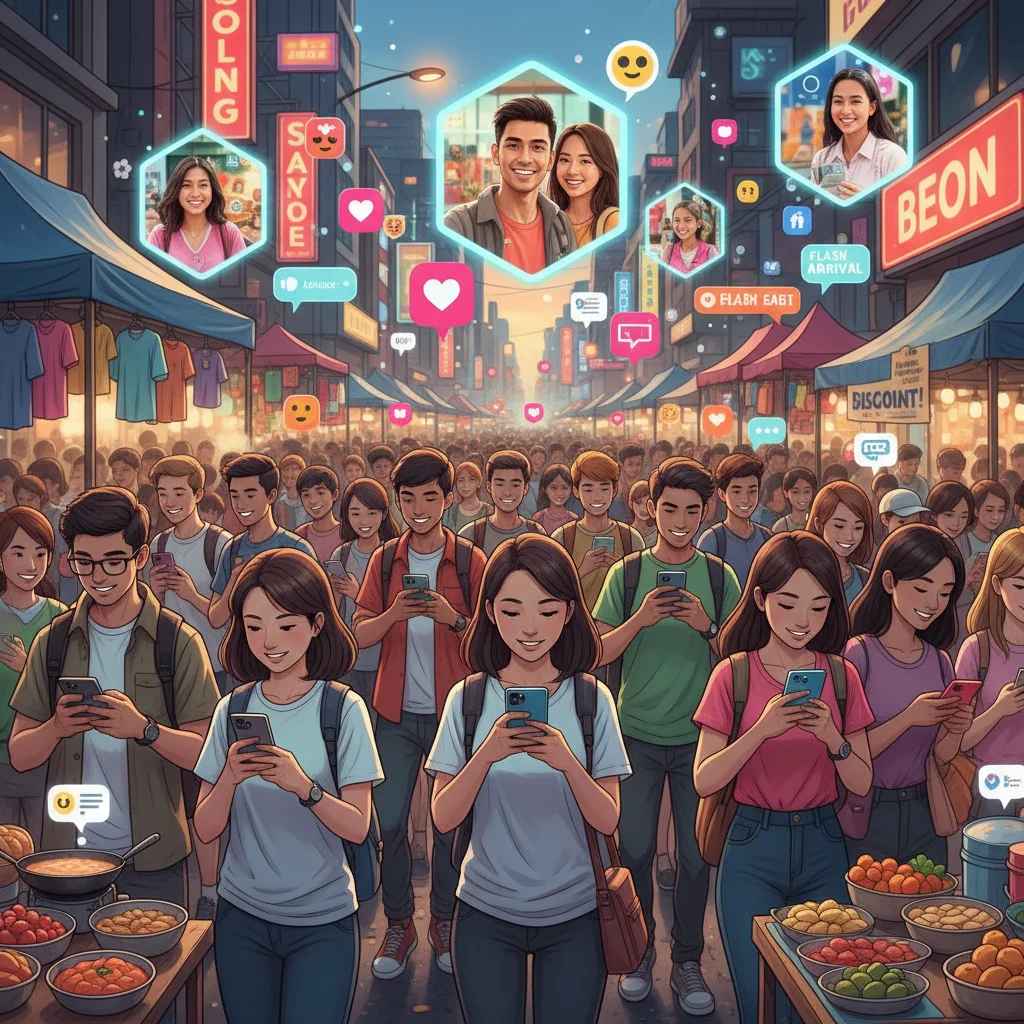
[IMAGE: A modern editorial illustration of South East Asia digital life with people using smartphones in a busy urban market, chat bubbles, social icons, shopping tags, and business messaging elements.]
The key point is not simply that users in the region spend a lot of time online. It is that this time often has direct economic value. Social platforms function as discovery engines, relationship tools, and informal retail channels. In many cases, the same app is used to see a product, ask about it, order it, and track the delivery. That combination helps explain why South East Asia social media behavior has become so central to commerce and influence.
Why this topic requires a slow analysis approach
This is best read as a slow analysis story rather than a breaking-news update. The most important trends are structural: how people communicate on mobile devices, how trust is built through networks, and how social platforms have become embedded in shopping and workplace coordination.
Usage data matters, but mostly as a verification layer. It shows the scale of engagement and helps compare countries and audience groups. The deeper story is the way these habits support a broader digital economy. That includes creator-led discovery, peer recommendations, and the use of messaging tools for business operations. In that sense, this is not only a trend report. It is an audit of regional digital behavior.
Usage remains high, even as the global gap narrows
Across South East Asia, the average social media user spends around three hours per day on social platforms, roughly 35 minutes more than the global average. In 2017, the region was about one hour above the world average, so the gap has narrowed over time. That does not necessarily indicate weaker engagement. It may instead reflect the fact that social media use has increased globally, reducing South East Asia’s relative lead while leaving the region still above average.
[IMAGE: A comparison chart showing average daily social media time in South East Asia versus the global average.]
This baseline matters because it helps explain why social platforms carry so much commercial weight in the region. When usage is frequent and routine, users are more likely to discover products, follow brand updates, and interact with sellers inside the same environment.
Country-level patterns vary, but the overall picture is consistent. Indonesia and the Philippines often stand out for especially intense social activity, while Singapore tends to show more balanced or utility-driven digital behavior. Vietnam and Thailand also show strong platform engagement, though the mix of platforms and content types can differ by age group and city tier.
Gender and audience segments are not evenly distributed
The usage pattern is not uniform across the population. Women in South East Asia spend 22 minutes more per day on social media than men, according to the data cited in the source material. That difference does not prove causation on its own, but it does suggest that some content categories and commerce behaviors are more concentrated among female audiences.
[IMAGE: A segmented audience visualization showing gender-based usage patterns, Gen Z audiences, and beauty-related user groups.]
The gap becomes more pronounced in specific interest groups. Gen Z females spend about 3 hours and 43 minutes per day on social media, while users interested in beauty or cosmetics spend nearly 4 hours a day. These are among the clearest examples of how platform use connects to purchasing behavior. A user following beauty creators is often not only consuming entertainment; they may also be comparing products, watching tutorials, reading comments, and checking offers.
This matters for digital behavior because high-frequency segments often become the earliest adopters of new formats. They are also more likely to respond to creator recommendations, live streams, short-form reviews, and product demonstrations. In markets such as Indonesia, Thailand, and the Philippines, these behaviors can quickly influence wider consumer demand.
Why influencers play a larger role in buying decisions
Influencers matter in South East Asia because they often sit close to the point where discovery becomes decision-making. That is an observation supported by platform behavior, not a claim that influencers replace formal advertising. In practice, users frequently encounter a product first through a creator, a peer comment, or a short video review before they ever visit a brand website.
[IMAGE: An influencer content scene with a phone screen showing product demos, comments, and shopping links.]
This is especially visible in categories such as beauty, fashion, food delivery, consumer electronics, and household goods. A creator’s post may not function as a direct sales pitch, but it can shape consideration by making the product visible, familiar, and socially validated. In that sense, influencer marketing in the region often works as part of a broader discovery process rather than as a standalone channel.
The phrase “layered credibility” is useful as analysis, but the underlying point is simpler: people often trust recommendations that come from someone they follow, know, or see repeatedly. That trust may be based on relatability, consistency, or perceived expertise. It also helps explain why brand discovery on social platforms is often a normal part of the path to purchase in this region.
The pattern is not identical everywhere. In more mature urban markets such as Singapore, consumers may combine creator content with reviews, search, and brand comparison. In Indonesia or the Philippines, social recommendations may play a larger role earlier in the funnel, especially where social commerce interfaces are easier to use than standalone e-commerce browsing.
Social commerce works because discovery and transaction are close together
The strength of social commerce in South East Asia is not only that people are online frequently. It is that discovery and transaction often happen in close proximity. A user can see a product in a post, ask a question in the comments, receive a reply in chat, and complete the purchase without leaving the social environment. That reduces friction, especially on mobile devices where typing, switching tabs, or filling out long forms can be cumbersome.
This is one reason social commerce has been adopted so widely in the region. It fits the way users already behave: short sessions, chat-based interaction, and high trust in peer feedback. On platforms such as Facebook Marketplace, TikTok Shop, and Instagram DMs, the line between content and storefront is thin.
In practical terms, this model benefits small sellers as well as larger brands. A seller in Ho Chi Minh City can use a video post to display inventory, then close the sale through comments or direct messages. A clothing seller in Jakarta may rely on live shopping sessions and chat follow-ups rather than a traditional website. These are not edge cases; they are representative of how commerce is structured in many parts of the region.
That is why social commerce should be understood less as a novelty and more as a retail format adapted to local behavior. The user journey is compressed, but the conversion path is often clearer because it takes place in a familiar social setting.
Platform preferences differ by market
South East Asia is not a single social media market. Platform preference varies by country, which helps explain why regional averages can hide important differences.
Indonesia has been one of the strongest markets for Facebook, Instagram, TikTok, and messaging-based commerce. The Philippines remains deeply social and messaging-heavy, with strong usage of Facebook and Messenger alongside video platforms. Vietnam has shown strong mobile and video engagement, with younger audiences particularly active on short-form content. Thailand combines high social media use with a broad creator ecosystem, especially in lifestyle and entertainment categories. Malaysia tends to show a more mixed pattern across Facebook, Instagram, TikTok, and WhatsApp. Singapore, while highly connected, often shows a more utility-oriented mix, with stronger emphasis on information, professional use, and cross-platform comparison.
[IMAGE: A regional map of Southeast Asia with icons indicating dominant platforms and usage patterns by country.]
These differences matter because they affect how brands communicate. A campaign that works in Thailand may need to be restructured for Vietnam or Singapore. The same is true for commerce flows. In some markets, live video and chat-based selling are effective. In others, users may prefer product research first and transaction later.
WhatsApp Business and the workplace dimension
One of the most important but less visible shifts is the use of messaging tools for work. WhatsApp Business is increasingly part of this landscape because it reduces friction in customer service, sales follow-up, appointment coordination, and informal operations. For many small businesses, the app functions as a lightweight CRM, a support channel, and a payment or order-confirmation workspace.
This is especially relevant in markets where entrepreneurs and microbusinesses operate with limited technical resources. A restaurant can use WhatsApp Business to confirm reservations and share menus. A distributor can send product lists to repeat customers. A clinic or service provider can manage bookings through messages instead of a full web portal. These examples show how social and business communication overlap in everyday practice.
The broader implication is that messaging apps are not only personal tools. They are becoming part of the operational layer of local commerce. That suggests a long-term shift in digital behavior: users increasingly expect fast, chat-based interaction across both consumer and workplace settings. It also helps explain why South East Asia remains a key market for mobile messaging and social-to-business integration.
What the regional pattern suggests
Taken together, the data point to a mature attention economy. High usage time is important, but the more significant story is how that attention gets converted into economic activity. In South East Asia, social platforms support discovery, comparison, purchase, and support in a way that is often more integrated than in markets where social media and commerce remain more separate.
The regional differences also matter. Countries with stronger creator ecosystems may see faster adoption of social shopping. Markets with more messaging-based coordination may rely more on WhatsApp Business and similar tools. More affluent or professionally oriented markets may use social platforms in a more segmented way, but they still participate in the same overall shift toward platform-based communication.
For advertisers, retailers, and workplace tool providers, the implication is straightforward: in South East Asia, social media is not only a channel for attention. It is part of the infrastructure through which attention becomes commerce and coordination. That is why the region continues to over-index on influencer relevance, brand discovery, and messaging-based business use.
Conclusion
South East Asia social media habits are best understood as a structural feature of the region’s digital economy. Users spend substantial time on social platforms, but the more important story is how those platforms are used: to discover products, evaluate recommendations, communicate with sellers, and organize work.
That pattern is visible across countries, though not in identical form. It is stronger in some segments, such as Gen Z women and beauty-related audiences, and it shows up in different ways across Indonesia, the Philippines, Vietnam, Thailand, Malaysia, and Singapore. The common thread is the same: social media is no longer just entertainment. In South East Asia, it is a daily interface for commerce, trust, and coordination.