South Asia’s Growth Paradox: Why More Industrial Policy Isn’t Creating More
The World Bank’s April 2026 South Asia Economic Update reveals a region
South Asia’s Growth Paradox: Why More Industrial Policy Isn’t Creating More Jobs
April 8, 2026 — South Asia stands at an inflection point. Growth is decelerating from 7.0% in 2025 to 6.3% in 2026 (World Bank, South Asia Economic Update, April 2026), yet the region is deploying industrial policies at roughly twice the frequency of other emerging economies. The disconnect between policy intensity and employment outcomes demands rigorous examination.
Introduction: The Slowing Engine and the Policy Paradox
The World Bank’s April 2026 update documents a region buffeted by global energy market disruptions. Growth moderation is projected across all major economies, though a recovery to 6.9% is anticipated by 2027 (Source 1: [Primary Data]). The policy response, however, reveals a structural anomaly: South Asia’s industrial policy frequency—measured by interventions per capita—exceeds comparable emerging market benchmarks by approximately 100%, yet the region’s employment elasticity of growth remains stagnant.
The central analytical question emerges: why does a higher density of intervention fail to produce commensurate labor market outcomes? The answer lies in sectoral targeting mismatches and implementation deficits.
1. The Global Headwinds: Energy, Tariffs, and Resilience
The 2026 growth deceleration is primarily attributable to global energy market disruptions—a structural vulnerability for net-importing economies in the region. India, representing approximately 80% of South Asian GDP, anchors the regional trajectory through robust domestic demand, recent tariff liberalization measures, and the newly concluded Free Trade Agreement with the European Union. These buffers, however, are not uniformly distributed.
Bangladesh and Nepal face elevated external risks, while Sri Lanka’s economic recovery remains complicated by climate shocks, most notably Cyclone Ditwah (Source 1: [Primary Data]). Johannes Zutt, World Bank Vice President for South Asia, identifies cross-cutting policy imperatives: “Countries need to implement critical policy reforms to sustain growth, create jobs, and increase resilience to shocks. Cross-cutting policies to improve public infrastructure, remove trade barriers, foster business-enabling environments, and mobilize private capital can diversify sources of growth” (Source 2: [Direct Quote]).
This framing suggests that the current industrial policy apparatus operates in parallel to, rather than in coordination with, broader structural reform agendas.
2. The Industrial Policy Overdrive: Quantity Over Quality
Empirical analysis within the World Bank report reveals a troubling pattern: South Asia directs approximately half of its industrial policy instruments toward the manufacturing sector. Yet the outcomes challenge conventional assumptions about policy efficacy.
Import-restricting measures—tariffs, non-tariff barriers, and local content requirements—were associated with statistically significant declines in import volumes. Critically, these same measures failed to generate corresponding export expansion. Export-promoting policies (subsidies, tax incentives, export processing zones) showed no statistically significant association with increased export performance (Source 1: [Primary Data]).
This asymmetry points to a design or implementation gap. Franziska Ohnsorge, World Bank Group Chief Economist for South Asia, contextualizes the failure: “South Asia’s mixed success on industrial policy in part reflects the region’s limited implementation capacity, fiscal space, and market size in some countries” (Source 2: [Direct Quote]).
The implication is clear: policy volume does not substitute for policy quality. The region’s industrial policy architecture exhibits a systematic bias toward protectionist instruments that contract trade rather than instruments that enhance competitiveness.
3. The Missing Job Creator: Why Services Are Overlooked
The most critical misalignment in South Asia’s industrial policy framework concerns sectoral focus. Services constitute the largest non-agricultural employment source across the region, contributing disproportionately to job creation relative to manufacturing. Yet industrial policy instruments systematically bypass this sector.
The World Bank data indicates that services receive minimal targeted policy attention despite their demonstrated capacity for labor absorption at scale. This omission carries structural consequences: manufacturing, while capital-intensive and high-productivity, has limited employment elasticity in South Asia’s current development stage. Services—particularly tradable services in information technology, business process outsourcing, logistics, and professional services—offer higher employment multipliers with lower capital intensity.
The policy mismatch explains a persistent paradox: high rates of intervention coinciding with stagnant employment-to-population ratios. Governments pursue manufacturing-led transformation strategies calibrated for earlier industrial epochs, while the actual employment dynamics of the region increasingly depend on service sector expansion.
4. Recalibrating the Policy Mix: From Intervention to Enablement
Ohnsorge offers a pathway beyond the current impasse: “While broad-based reforms remain the priority, well-calibrated industrial policies could address specific market failures, including through measures such as industrial parks, skill development programs, market access assistance, and improving export quality standards” (Source 2: [Direct Quote]).
This formulation distinguishes between generic intervention and targeted enablement. Industrial parks address coordination failures in land and infrastructure provision. Skill development programs correct labor market information asymmetries. Market access assistance and quality standard improvements address export readiness gaps that constrain participation in global value chains.
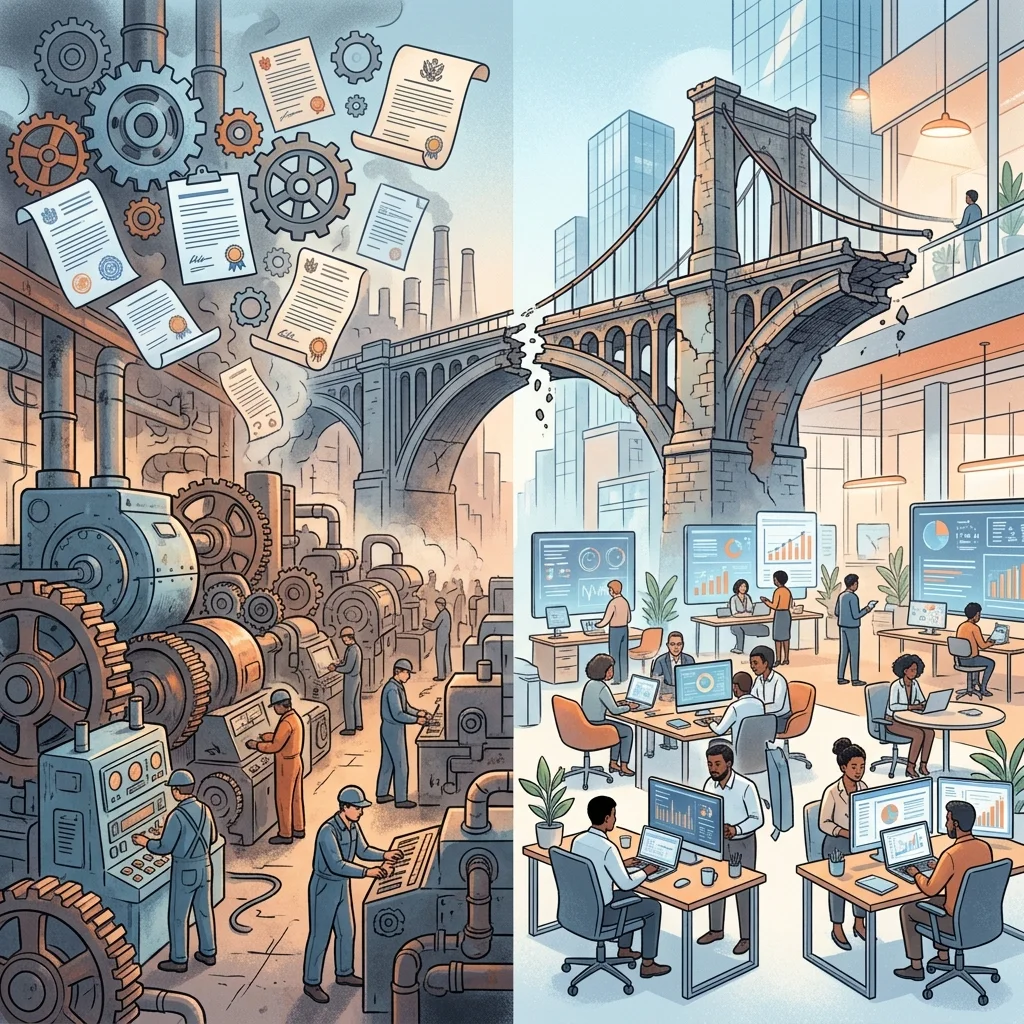
The shift implied is from a defensive industrial policy—focused on import substitution and domestic market insulation—to an offensive industrial policy—focused on competitiveness enhancement and global market integration.
Outlook: The Path to 2027 and Beyond
Projections indicate a growth recovery to 6.9% by 2027, contingent on stabilization of global energy markets and sustained domestic demand (Source 1: [Primary Data]). However, the composition of growth matters more than the aggregate figure. A growth trajectory driven by services expansion and trade integration will generate structurally different employment outcomes than one dependent on capital-intensive manufacturing subsidies.
Three trends warrant monitoring for the medium term:
First, the India-EU FTA represents a test case for whether trade agreements can reorient industrial policy toward export competitiveness. If India’s manufacturing exports demonstrate measurable improvement, the model may prove replicable for smaller economies in the region.
Second, the fiscal space constraints identified by Ohnsorge will intensify as debt servicing costs rise. Countries with limited fiscal capacity—including Bangladesh and Nepal—may need to prioritize regulatory reform over fiscal interventions.
Third, climate adaptation costs, as evidenced by Sri Lanka’s cyclone exposure, will increasingly compete with industrial policy spending. The intersection of climate resilience and industrial competitiveness will define policy trade-offs through 2030.
The data from the April 2026 update suggests that South Asia does not need more industrial policy. It needs better targeted, implementation-ready policy that aligns with the actual structure of its labor market—one in which services, not manufacturing, hold the key to employment generation.