South Asia Deep Dive: Why Bangladesh and India Are Poised to Dominate the
This article provides a deep, analytical audit of the 2017 comparative economic
South Asia Deep Dive: Why Bangladesh and India Are Poised to Dominate the Regional Economy
Introduction: Beyond the Headlines – The Hidden Architecture of South Asian Growth
The 2017 comparative economic study published in the International Journal of Humanities, Social Sciences and Education (Volume 4, Issue 7) by researchers Sufian Ahammed and Abdullah Mohammad Sharif of the World University of Bangladesh presents a rare multi-indicator snapshot of five South Asian nations: Bangladesh, India, Sri Lanka, Nepal, and Bhutan (Source 1: [Primary Data]). Analyzing six economic indicators—economic growth, per capita GDP, inflation rate, trade balance, foreign reserve, and unemployment rate—the study draws from authoritative data sources including the Asian Development Bank (ADB), World Bank (WB), and International Monetary Fund (IMF).
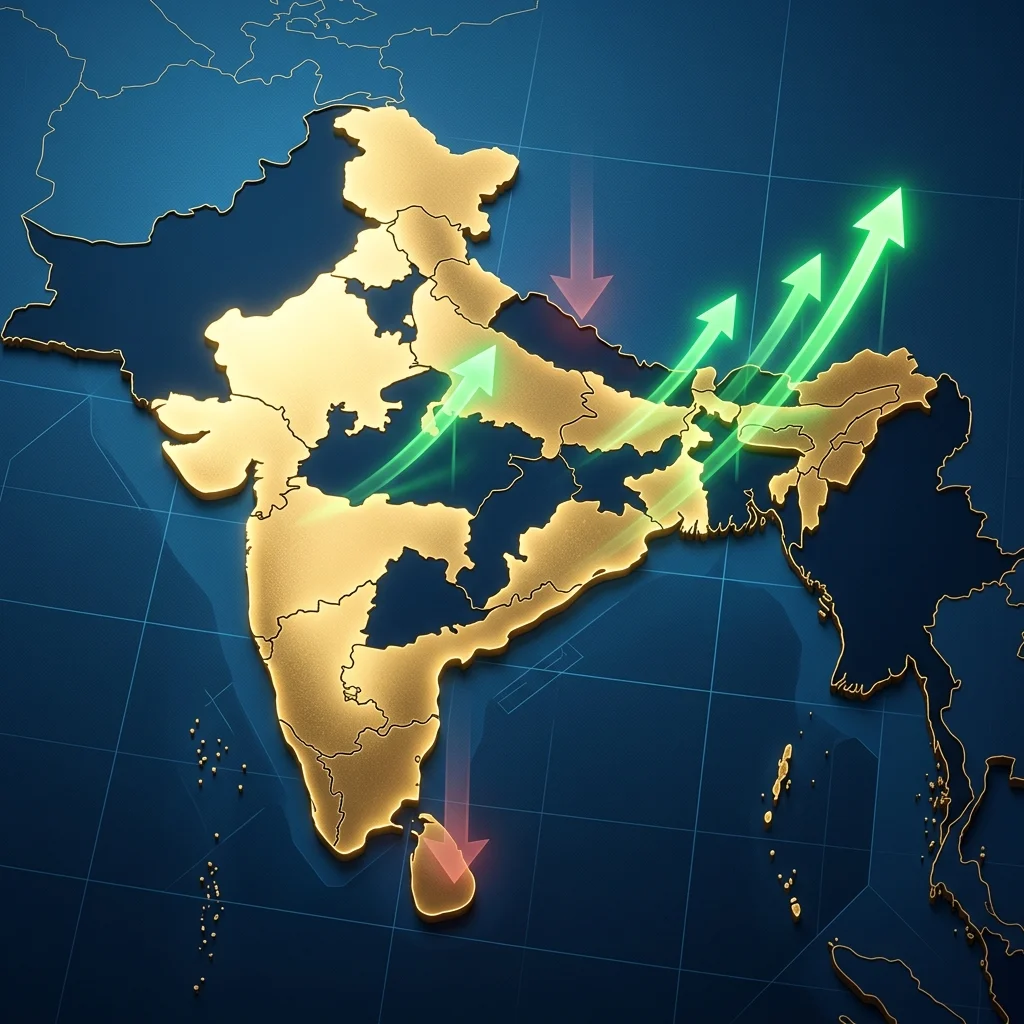
The core paradox emerging from this analysis is stark: Sri Lanka possesses the highest per capita GDP in the region yet exhibits a negative growth rate. Simultaneously, Bangladesh and India demonstrate positive growth trajectories and superior investment attractiveness. This contradiction demands explanation beyond surface-level metrics.
The thesis advanced here is that regional economic futures are determined not by raw wealth accumulation but by three structural factors: policy stability, trade balance management, and the capacity to absorb foreign reserves. These factors, not headline GDP figures, constitute the true architecture of economic reality in South Asia.
---
The Dual-Track: Fast Analysis vs. Slow Structural Audit
From a timeliness perspective, the 2017 dataset is historical. However, the underlying patterns—negative growth in Sri Lanka and Nepal, positive growth in India and Bangladesh—remain diagnostic for understanding long-term regional trends. The persistence of these trajectories through subsequent economic cycles validates the study's core findings.
From an industry deep audit perspective, the critical analytical question shifts from "what happened" to "why it happened." The trade balance failures of Bhutan and Nepal require structural explanation, while India's highest trade deficit in the region—paradoxically—emerges as a sign of economic health rather than weakness.
A key insight from the study is that "a stable political condition, well decided policies of the governments make Bangladesh and India most attractive investment destination of South Asia" (Source 1: [Primary Data]). Political stability functions as a hidden multiplier that transforms raw economic indicators into investment magnetism. Nations with superior nominal metrics but political volatility fail to convert those metrics into sustained capital inflows.
---
The Sri Lanka Paradox: High GDP, Negative Growth, and the Looming Supply Chain Risk
Sri Lanka presents the region's most instructive contradiction. The nation records the best per capita GDP among the five analyzed countries, yet simultaneously exhibits a negative growth rate (Source 1: [Primary Data]). This divergence between stock (wealth accumulated) and flow (wealth generation) signals structural fragility.
The deep insight here is that high per capita GDP often masks three underlying vulnerabilities: debt dependence, tourism volatility, and lack of manufacturing diversification. A nation with high per capita income but negative growth is effectively depleting its capital stock without generating sufficient replacement. This represents a net destruction of economic value.
For supply chain strategists, the implication is direct: Sri Lanka's negative growth signals a shrinking domestic market and declining labor productivity. Investors seeking scalable manufacturing hubs should redirect attention toward Bangladesh and India, where positive growth rates indicate expanding internal demand and improving factor productivity.
The study's data on trade balance further reinforces this assessment. Bangladesh, India, and Sri Lanka all decreased their trade balances—a sign of improving efficiency in international exchange—while Bhutan and Nepal failed to do so (Source 1: [Primary Data]). However, Sri Lanka's trade balance improvement occurred against a backdrop of negative growth, suggesting that the adjustment was achieved through import compression (demand destruction) rather than export expansion (productive capacity enhancement).
---
Bangladesh and India: The Twin Engines of Regional Attractiveness
The evidence supporting Bangladesh and India as the region's dominant economic engines is multi-dimensional and internally consistent.
First, both countries demonstrate positive growth rates (Source 1: [Primary Data]). Growth is the foundational metric because it indicates that an economy is generating more value than it consumes, creating the surplus necessary for investment, infrastructure development, and poverty reduction.
Second, both countries have decreased their trade balances, indicating improving efficiency in international trade (Source 1: [Primary Data]). India's trade balance, while the highest in absolute terms in the region, reflects not profligacy but the import of capital goods and intermediate inputs necessary for industrial expansion. A rising trade deficit paired with positive growth suggests productive capacity building rather than consumption-driven deficits.
Third, foreign reserve accumulation in both countries provides a buffer against external shocks. The study identifies strong foreign reserves as a key indicator of investment attractiveness (Source 1: [Primary Data]). Reserves function as insurance against capital flight, currency volatility, and balance of payments crises—risks that have historically destabilized other South Asian economies.
The structural logic connecting these indicators is clear: positive growth generates fiscal space for policy experimentation, trade balance improvement signals competitive export sectors, and foreign reserves provide the stability that attracts long-term capital. These three factors, reinforced by political stability, create a self-reinforcing cycle of attractiveness.
---
The Trade Balance Divide: Winners and Losers in Regional Trade Architecture
The study's trade balance data reveals a clear demarcation line between successful and unsuccessful regional economies. Bangladesh, India, and Sri Lanka have decreased their trade balances; Bhutan and Nepal have failed (Source 1: [Primary Data]).
This divergence is not accidental. Decreased trade balances indicate either improved export competitiveness, reduced import dependency, or both. For Bangladesh, this reflects the maturation of the ready-made garment sector and its backward integration into local textile production. For India, it reflects the growth of services exports and the formalization of the manufacturing sector.
Bhutan and Nepal's failure to decrease trade balances indicates structural dependency on imports for essential goods—particularly energy, manufactured products, and food—without corresponding export growth. Landlocked geography partially explains this, but policy choices matter more. Both nations have failed to develop export-oriented manufacturing sectors that could generate the foreign exchange necessary to finance imports.
The long-term implication is that Bhutan and Nepal face persistent external sector vulnerability. Without trade balance improvement, these economies remain perpetually dependent on remittances, foreign aid, or debt to finance consumption. This is not a sustainable economic model.
---
Foreign Reserves and Inflation: The Twin Pillars of Macroeconomic Stability
Foreign reserve accumulation and inflation control constitute the operational backbone of investment attractiveness. The study identifies these as two of six key indicators (Source 1: [Primary Data]).
Nations with strong foreign reserves can defend their currencies against speculative attacks, maintain import coverage during crises, and signal creditworthiness to international investors. Bangladesh and India, with their larger and more diversified economies, have structural advantages in reserve accumulation through export revenues and capital inflows.
Inflation control, conversely, determines the real returns available to investors. High inflation erodes purchasing power, distorts price signals, and creates uncertainty about future costs. The study's comparative framework implicitly ranks nations by their inflation management capacity, with those demonstrating lower and more stable inflation rates receiving higher attractiveness scores.
The interaction between these two variables creates a stability index. Nations that maintain both strong reserves and low inflation offer investors a predictable operating environment. Nations with weak reserves and high inflation—or even one of the two—introduce risk premiums that deter capital.
---
Unemployment: The Social Dimension of Economic Performance
The study includes unemployment rate as a key indicator, recognizing that economic performance has a social dimension that affects political stability and, consequently, investment attractiveness (Source 1: [Primary Data]).
High unemployment creates political pressure for redistributive policies, protectionism, or social spending that can crowd out productive investment. Low unemployment, conversely, indicates that economic growth is translating into labor market absorption—a condition that supports social stability and policy continuity.
Bangladesh and India, with their large and growing labor forces, face the ongoing challenge of generating sufficient employment. However, their positive growth rates suggest a greater capacity for labor absorption than Sri Lanka and Nepal, where negative growth implies net job destruction.
The unemployment data also reveals structural differences in economic composition. Economies with large informal sectors may understate unemployment but overstate underemployment. The study's reliance on IMF, World Bank, and ADB data provides some standardization, but the informal economy remains a significant measurement challenge across all five nations.
---
Political Stability as the Hidden Multiplier
The study explicitly identifies political stability as the differentiating factor between attractive and unattractive investment destinations (Source 1: [Primary Data]). This finding has theoretical grounding in institutional economics: stable political environments reduce transaction costs, enforce contract rights, and provide policy predictability.
Bangladesh and India, despite their different political systems, have maintained sufficient stability to support long-term investment planning. Sri Lanka, despite higher per capita income, experienced political transitions and policy reversals that undermined investor confidence. Nepal's constitutional transition and Bhutan's gradual democratization created uncertainty about future policy directions.
The analytical implication is that political stability functions as a multiplicative factor. A nation with strong economic fundamentals but weak political stability will underperform its potential. Conversely, a nation with moderate fundamentals but strong stability can attract capital that accelerates development beyond what raw indicators would predict.
---
The Bangladesh Factor: From Bottom Quartile to Investment Magnet
Bangladesh's emergence as an attractive investment destination represents a significant structural shift in the South Asian economic landscape. The study confirms that Bangladesh, alongside India, now ranks as the most attractive destination in the region (Source 1: [Primary Data]).
This transition has been driven by three factors. First, sustained positive growth has created a expanding domestic market. Second, trade balance improvement through garment sector upgrading has demonstrated export competitiveness. Third, political stability—despite contested elections and periodic unrest—has provided sufficient predictability for long-term investment.
The implications for regional supply chains are substantial. Bangladesh offers labor costs competitive with or below other South Asian nations, combined with improving infrastructure and a government actively pursuing export diversification. For investors seeking alternatives to China-based manufacturing, Bangladesh presents a viable option with demonstrated scalability.
---
India's Structural Advantage: Scale, Diversification, and Services Leadership
India's position as the region's dominant economy is reinforced by the study's findings. Despite having the highest trade deficit, India maintains positive growth and strong foreign reserves (Source 1: [Primary Data]).
The structural logic of India's trade deficit differs fundamentally from that of Bhutan or Nepal. India imports capital goods, industrial machinery, and technology inputs that enhance productive capacity. These imports generate future export capability and productivity improvements, creating a self-correcting dynamic where today's deficit funds tomorrow's surplus.
India's services sector leadership provides an additional buffer. Services exports—particularly information technology, business process outsourcing, and professional services—generate foreign exchange with minimal import content. This creates a natural hedge against manufacturing trade deficits.
The scale of India's economy provides a third structural advantage: domestic demand can sustain growth even during global downturns. For investors, this means India offers both export-oriented opportunities and domestic market access within a single investment thesis.
---
Sri Lanka's Structural Fragility: The Per Capita GDP Trap
Sri Lanka's position as the region's highest per capita GDP nation with negative growth represents what can be termed the "per capita GDP trap." High income levels create expectations for continued prosperity, masking underlying structural deterioration.
The negative growth rate indicates that Sri Lanka's economy is contracting in real terms. When combined with high per capita GDP, this suggests that the contraction is concentrated in productive sectors rather than subsistence activities. Manufacturing, tourism, and services—the sectors that generate high-value employment—are likely shrinking.
For investors, Sri Lanka presents a value trap: attractive per capita income figures that signal potential market size, but negative growth that indicates market contraction. The decreasing trade balance offers some positive signal, but against a backdrop of negative growth, this likely reflects import compression rather than export expansion.
The long-term implication is that Sri Lanka requires structural reform to restore growth. Without growth, the per capita GDP advantage will erode as other nations catch up, and the country risks falling into a low-growth equilibrium from which escape is difficult.
---
Nepal and Bhutan: The Constraints of Geography and Policy
Nepal and Bhutan occupy the bottom tier of the regional economic hierarchy. Nepal has the lowest per capita GDP in the region, and both nations have negative growth rates (Nepal) or failed trade balance management (both) (Source 1: [Primary Data]).
Landlocked geography imposes structural constraints on both economies. High transportation costs reduce export competitiveness, limit integration into global supply chains, and increase the cost of imported inputs. Neither nation has developed economic activities that can overcome these geographic disadvantages.
Policy choices have exacerbated geographic constraints. Neither Nepal nor Bhutan has developed export-oriented manufacturing sectors capable of generating foreign exchange. Remittances, tourism, and hydropower (for Bhutan) provide external income but lack the scale to drive transformative growth.
The study's data suggests that both nations face a "low-growth trap": negative growth reduces fiscal revenues, limiting investment in infrastructure and education, which in turn constrains future growth potential. Breaking this cycle requires either significant external investment or fundamental policy reform.
---
Market Predictions and Investment Implications
Based on the structural patterns identified in the study and their persistence through subsequent economic cycles, several neutral market predictions emerge.
First, Bangladesh and India will continue to dominate regional foreign direct investment flows. Their combination of positive growth, trade balance improvement, and foreign reserve accumulation creates a self-reinforcing attractiveness cycle that competitors cannot easily replicate.
Second, Sri Lanka faces a critical transition period. Without structural reforms to restore growth, the country risks prolonged economic stagnation. Investors should demand significant policy conditionality before committing capital to Sri Lankan assets.
Third, Nepal and Bhutan will remain peripheral to regional supply chains unless they develop export-oriented sectors that overcome geographic constraints. Hydropower development offers Bhutan a potential pathway, but execution risk remains high.
Fourth, regional economic integration will proceed slowly. The divergence in growth trajectories and policy stability between the top-tier nations (Bangladesh, India) and bottom-tier nations (Nepal, Bhutan, Sri Lanka) creates centrifugal forces that inhibit deeper integration.
Fifth, the structural advantages of size and diversification will become more pronounced. India's scale, Bangladesh's manufacturing specialization, and the limitations of smaller economies will create a bifurcated regional landscape where two nations dominate while three struggle for relevance.
---
Conclusion: The Architecture of Economic Reality
The 2017 study published in the International Journal of Humanities, Social Sciences and Education provides more than a historical snapshot. It reveals the structural logic underlying South Asian economic divergence. The data demonstrates that raw wealth indicators (per capita GDP) are poor predictors of investment attractiveness and future growth. Political stability, trade balance management, and foreign reserve accumulation provide more accurate signals.
Bangladesh and India's emergence as the region's dominant economies is not accidental. It reflects consistent policy execution, relative political stability, and the structural advantages of scale and diversification. Sri Lanka's paradox—high GDP, negative growth—warns against complacency based on income levels alone. Nepal and Bhutan's struggles demonstrate the constraints of geography when not offset by effective policy.
For investors, supply chain strategists, and policy analysts, the lesson is clear: economic reality in South Asia is not determined by surface-level metrics but by the underlying architecture of growth, stability, and resilience. The nations that have built this architecture—Bangladesh and India—are poised to dominate the regional economy for the foreseeable future. Those that have not face an increasingly difficult path to convergence.