Beyond the $99 Million: How John Deere''s Settlement Unlocks a New Era for
John Deere's landmark $99 million settlement and 10-year repair access commitment
Beyond the $99 Million: How John Deere's Settlement Unlocks a New Era for Right-to-Repair and Agricultural Economics
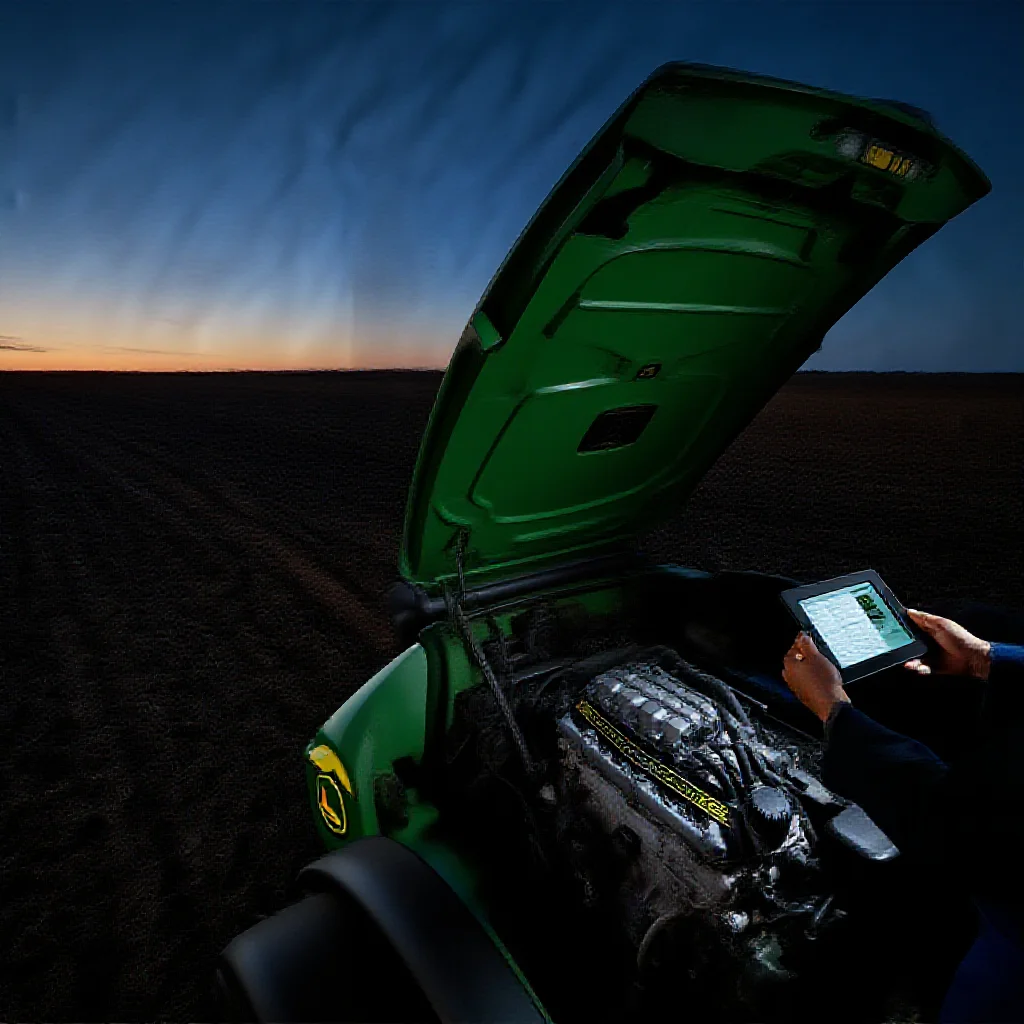
Cover Image Prompt: A dramatic, high-contrast photo of a modern John Deere tractor at dusk, with its hood open. An independent mechanic's hands are visible, holding a diagnostic tablet that illuminates the complex engine components. The scene is set in a vast, empty field under a twilight sky, symbolizing access and openness.
---
On April 9, 2026, Deere & Company announced a resolution to a protracted class-action lawsuit. The agreement comprises two core components: a $99 million settlement fund and a binding commitment to provide customers and independent repair shops with access to its repair tools, software, and documentation for a period of 10 years (Source 1: [Primary Data]). This legal resolution transcends a simple payout; it represents a strategic inflection point for the agricultural technology economy, recalibrating long-standing power dynamics between manufacturer, dealer, and end-user.
The Settlement Decoded: More Than a Payout
The $99 million figure serves as the headline, but its significance is contextual. Analysis requires juxtaposing this sum against the broader economic model of agricultural equipment manufacturing. For a corporation of Deere's scale, the settlement may be framed as a strategic cost of resolving litigation and mitigating regulatory risk, rather than a punitive penalty. The more consequential element is the decade-long access window. A 10-year commitment aligns strategically with the product lifecycle of major agricultural equipment. It effectively covers the primary productive lifespan of a tractor or combine for a single owner, addressing the core period of repair need and planned obsolescence pressure. This moves the right-to-repair dispute from the court of public opinion into a binding, enforceable legal framework, setting a measurable precedent for performance.
Image Suggestion: An infographic breaking down the $99 million figure relative to John Deere's annual parts and service revenue.
The Hidden Economic Logic of the 'Repair Monopoly'
The litigation's viability was rooted in a quantifiable economic logic. Manufacturers have historically derived significant, high-margin revenue from being the sole source for proprietary diagnostic software, specialized tools, and firmware updates. This creates a de facto repair monopoly channeled through authorized dealerships. The economic pressure on farmers is not merely the cost of parts, but the cost of downtime. When a critical machine fails during a narrow planting or harvest window, the inability to access timely, affordable repair from an independent technician translates directly into substantial revenue loss. The settlement's provision for independent repair access disrupts this monopoly, introducing competition into the service ecosystem. The logical deduction is a potential reduction in the long-term total cost of equipment ownership, as repair options diversify.
Image Suggestion: A comparative chart showing estimated repair cost curves for dealer-only service vs. independent shop access over a tractor's lifespan.
The 10-Year Commitment: A Deep Audit of Long-Term Impacts
The commitment to provide "documentation" alongside tools and software is a critical variable for achieving true repair parity. Comprehensive service manuals and wiring diagrams enable effective knowledge transfer, elevating independent technicians from parts-swappers to true diagnosticians. This access could act as an innovation catalyst, spurring a secondary market for compatible diagnostic tools and third-party replacement components, mirroring the explosion of the automotive aftermarket following the standardization of OBD-II systems. The supply chain ripple effects will be multifaceted: dealership service departments may face increased competition, potentially driving service innovation and pricing adjustments. Conversely, parts distributors and technical training programs may expand to serve a newly legitimized independent repair sector.
Image Suggestion: A timeline graphic projecting the potential evolution of the agricultural repair ecosystem over the next 10 years.
The Broader Battlefield: Right-to-Repair as an Industry Inflection Point
Agriculture has served as a leading edge for the right-to-repair movement due to the high stakes of equipment functionality and operator self-reliance. John Deere, as a dominant market leader, functions as an industry bellwether. Its agreement to a structured access model provides a tangible template for other sectors embroiled in similar conflicts, including consumer electronics, medical equipment, and automotive. The settlement's terms may also influence the trajectory of legislation. By establishing a private-sector benchmark—a 10-year access window—the agreement could pre-empt more stringent or prescriptive state or federal right-to-repair laws, offering a model that other manufacturers might adopt to achieve regulatory compliance.
Image Suggestion: A conceptual map linking the agricultural settlement to parallel right-to-repair debates in electronics, medical tech, and automotive sectors.
Neutral Market Predictions
The long-term implications will unfold across several axes. Farm operational economics may see a gradual shift as repair cost inflation moderates. The independent repair sector for agricultural machinery is predicted to formalize and expand, creating new small business opportunities. Equipment design may incrementally evolve, as manufacturers balance proprietary innovation with the new expectation of external serviceability. Finally, the settlement establishes a measurable precedent: a decade of access is now a documented industry benchmark. This quantitative concession will serve as a reference point in future negotiations, legal challenges, and policy discussions across the global technology landscape, permanently altering the calculus of repair.