Beyond UNCAC: How Institutional Combinations Drive Corruption in South Asia
A recent study published in Humanities and Social Sciences Communications
Beyond UNCAC: How Institutional Combinations Drive Corruption in South Asia – A Deep Dive into fsQCA Findings
Introduction: The Corruption Paradox in South Asia
Every South Asian country—from India and Pakistan to Bangladesh, Nepal, Sri Lanka, Bhutan, and the Maldives—has ratified the United Nations Convention against Corruption (UNCAC). Yet public sector corruption levels across the region remain strikingly divergent. In India, corruption drains welfare spending and erodes trust; in Bangladesh, it cripples public service delivery; and across Bangladesh, India, and Nepal, corruption fuels human trafficking networks. The paradox is plain: a shared legal commitment to anti-corruption has not produced shared outcomes.
A study published on 6 February 2025 in Humanities and Social Sciences Communications (volume 12, article number 148) tackles this puzzle head-on. Rather than asking which single factor causes corruption, the researchers investigate how different combinations of political and economic institutions work together to either enable or curb public sector corruption. Using two-step fuzzy-set qualitative comparative analysis (fsQCA), they identify specific causal recipes that explain why corruption persists in some contexts while being contained in others.
[IMAGE: A bar chart comparing Corruption Perceptions Index scores for South Asian countries, with a timeline overlay marking UNCAC ratification dates.]
Why Traditional Approaches Fall Short: The Need for Configurational Analysis
Conventional regression-based methods test the average effect of individual variables—such as “democracy reduces corruption” or “better e-governance lowers bribery.” But these approaches assume that factors operate independently and uniformly across contexts. In reality, institutions interact. A strong parliament may reduce corruption in one setting, but in another, it may be irrelevant if the judiciary is weak or e-governance is absent.
fsQCA overcomes this limitation by treating conditions as combinations rather than isolated causes. It identifies necessary conditions (those that must be present for corruption to occur) and sufficient conditions (those that, by themselves, can produce corruption). More importantly, it reveals causal recipes—configurations of political and economic institutions that together lead to either high or low corruption.
The study employs a two-step fsQCA design. The first step separates “remote” (structural) conditions—such as the type of political system or the level of external audit integrity—from “proximate” (policy) conditions—such as e-governance adoption or budget transparency. This distinction allows the researchers to see how deeper structural factors set the stage for policy interventions to succeed or fail.
[IMAGE: A Venn diagram with overlapping circles labelled 'Political Institutions', 'Economic Institutions', and 'Corruption', highlighting the intersection where causal combinations emerge.]
Key Findings: Causal Recipes for Public Sector Corruption
The analysis yields several distinct pathways that lead to high corruption in the public sector. These are not single-factor explanations but combinations of conditions that reinforce each other.
Pathway 1 – Weak parliamentarism combined with poor e-governance.
In countries where parliamentary oversight is weak—meaning legislatures lack the capacity or independence to hold the executive accountable—and where e-governance systems are underdeveloped (e.g., limited digital service delivery, opaque procurement portals), corruption thrives. The absence of two complementary checks creates a vacuum. Without parliamentary scrutiny, officials face little political risk; without digital transparency, citizens lack the means to monitor transactions.
Pathway 2 – Low external audit integrity coupled with weak democratic governance.
When independent audit institutions—such as supreme audit offices or anti-corruption commissions—lack teeth (e.g., underfunding, restricted access to records, political interference) and when democratic governance is shallow (e.g., curtailed civil liberties, weak rule of law), corruption becomes systemic. Audits are meant to detect irregularities, but if findings are ignored or suppressed, the deterrent effect vanishes. Weak democracy further erodes public accountability.
Pathway 3 – Strong external audit integrity combined with low e-governance.
Surprisingly, the study also finds that strong external audits can be associated with higher corruption if e-governance is simultaneously low. The reasoning: when auditors uncover wrongdoing but no digital system exists to translate their findings into enforceable administrative procedures or public transparency, the revelations remain isolated. Auditors may identify problems, but without digital tools to streamline corrective actions, the corruption persists—or even adapts.
Pathway 4 – High e-governance without complementary democratic institutions.
Even robust e-governance platforms can fail to reduce corruption if they exist in a politically closed environment. Digital portals may list procedures and fees, but without independent media, a free judiciary, or civil society oversight, officials can manipulate or bypass digital systems. The study shows that e-governance is most effective when paired with democratic governance, not as a standalone fix.
Importantly, the researchers also identify configurations associated with low corruption. For instance, strong parliamentary systems combined with high e-governance consistently appear as a recipe for cleaner public administration.
[IMAGE: A simplified infographic showing three causal pathways – e.g., Pathway A: weak parliamentarism + low e-governance → high corruption; Pathway B: low audit integrity + weak democracy → high corruption; Pathway C: strong audit + low e-governance → high corruption.]
Embedded Evidence: The Authors’ Own Words
The study’s authors make their policy recommendations explicit. As they note: “We recommend strengthening e-governance to streamline administrative processes, thereby reinforcing the corruption-reducing effects of parliamentarism.” This statement underscores the core insight: institutions do not operate in isolation. Strengthening one pillar without attending to complementary others can produce disappointing results—or even backfire.
The research also highlights that simply adopting UNCAC provisions is insufficient. The Convention provides a framework, but its effectiveness depends on how well it is embedded within a country’s specific institutional configuration. For example, establishing an anti-corruption agency (a requirement under UNCAC) may reduce corruption only if the agency has genuine independence and if there are digital systems to support its work and democratic channels to amplify its findings.
Policy Implications: What Works, and Under What Conditions
The fsQCA results offer actionable lessons for policymakers, international organisations, and civil society.
1. Strengthen e-governance as a complement to political reforms.
Digital platforms for procurement, tax filing, land registration, and public service delivery reduce discretion and create audit trails. But the study shows they work best alongside strong parliamentary oversight. Governments should invest in both simultaneously.
2. Empower independent audit institutions, but also improve e-governance.
Strong audits can backfire if their findings cannot be translated into systemic fixes. A digital dashboard that tracks audit recommendations, deadlines, and implementation can turn audit reports into real accountability.
3. Deepen democratic governance as a foundation.
E-governance and audits are important, but they are not substitutes for democratic checks and balances. Free media, an independent judiciary, and vibrant civil society create the environment in which transparency tools can actually constrain corruption.
4. Avoid one-size-fits-all prescriptions.
The study demonstrates that the same reform (e.g., setting up a digital procurement portal) can reduce corruption in one country but prove ineffective in another, depending on the broader institutional configuration. Context matters.
Conclusion: Moving Beyond Legal Formalism
The South Asian corruption paradox—universal ratification of UNCAC alongside persisting, uneven corruption—is explained not by a failure of laws but by the complex interplay of political and economic institutions. The fsQCA findings reveal that corruption is not the product of any single cause, but of specific combinations of conditions that reinforce each other.
For policymakers, the message is clear: anti-corruption strategies must be designed as bundles of complementary reforms. Bologna-style legal transplants—simply copying clauses from UNCAC—are unlikely to work. Instead, countries need to identify their own causal recipes and craft interventions that address the missing pieces in their institutional puzzle.
The study also opens new avenues for research. Future work could apply the same two-step fsQCA approach to other regions, or examine how corruption changes over time as institutions evolve. For now, one conclusion stands out: in the fight against public sector corruption, the whole is indeed greater than the sum of its parts—but only when those parts fit together.
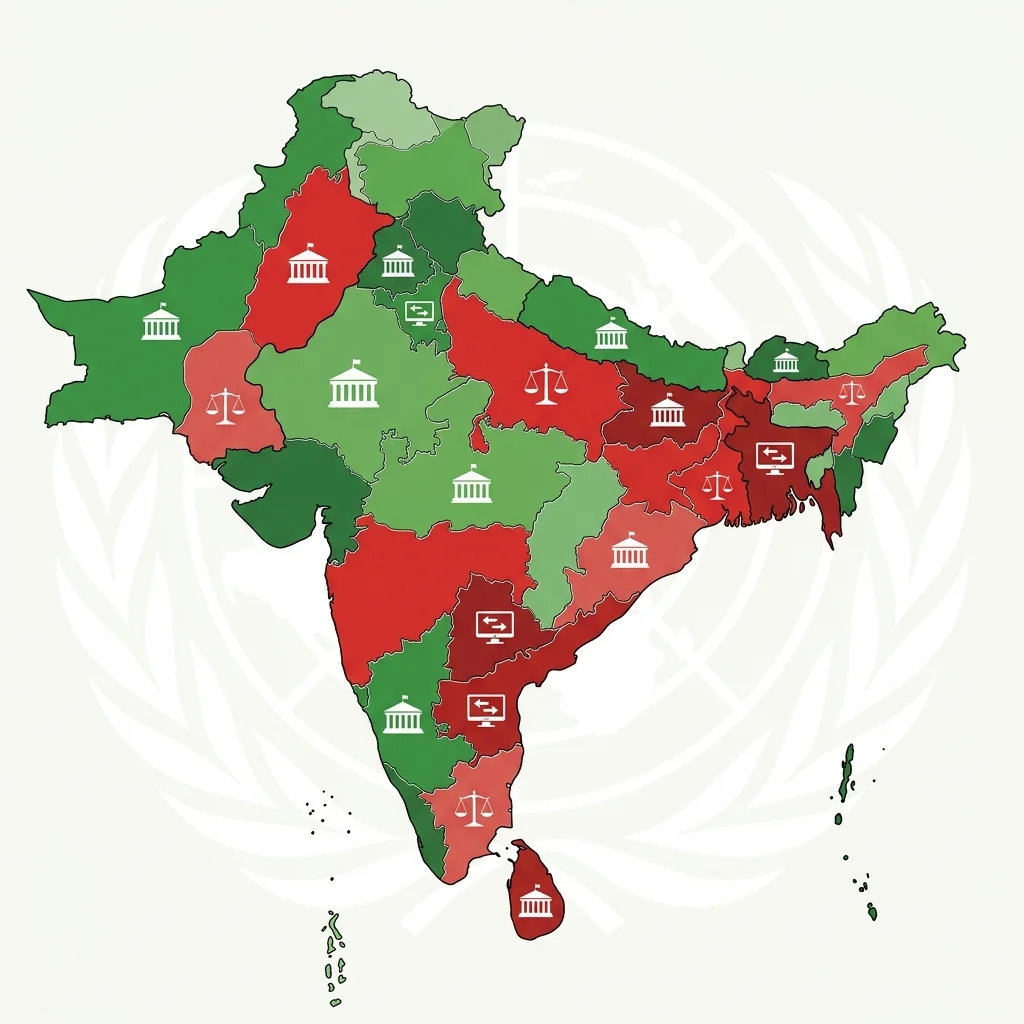
[IMAGE: A stylized map of South Asia with puzzle pieces shaded green (low corruption) and red (high corruption), with icons for parliament, courts, e-governance, and the UN symbol, forming an uneven pattern.]