Beyond Mach 32: How Artemis II''s Re-Entry Tests Are Forging the Future of
The Artemis II mission's re-entry tests at Mach 32 are more than a technical
Beyond Mach 32: How Artemis II's Re-Entry Tests Are Forging the Future of Deep Space Commerce
Article Summary: The Artemis II mission's re-entry tests at Mach 32 are more than a technical milestone for NASA's lunar ambitions. This analysis reveals how the validation of the Orion spacecraft's thermal protection system and avionics serves as a critical stress test for an emerging commercial supply chain. The extreme conditions simulated are not just about returning astronauts from the Moon but are de-risking technologies essential for future high-value cargo return, satellite servicing, and even asteroid mining. This article explores the hidden economic logic behind these tests, positioning them as foundational events that are building confidence, setting performance benchmarks, and catalyzing private investment in the next era of space-based industry.
The Mach 32 Benchmark: More Than a Speed Check
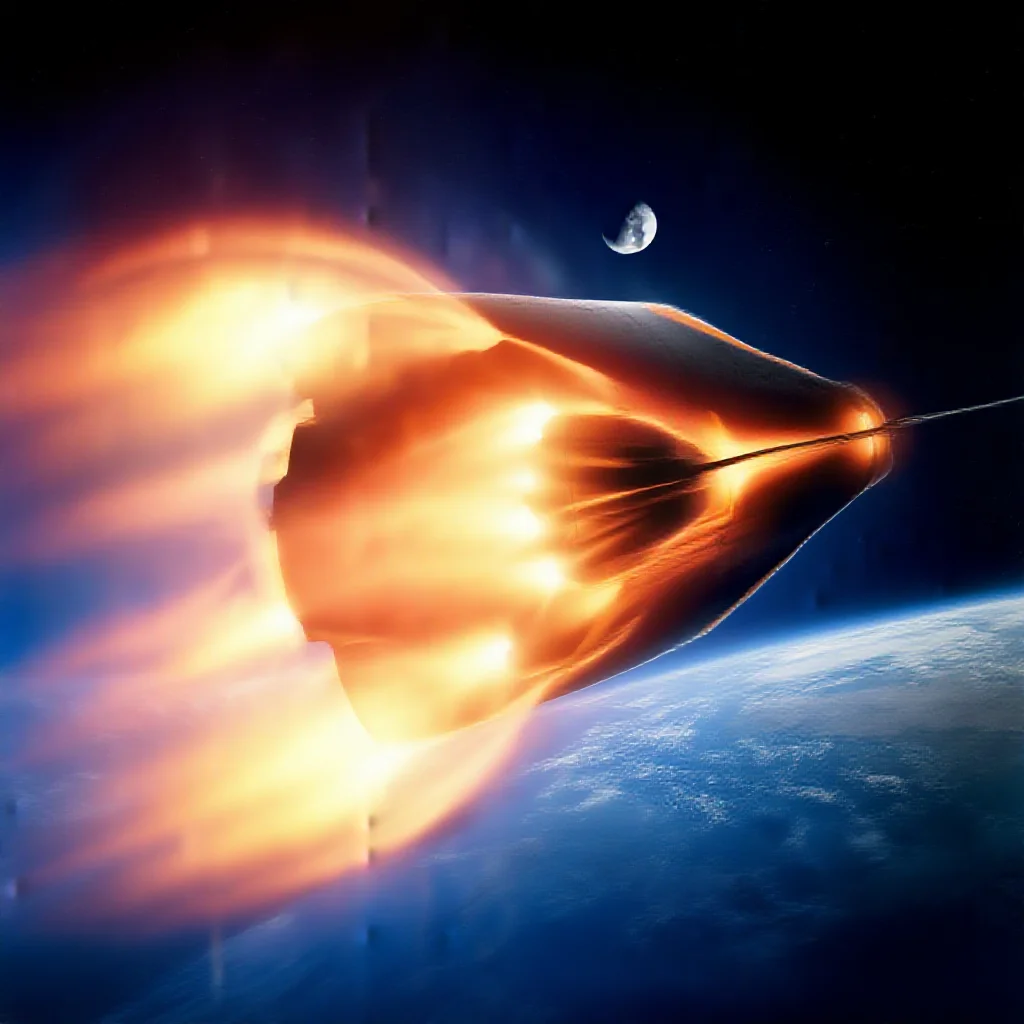
The Artemis II mission, a crewed lunar flyby, includes a critical phase of re-entry testing at approximately Mach 32. This velocity, nearly 32 times the speed of sound, represents the specific energy profile for a spacecraft returning from the Moon (Source 1: [Primary Data]). Unlike re-entries from Low Earth Orbit (LEO), which occur at roughly Mach 25, a lunar return involves a significantly higher kinetic energy conversion into thermal load upon atmospheric interface. The Artemis program's validation of this re-entry corridor is therefore a non-negotiable prerequisite for human lunar return.
The technical benchmark, however, extends beyond the immediate scope of NASA's crewed missions. Mach 32 represents the threshold velocity for any mass—crewed or uncrewed—returning from cislunar space. The successful demonstration of a controlled, intact re-entry at this speed serves as a proxy validation for systems required for any future high-energy return trajectory. This establishes a proven performance envelope that commercial entities can reference, reducing the fundamental physics uncertainty for ventures involving lunar resource return, high-value satellite retrieval, or point-to-point high-speed transport concepts.
De-risking the Deep Space Supply Chain
The core technological element under validation is the Orion spacecraft's thermal protection system (TPS). Its performance is not merely a component success for a single government program. The systematic testing and subsequent public data release on material ablation rates, bonding integrity, and thermal soak characteristics constitute a de-risking event for an entire adjacent commercial sector (Source 1: [Primary Data]).
This government-funded R&D provides a credible, extreme-environment dataset that informs material science and manufacturing standards for private industry. Companies developing lunar landers, which must withstand direct descent engine plumes and lunar night thermal cycles, can derive material insights. Ventures proposing reusable orbital transfer vehicles or high-speed atmospheric entry capsules for cargo return now have a publicly vetted performance baseline. The TPS validation acts as a foundational stress test, shifting key technologies from theoretical models to empirically demonstrated capabilities. This reduction in perceived technological risk is a direct catalyst for investment, as it allows financiers and insurers to model failure probabilities with greater confidence.
Avionics at the Edge: The Data Goldmine from Extreme Re-Entry
Concurrent with TPS validation, the Artemis II re-entry serves as an ultimate test for avionics and guidance, navigation, and control (GNC) systems. The spacecraft's computers, sensors, and software must operate flawlessly while subjected to intense vibration, plasma-induced communication blackout, and extreme thermal gradients. The data harvested from this event is a goldmine for the development of autonomous systems.
The sensor fusion algorithms and fault-tolerant software architectures proven under these conditions have direct commercial applicability. Uncrewed missions requiring precise, autonomous high-speed re-entry for cargo return—such as delivering manufactured goods from orbital facilities or scientific samples from asteroids—will leverage these advancements. The evolution towards resilient, AI-augmented GNC systems for deep-space operations receives a significant validation push from this extreme boundary test. The demonstrated ability to maintain control authority and navigation accuracy during a Mach 32 re-entry sets a new performance standard for the entire industry's autonomous mission profiles.
From Government Program to Market Catalyst
The Artemis II re-entry test exemplifies a government program functioning as a market catalyst through technological de-risking. The mission's schedule is less critical to this analysis than the long-term, spillover effects of its technological demonstrations. The performance data generated creates a rising tide that lifts multiple commercial boats.
The primary beneficiaries extend beyond aerospace prime contractors. Advanced ceramics firms supplying TPS materials gain flight heritage for their products. Sensor manufacturers specializing in radiation-hardened, high-temperature components receive validation. Companies developing high-fidelity computational fluid dynamics and thermal simulation software can calibrate their models against real-world Mach 32 data, improving their commercial product offerings. Furthermore, the established performance parameters will directly influence the actuarial models used by space insurers. Demonstrated reliability of core systems like TPS and avionics under extreme duress will lead to more refined risk assessments and potentially lower premium structures for commercial lunar and deep-space logistics missions.
The Artemis II re-entry is a singular event focused on human safety. Its broader legacy, however, will be measured in the commercial ventures it enables. By proving the feasibility of reliable, high-energy return, it lays a foundational piece of the infrastructure required for a sustainable, economically viable deep-space economy.