India Anchors South Asia’s Growth Amid Global Headwinds: WEF Chief Economists
The World Economic Forum’s January 2026 Chief Economists Outlook reveals
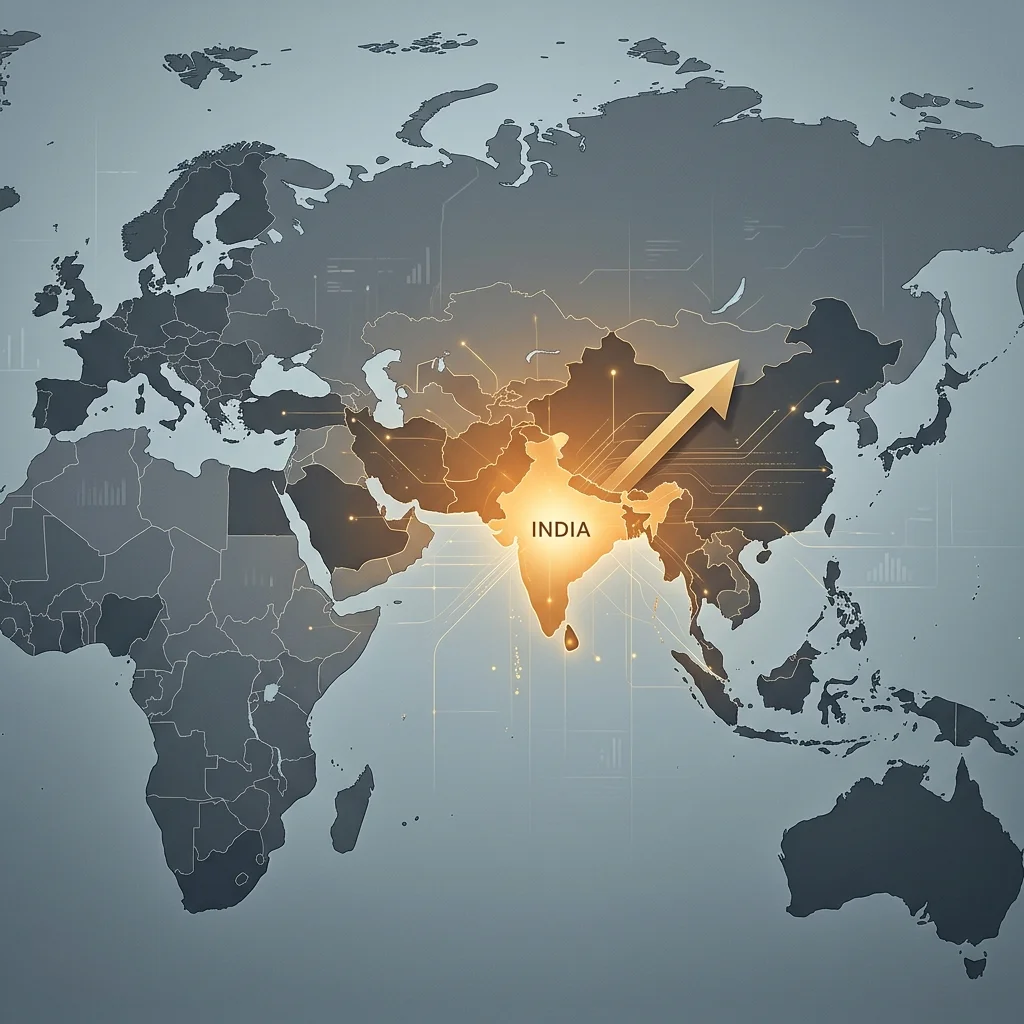
India Anchors South Asia’s Growth Amid Global Headwinds: WEF Chief Economists Outlook 2026
January 16, 2026 — The World Economic Forum’s (WEF) latest Chief Economists Outlook, released ahead of the annual Davos meeting, presents a global economic landscape defined by stark regional divergence. While 53% of chief economists surveyed expect global economic conditions to weaken over the next 12 months, South Asia—led by India—has emerged as the most resilient growth corridor. The report, based on responses from leading economists across public and private sectors, reveals that 66% of respondents now expect strong or very strong growth in South Asia, a dramatic increase from 31% in the previous survey edition (Source: WEF Chief Economists Outlook, January 2026).
The Global Mood Shift: From Panic to Cautious Pessimism
The headline indicator of the survey—the proportion of chief economists expecting global economic weakening—has dropped from 72% in September 2025 to 53% in January 2026. This 19-percentage-point decline signals a stabilization of fear rather than a genuine recovery. The downward trajectory of pessimism indicates that the worst-case recession scenarios widely anticipated six months ago have not materialized, but optimism remains conspicuously absent.
Regional disaggregation reveals the uneven nature of this stabilization:
- Europe remains the weakest major region, with 53% of economists expecting weak growth (Source: WEF Outlook).
- The United States is viewed as a moderate performer, with 69% forecasting moderate growth, reflecting a soft-landing narrative that has gained traction since late 2025.
- East Asia and the Pacific shows strength, with 45% expecting strong growth, partially buoyed by China’s stabilization efforts.
The survey’s trajectory suggests that global economic sentiment has moved from acute recession panic to a state of chronic weakness acceptance—a shift that has profound implications for investment strategies and policy planning.
South Asia’s Bright Spot: Why India’s Fundamentals Matter More Than Trade Noise
The most striking regional finding in the January 2026 Outlook is the 35-percentage-point increase in economists expecting strong or very strong growth in South Asia—from 31% to 66% within approximately four months. Within this category, 60% of respondents expect “strong” growth and 6% anticipate “very strong” growth (Source: WEF Chief Economists Outlook).
India anchors this outperformance. The country recorded 8.2% year-on-year real GDP growth in the September quarter (Q3 2025), accompanied by near-zero inflation—a combination rarely seen in large emerging economies (Source: Government of India data, cited in WEF report). These figures stand in marked contrast to the inflationary pressures and growth deceleration observed in many other emerging markets.
Saadia Zahidi, Managing Director of the World Economic Forum, contextualized this resilience: “South Asia remains the brightest growth spot among emerging regions, with India anchoring the outlook despite mounting trade headwinds.” (Source: WEF press release, January 16, 2026)
The structural logic behind India’s insulation from global headwinds rests on three interconnected fundamentals:
1. Macroeconomic discipline as a buffer. The Reserve Bank of India’s monetary policy stability is critical: two-thirds of economists surveyed expect interest rates to remain unchanged in South Asia, while 85% do not anticipate major shifts in fiscal policy (Source: WEF Outlook). This policy predictability creates a stable environment for capital flows precisely when global volatility is highest.
2. Decoupling through domestic demand. India’s growth composition—heavily weighted toward domestic consumption and services—reduces its vulnerability to external trade shocks. While US tariff policies create headwinds for export-dependent Asian economies, India’s internal market scale (1.4 billion consumers) and rising middle-class spending provide a self-reinforcing growth loop.
3. Inflation control as a competitive advantage. Near-zero inflation in a world where many central banks are still battling sticky price pressures gives India unusual policy flexibility. The Reserve Bank of India can maintain accommodative stances without re-igniting price pressures, unlike peers in Latin America or parts of Southeast Asia.
This combination positions India as a “safe haven” within emerging markets—a designation typically reserved for commodity exporters or low-debt economies, but now applicable to a large manufacturing and services economy.
The AI Paradox: Productivity Boom vs. Job Anxiety
The WEF Outlook reveals a deep tension in how chief economists assess artificial intelligence’s economic impact. Approximately 80% of respondents expect AI-led productivity improvements within two years in the United States and China—the two largest AI investment destinations (Source: WEF Outlook). Yet only 36% anticipate that AI investments will have a significant positive impact on overall growth globally over the same timeframe.
This disconnect between micro-level productivity expectations and macro-level growth impact suggests a structural lag: AI’s benefits are expected to be concentrated in specific sectors and geographies before diffusing broadly.
The labor market implications are more clearly negative in the near term:
- 67% of economists expect modest job losses from AI over the next two years (Source: WEF Outlook).
- 57% foresee net job losses over a decade, while only 32% expect net gains.
- The remaining economists either see no net effect or did not provide an assessment.
The two-year versus ten-year divergence is analytically significant. The fact that a larger share of economists expects net job losses over a decade (57%) than over two years (67% expecting modest losses) suggests that while immediate disruption may be “modest,” the cumulative effects of automation and algorithmic substitution could compound over time. Importantly, the 32% who expect net job gains over a decade represent a minority view—challenging the historical narrative that technological advancement ultimately creates more jobs than it destroys.
Deep insight: The disconnect between AI productivity expectations and growth impact reveals a hidden structural risk. If AI investments in the US and China generate efficiency gains without corresponding demand expansion, the result could be deflationary pressures combined with labor displacement—a scenario for which few central banks or fiscal authorities have adequate policy tools.
Asset Market Signals: Gold’s Peak and Crypto’s Decline
The survey provides telling signals on commodity and digital asset markets:
- 62% of economists expect further declines in cryptocurrencies, reflecting sustained skepticism about digital assets as stores of value or inflation hedges (Source: WEF Outlook).
- Nearly 54% believe gold may have peaked, suggesting that the precious metal’s rally—driven by geopolitical uncertainty and dollar weakness—may be exhausted (Source: WEF Outlook).
These two assessments, when read together, indicate a shift in risk appetite. The gold peak expectation implies that a significant share of economists believe the “safe haven” premium has been fully priced. The crypto decline expectation suggests that the speculative premium on digital assets—already compressed since 2022—has further room to fall. Both signals point toward a normalization of asset pricing, where traditional valuation metrics reassert themselves over narrative-driven trading.
Europe’s Structural Weakness and US Moderation
The survey’s regional assessments paint a picture of three distinct growth tiers:
Europe: The structural laggard. With 53% of economists expecting weak growth, Europe faces compound challenges: energy price decoupling from Russia remains incomplete, industrial competitiveness relative to US and Chinese firms has eroded, and demographic headwinds intensify labor shortages. No other major region received such a concentrated “weak growth” assessment.
United States: Moderate resilience. The 69% forecast for moderate growth reflects a softening economy but not a contraction. The US benefits from AI investment concentration and less exposure to global trade disruptions than export-dependent economies, but fiscal tightening and consumer debt burdens act as brakes.
East Asia and Pacific: Selective strength. The 45% expecting strong growth is driven primarily by technology-exporting economies and those benefiting from nearshoring trends, rather than broad-based regional expansion.
Outlook: The Three Forces Shaping 2026–2027
Based on the WEF survey data and underlying structural dynamics, three forces will determine whether South Asia’s outperformance sustains or erodes:
1. US tariff trajectory. The primary external risk to India’s growth is not a global recession but targeted US tariff actions. If tariff escalation extends to services or digital trade—areas where India has competitive advantages—the growth impact could materialize with a 6-12 month lag, potentially weakening the 2027 outlook.
2. AI investment allocation. The 80% productivity expectation in US and China creates a risk for India if AI-driven efficiency gains concentrate exclusively in those two markets. India’s ability to attract AI-related foreign direct investment and build domestic capabilities will determine whether it captures productivity spillovers or suffers from competitive displacement.
3. Monetary policy synchronization. The two-thirds expectation of unchanged interest rates in South Asia assumes that global inflation remains contained. If energy prices or supply chain disruptions reignite inflation, the Reserve Bank of India may be forced to tighten, compressing domestic demand precisely when export headwinds strengthen.
Zahidi’s concluding statement in the report offers a framework for interpretation: “Governments and companies will have to navigate an uncertain near-term environment with agility while continuing to build resilience and invest in the long-term fundamentals of growth.” (Source: WEF press release)
Conclusion: The Decoupling Hypothesis Under Examination
The January 2026 Chief Economists Outlook provides evidence that South Asia—and India specifically—is executing a partial economic decoupling from global weakness. The 66% strong growth expectation, up from 31% in September 2025, is not merely a statistical artifact but reflects real macroeconomic differentiation: 8.2% GDP growth, near-zero inflation, policy stability, and domestic demand scale.
However, the survey’s own internal data provides reasons for tempered optimism. The AI productivity paradox (80% expecting gains yet only 36% seeing significant growth impact), the expected decline in risk assets (62% for crypto, 54% for gold), and Europe’s persistent weakness all suggest that the global economic environment will remain fragile through 2026. For India to sustain its growth premium, it must continue to demonstrate that its structural fundamentals—not ephemeral trade diversion or monetary accommodation—are the true drivers of performance.
The WEF’s next survey, expected mid-2026, will provide the first test of whether South Asia’s bright spot can withstand the headwinds that the current chief economists themselves have identified.