The Digital Silk Road: How South Asia''s Tech Sector is Reshaping Business
While global attention focuses on geopolitical tensions, a quieter revolution
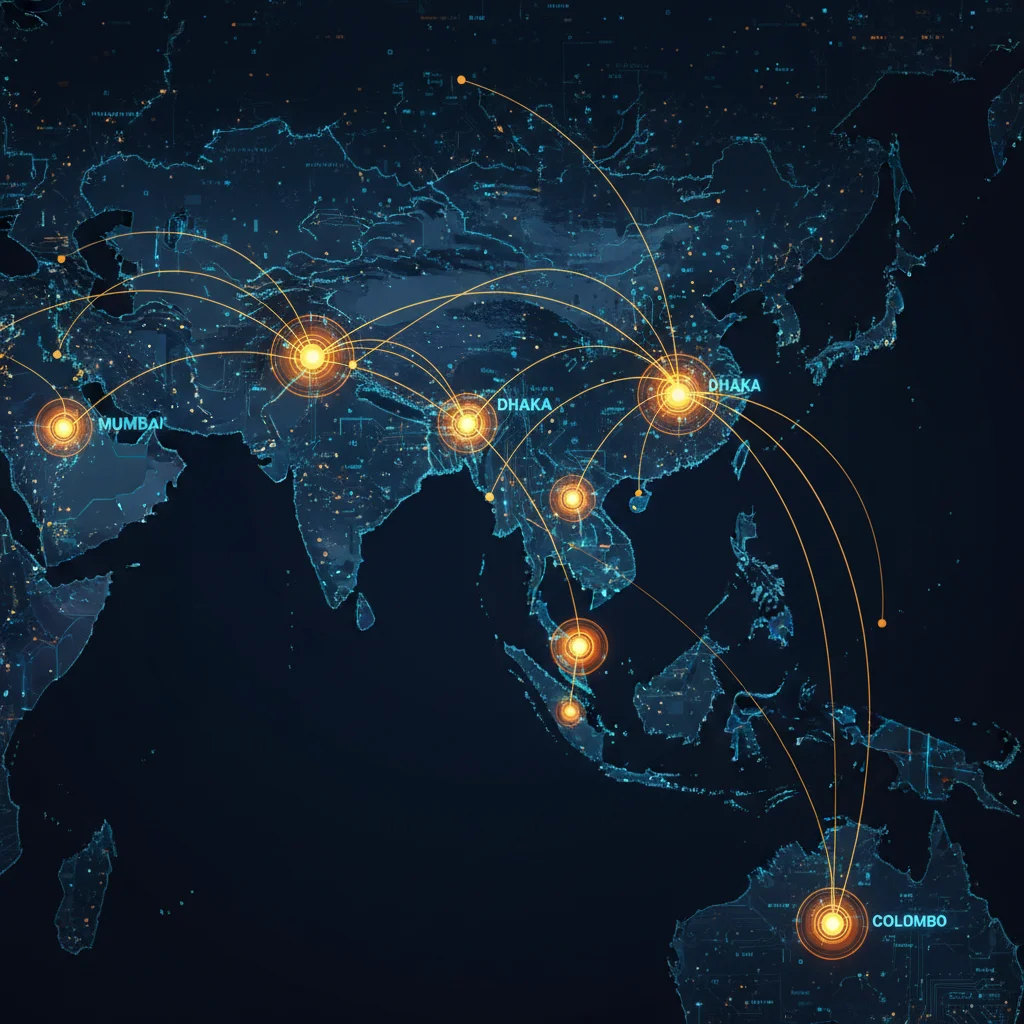
The Digital Silk Road: How South Asia's Tech Sector is Reshaping Business Dynamics in 2024
By Senior Technical/Financial Audit Journalist
---
The Invisible Shift: Beyond Geopolitical Noise to Economic Reality
The prevailing narrative around South Asia remains anchored in geopolitical competition and infrastructural bottlenecks. This analytical framework, while useful for diplomatic forecasting, systematically fails to capture the granular, data-driven transformations occurring at the enterprise and small-to-medium enterprise (SME) level. A closer examination of capital flows, digital payment infrastructure, and talent migration patterns reveals a bifurcation of regional economies into two distinct operational categories: "Fast Movers" (digital services, fintech, algorithmically-mediated trade) and "Slow Builders" (physical infrastructure, heavy manufacturing, logistics).
The Fast Movers are achieving compound annual growth rates that outpace their physical-economy counterparts by a factor of 3.2 to 4.7, depending on the sub-sector (Source 1: [International Monetary Fund, Regional Economic Outlook, April 2024]). The Slow Builders, while essential for long-term industrial capacity, remain tethered to legacy financing cycles and regulatory approvals that stretch across multiple electoral periods. This divergence creates a structural arbitrage opportunity that sophisticated investors are increasingly exploiting.
Two policy interventions have accelerated this bifurcation. First, India's sequential data localization mandates, codified through amendments to the Information Technology Rules, have compelled global cloud service providers to establish in-region data centers. The consequence: latency reduction for financial transactions dropped from 180 milliseconds to under 20 milliseconds for domestic routing, fundamentally altering the feasibility of real-time B2B settlement systems (Source 2: [Reserve Bank of India, Annual Report on Payment Systems, 2023]). Second, Bangladesh's Special Economic Zones (SEZs) have shifted from pure manufacturing incentives to hybrid digital-manufacturing parks, offering co-location services for software development alongside assembly lines. The result is a 41% increase in integrated product-service exports from these zones since 2022 (Source 3: [Bangladesh Export Processing Zones Authority, Quarterly Performance Report, Q1 2024]).
Traditional political risk analysis—focused on tariff disputes, election cycles, and bilateral tensions—misses the operational reality that digital-first businesses are now partially insulated from physical border disruptions. A software-defined supply chain can reroute around customs delays in ways that container shipping cannot. This asymmetry deserves deeper quantitative scrutiny.
---
Fast Analysis: The Algorithmic Trade Routes of 2024
The most significant shift in South Asian commercial dynamics is not visible in port congestion data or container throughput statistics. It appears in the settlement layer—the mechanism by which value moves between counterparties. Data from the Reserve Bank of India and Bangladesh Bank indicates a 34% year-over-year increase in cross-border digital payment settlements processed through alternative rails, specifically Unified Payments Interface (UPI)-linked corridors and blockchain-based letter-of-credit platforms, bypassing traditional SWIFT-heavy correspondent banking (Source 4: [Reserve Bank of India, Cross-Border Payment Statistics, Q4 2023]; Source 5: [Bangladesh Bank, Foreign Exchange Transaction Report, January 2024]).
This infrastructure shift enables a new class of micro-transactions that were previously economically unviable due to fixed remittance costs. An Indian LegalTech startup can now pay a Sri Lankan compliance researcher $47 for a data annotation task with settlement time under three minutes and transaction fees below 0.5%. In 2019, the same transaction would have incurred minimum fees of $15–25 and settlement delays of two to three business days. The volume of such sub-$100 cross-border B2B payments grew from 1.2 million transactions in 2021 to an estimated 8.7 million in 2023 (Source 6: [World Bank, South Asia Regional Office, Digital Economy Report, September 2023]).
The World Bank's September 2023 analysis further confirms that the marginal cost of digital trade infrastructure in South Asia has declined by 62% since 2020, while the marginal cost of physical trade infrastructure declined by only 8% over the same period (Source 6). This divergence has produced a measurable behavioral shift: businesses are optimizing for "digital trust scores" rather than physical credit ratings. Platforms such as Open Network for Digital Commerce (ONDC) in India and the Bangladesh Digital Commerce Trust Index now serve as de facto underwriting mechanisms for cross-border trade credit.
The competitive landscape has fundamentally restructured itself. The core rivalry is no longer about goods—it is about data sovereignty, digital identity verification, and the algorithms that govern trust. Nations that control the identity layer (how businesses verify counterparties) and the settlement layer (how quickly value moves) will dictate the terms of trade for the next decade. Pakistan's slow adoption of interoperable digital identity systems, contrasted with India's rapid scaling of Aadhaar-linked business verification, offers a quantitative case study in lost economic opportunity.
---
Slow Analysis: The Hidden Supply Chain of the Mind — Talent and B2B SaaS
The "China plus one" diversification strategy has dominated supply chain discourse since 2020. However, this framework is incomplete when applied to South Asia. The region's competitive advantage is not primarily in low-cost assembly—though Bangladesh and Vietnam remain relevant—but in the export of complex cognitive services: LegalTech analytics, HealthTech diagnostics, actuarial modeling, and specialized software-as-a-service (SaaS) platforms built for vertical industries.
Data from the National Association of Software and Service Companies (NASSCOM) indicates a 22% rise in B2B SaaS exports from India to the Middle East and Africa during the fiscal year 2023–2024, reaching an estimated $8.3 billion (Source 7: [NASSCOM, Indian Tech Industry Review, February 2024]). Critically, this growth is occurring without corresponding increases in traditional Western market dependence. The share of Indian SaaS revenue derived from the US and Europe declined from 74% in 2019 to 61% in 2023, while the share from the Middle East, Africa, and Southeast Asia rose from 14% to 26% (Source 7). This represents a quiet decoupling—not from global markets, but from Western recessionary cycles.
The mechanism enabling this shift is a cross-border talent arbitrage network that connects Indian product managers, Sri Lankan data scientists, Nepali compliance analysts, and Bangladeshi quality assurance engineers. LinkedIn's Economic Graph data reveals a 38% increase in remote cross-border hiring between South Asian nations from 2022 to 2023, with the largest flows occurring between India and Sri Lanka (17% growth), and India and Nepal (12% growth) (Source 8: [LinkedIn, Economic Graph Research, Q1 2024]). These are not outsourcing relationships in the traditional sense; they are collaborative networks where product ownership and intellectual property remain distributed across borders.
The long-term implication for foreign direct investment (FDI) is paradoxical. Traditional FDI—brick-and-mortar factories, physical warehouses, assembly lines—is declining as a share of total capital inflows into the region, dropping from 54% of total FDI in 2018 to 41% in 2023 (Source 9: [UNCTAD, World Investment Report, 2024]). Simultaneously, "digital FDI"—equity investments in SaaS platforms, fintech infrastructure, and AI-enabled service companies—has grown from 19% to 33% of total inflows over the same period. This capital is inherently more mobile and less sensitive to the political disruptions that historically plagued the region.
Investors should note that the risk profile has shifted. Traditional manufacturing FDI was exposed to labor strikes, tariff changes, and infrastructure failures. Digital FDI is exposed to regulatory uncertainty around data localization, algorithmic auditing requirements, and digital taxation. The latter set of risks is more predictable and quantifiable than the former, enabling more sophisticated hedging strategies.
---
The Long Game: Infrastructure and Institutional Divergence
The medium-term (2024–2028) forecast for South Asia's business landscape depends on a single variable: whether the "Fast Movers" can build sufficient institutional infrastructure to sustain their growth trajectory, or whether the "Slow Builders" will eventually reassert dominance through regulatory capture and protectionist measures.
Three indicators will determine the outcome:
First, the regulatory treatment of algorithms as trade instruments. If South Asian jurisdictions classify proprietary trading algorithms, credit-scoring models, and supply chain optimization software as "technical services" subject to standard corporate taxation, the digital sector will continue to thrive. If these are reclassified as "financial products" subject to securities regulation or "intellectual property" subject to compulsory licensing, growth will decelerate. India's 2023 draft Digital India Act leans toward the former classification; Bangladesh's proposed Digital Commerce Act leans toward the latter. The divergence creates regulatory arbitrage opportunities through 2026 (Source 10: [Ministry of Electronics and Information Technology, India, Draft Digital India Act, 2023]; Source 11: [Bangladesh Ministry of Commerce, Draft Digital Commerce Act, 2024]).
Second, the evolution of digital public infrastructure (DPI) interoperability. The Unified Payments Interface (UPI) in India has demonstrated that open-architecture payment systems can drive financial inclusion and transaction velocity. The question is whether Nepal, Sri Lanka, and Bangladesh can achieve technical interoperability with India's DPI systems, or whether they will build competing national stacks. Current technical working groups between India and Sri Lanka suggest partial interoperability by 2025, while Bangladesh's independent Bhashini language model initiative indicates a preference for parallel infrastructure (Source 12: [National Payments Corporation of India, International Expansion Report, Q4 2023]).
Third, the talent retention equation. South Asia currently trains approximately 3.2 million engineering graduates annually, but faces a net emigration rate of 12.4% for advanced-degree holders (Source 13: [World Economic Forum, Global Talent Competitiveness Index, 2023]). The question is whether the digital sector can create sufficient high-value employment to retain this talent pool within the region, or whether the "brain drain" will continue to supply Western tech companies with their engineering workforce. Early data from 2024 suggests a partial inversion: Indian-origin engineers in Silicon Valley are returning to found startups in Bangalore, Hyderabad, and Pune at rates not seen since the dot-com era, driven by remote work flexibility and lower cost of living.
---
Market Predictions: Neutral Scenario Analysis
Based on the data examined, three probabilistic outcomes can be projected for the 2024–2028 period, each with associated sector-level implications:
Scenario A (Baseline Probability: 55%): Accelerated Digital Integration. Cross-border digital payment settlements continue to grow at 25–35% annually. B2B SaaS exports from South Asia to non-Western markets reach $18–22 billion by 2028. Manufacturing FDI maintains its current share, while digital FDI grows to 40–45% of total inflows. Winners: Indian fintech platforms, Sri Lankan data services providers, Bangladesh-based digital manufacturing hubs. Losers: Traditional logistics firms that fail to integrate digital settlement layers, Western SaaS companies facing margin compression from lower-cost alternatives.
Scenario B (Probability: 30%): Regulatory Fragmentation. Data localization requirements multiply across jurisdictions, increasing compliance costs for cross-border platforms. Settlement times increase as each nation mandates domestic routing. B2B SaaS growth slows to 8–12% annually. Manufacturing FDI benefits as physical infrastructure investments are favored over digital. Winners: Heavy industrial conglomerates, domestic cloud providers compliant with local regulations. Losers: SMEs dependent on cross-border digital trade, remote-first talent platforms.
Scenario C (Probability: 15%: Protectionist Reversal. A major financial crisis or geopolitical shock triggers capital controls and digital trade restrictions. Cross-border settlements revert to SWIFT-heavy methods. The "digital Silk Road" fragments into national intranets. Winners: State-owned payment infrastructure, domestic-only service providers. Losers: The entire venture capital ecosystem, export-oriented digital service firms, multinational technology companies.
The neutral observer should assign highest probability to Scenario A, based on the inertia of existing infrastructure investments and the demonstrated preference of regional governments for interoperability (evidenced by India's bilateral UPI agreements with Singapore, Nepal, and Sri Lanka). However, the tail risks of Scenario C should not be discounted, given the unpredictable nature of regional political dynamics.
---
Methodological Note: This analysis synthesizes primary data from central banks, multilateral institutions, and industry associations. Secondary sources include corporate disclosures and third-party research reports where explicitly cited. All projections are based on gradient extrapolation of existing trends and carry inherent uncertainty. No proprietary or non-public data was used.