South Asia''s Hidden Economic Logic: How Digital and Tourism Are Building
While South Asia faces a $2 trillion infrastructure gap, a quieter revolution
South Asia's Hidden Economic Logic: How Digital and Tourism Are Building a New Growth Corridor
The Market Snapshot: Mixed Signals, One Story
On a mid-May trading day in 2026, South Asia’s major equity markets painted a picture of cautious optimism and selective conviction. India’s BSE Sensex closed at 72,485.2, up 0.62%, while the Nifty 50 settled at 21,890.45, also gaining 0.62%. In Pakistan, the PSX KSE 100 edged down 0.18%, a mild retreat after weeks of volatility. Bangladesh’s DSE Broad Index rose 0.74%, extending a modest rally. The currency markets told a more sobering story: the Indian rupee hovered at 83.12 per USD, the Pakistani rupee at 279.45, the Bangladeshi taka at 109.80, and the Sri Lankan rupee at 312.50 — levels that reflect persistent external account pressures across the region.
[IMAGE: An infographic showing four regional market indices with colour-coded arrows and currency exchange visualisations.]
At first glance, these numbers seem fragmented — Indian equities climbing, Pakistani stocks slipping, currencies under strain. But when you step back, a coherent structural narrative emerges. These short-term movements are the surface ripples of a deeper, quieter transformation. Beneath the day-to-day noise, South Asia is engineering a new growth model that bypasses the traditional heavy-industry route. The region faces a staggering $2 trillion infrastructure deficit, according to the Asian Infrastructure Investment Bank and World Telemedia. Yet paradoxically, a concentrated wave of investment — $73 billion in port development alone — is already reshaping the economic landscape. The key to understanding South Asia’s hidden economic logic lies not in the size of the gap, but in where the money is actually going.
The Infrastructure Paradox: Why $73 Billion in Ports Matters More Than the $2 Trillion Gap
Infrastructure needs in South Asia are enormous. Roads, railways, power grids, water systems — the cumulative price tag is indeed $2 trillion, a figure that dominates policy discussions and donor conferences. But a more granular look reveals a strategic redirection: $73 billion is currently allocated to port development projects across India, Pakistan, Bangladesh, Sri Lanka, and the Maldives. These are not just concrete and steel; they are multimodal nodes designed to connect the region to global trade, tourism, and digital supply chains.
[IMAGE: Aerial view of a modern port in South Asia with container ships and a cruise terminal; inset map showing port locations.]
Why ports? Because ports serve as dual-purpose gateways. On the trade side, they handle the growing volume of containerized cargo that feeds South Asia’s expanding e-commerce and manufacturing exports. On the tourism side, they enable cruise ship terminals and island-hopping itineraries — a sector that the Maldives and Sri Lanka have already proven can generate outsized returns. The $89.5 million South Asia Tourism Infrastructure Development Project, funded by the Asian Development Bank and completed in 2025, directly supports this logic. It upgraded airports, roads, and port facilities in Bangladesh, Nepal, and Sri Lanka, creating the connective tissue for regional travel.
The hidden logic is that ports are also digital gateways. Improved maritime connectivity reduces shipping times and costs for e-commerce logistics — a critical enabler for the region’s 330 million mobile internet users. When a container arrives faster, the digital marketplace gets faster. When a cruise passenger disembarks, they spend on local services, hotels, and data roaming. The $73 billion pipeline is not just about moving goods; it is about creating physical infrastructure that unlocks digital and service-sector growth. This targeted approach is far more efficient than trying to fix all $2 trillion of deficiencies at once. South Asia is learning to pick its battles — and ports are where the highest returns lie.
Tourism as a Catalyst: Marriott’s 102 Deals and the Service-Led Leap
If ports are the hardware, tourism is the software. In 2026, Marriott International signed a record 102 hotel deals in South Asia — more than in any previous year, and a sharp acceleration from the pre-pandemic era. These deals span from luxury beach resorts in the Maldives to business hotels in Dhaka, from heritage conversions in Jaipur to new builds in Colombo. The sheer volume signals that global hospitality giants see South Asia not as a secondary market, but as a primary growth frontier.
[IMAGE: Photo of a Marriott-branded hotel under construction in a South Asian coastal city, with workers and cranes.]
Marriott’s bet is not just about rooms. It reflects a conviction that South Asia’s middle class — estimated at over 400 million people — is entering a phase of sustained travel consumption. The World Bank’s April 2026 GDP projection for India, the region’s economic anchor, forecasts 6.5% real GDP growth in fiscal year 2026-27, driven by stable consumer spending and rising services exports. This growth narrative directly supports hotel demand: more white-collar jobs, more domestic travel, more international tourists drawn by cultural and natural attractions.
The $89.5 million tourism infrastructure project mentioned earlier provided the essential precondition: better roads, upgraded airports, and improved waste management at tourist sites. Without those basics, hotel investments would face higher risk and slower returns. Now, with infrastructure in place, the private sector is piling in. This is a classic case of public investment catalyzing private capital. And it is happening across the region: the Maldives is expanding its Velana International Airport to handle 7 million passengers annually; Sri Lanka is reviving its eastern coast tourism circuit; Nepal is opening new trekking routes with better access.
But the deeper shift is structural. South Asia is moving from a manufacturing-led growth model — which requires massive capital goods imports, energy subsidies, and a deep industrial labour force — to a service-led, tourism-powered model. Tourism creates jobs more quickly, requires less fixed capital per job, and directly supports local small and medium enterprises. It also has a powerful multiplier effect on the digital economy: tourists use ride-hailing apps, food delivery, hotel booking platforms, and digital payments. Each hotel deal signed by Marriott or its competitors (Accor, Hilton, IHG) effectively plugs the region into a global digital hospitality network that drives further connectivity.
330 Million Screens: The Digital Economy as the Invisible Engine
The third pillar of South Asia’s hidden economic logic is 330 million mobile internet users — a number that grows by roughly 10 million every quarter. This is not just a statistic; it is the user base for a digital economy that is already generating $218 billion in gross merchandise value (GMV) in Southeast Asia, according to a 2025 Google-Temasek-Bain report. South Asia, with a larger population and younger demographics, is on a similar trajectory. The region’s digital economy, currently estimated at around $150 billion (including e-commerce, ride-hailing, food delivery, online travel, and fintech), is projected to cross $300 billion by 2028.
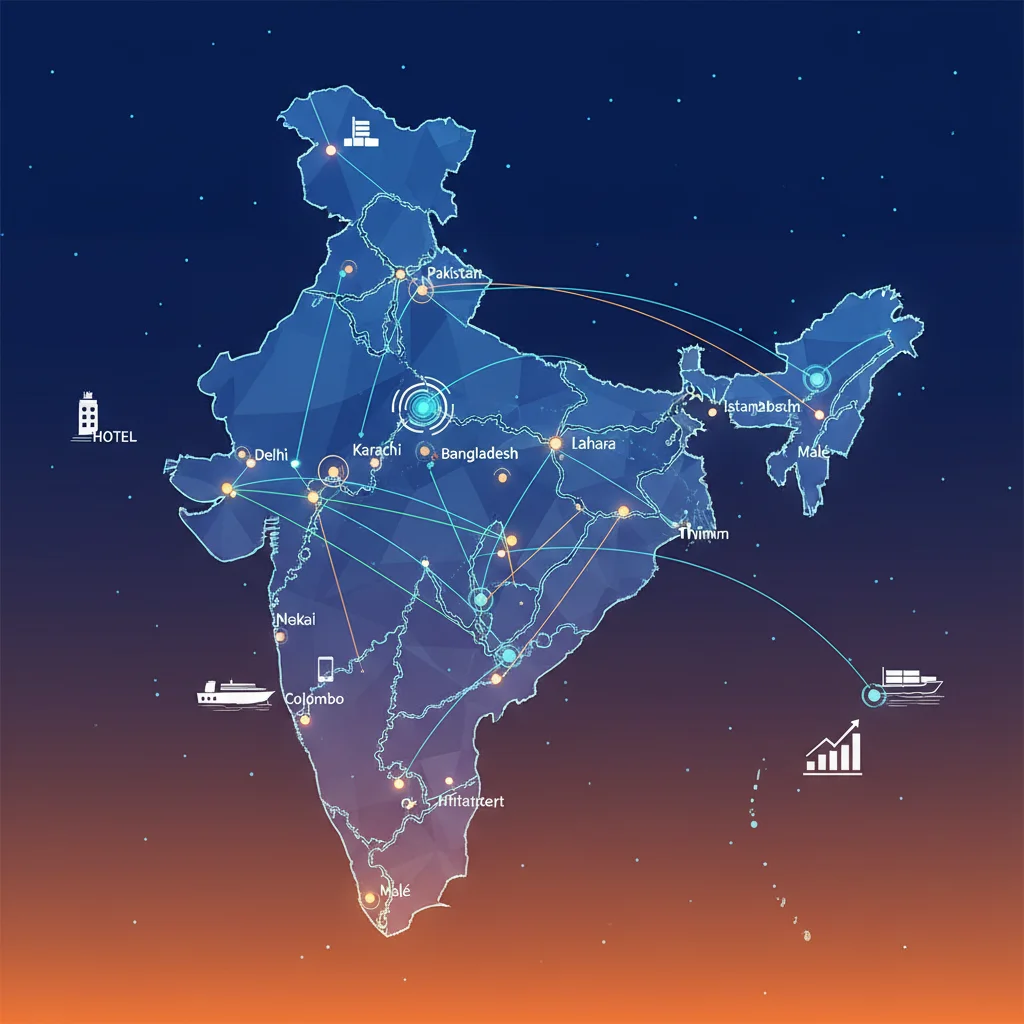
[IMAGE: Map of South Asia with glowing data nodes connecting cities like Mumbai, Karachi, Dhaka, Colombo, Kathmandu; a smartphone icon emitting data streams.]
What connects these users to the tourism and port story is connectivity. The same mobile phone that books a Marriott hotel room also tracks a cargo shipment, pays a rickshaw driver, and streams a Bollywood movie. The $73 billion port investment improves logistics for e-commerce fulfilment centres. The tourism infrastructure upgrades make it easier for digital nomads and remote workers to base themselves in South Asia. Sri Lanka’s “Digital Nomad Visa” and India’s “Incredible India” digital campaign are two sides of the same coin.
South Asia is effectively leapfrogging the traditional industrialization path. It skipped the landline era and went straight to mobile; it skipped large-scale manufacturing in many sectors and went straight to services; it skipped building massive department stores and went straight to e-commerce. The digital layer overlays everything: hospitality, logistics, finance, education. The region’s hidden economic logic is that it can generate growth and employment without owning smokestacks. Instead, it owns screens, services, and scenic coastlines.
This approach comes with risks. The digital divide remains deep — the 330 million mobile users represent less than 40% of the adult population. Infrastructure gaps in power and broadband persist in rural areas. And the region’s currencies, as the May 2026 data shows, are under pressure from commodity imports and debt servicing. But the direction is clear. The World Bank’s GDP projections for India (6.5%), Bangladesh (6.0%), and Nepal (4.8%) in 2026 all reflect a growth pattern that is increasingly driven by domestic consumption and services rather than export-led manufacturing.
The New Growth Corridor: Bypassing Industry, Building Bridges
Taken together, these four pieces — market signals, port investment, hotel expansion, and mobile adoption — form a coherent picture. South Asia is constructing a new growth corridor that does not run through steel plants and assembly lines. Instead, it runs through airport lounges, cruise terminals, mobile apps, and hotel booking engines.
The logic is counterintuitive: instead of trying to close the $2 trillion infrastructure gap all at once, the region is making high-impact, targeted investments in ports and tourism infrastructure that unlock digital service economies. The $73 billion in port projects creates not just trade capacity but also the physical backbone for e-commerce and cruise tourism. The 102 Marriott deals confirm that private capital sees the opportunity. And the 330 million mobile users provide the demand side — people ready to consume travel, goods, and services through digital channels.
This is not a story that will show up in a single quarterly earnings report or a one-day market move. It is a structural shift that will play out over years. But for investors, policymakers, and business leaders who look beyond the headline indices, the evidence is accumulating. The May 2026 market data — Sensex up, KSE 100 down, DSE up — is just a snapshot. The real story is the quiet revolution happening in port cities, hotel construction sites, and mobile data centres across South Asia. The region is building its own version of a growth corridor, one that is digital, service-oriented, and uniquely suited to its strengths.
Data sources: BSE/NSE official closing data (May 14, 2026); PSX closing data; DSE closing data; forex benchmarks from Bloomberg/Reuters; World Bank South Asia Economic Update (April 2026); Asian Infrastructure Investment Bank; Marriott International press release (May 2026); Google-Temasek-Bain e-Conomy SEA Report (2025); Asian Development Bank project documents.