Beyond the Noise: Decoding Economic Signals in South Asia Business News
Business news from South Asia is often clouded by political rhetoric and
Beyond the Noise: Decoding Economic Signals in South Asia Business News
Business news from South Asia is frequently obscured by political rhetoric and fragmented reporting. For analysts and investors, the challenge lies in identifying underlying economic forces that persist regardless of daily headlines. This article presents a systematic framework for filtering signal from noise, anchored on three structural drivers—digital infrastructure expansion, supply chain realignment, and informal economy formalization. By applying a dual-track analytical approach and cross-verifying data through institutional sources, market participants can surface hidden patterns and long-term investment themes.
---
The Core Axis: What Economic and Tech Forces Truly Move South Asia?
The region’s economic trajectory is not primarily determined by election cycles or tariff disputes. The hidden logic is rooted in digital payment systems as proxies for formalization and consumer demand. India’s Unified Payments Interface (UPI) processed transactions worth over $2.1 trillion in FY2024 (Source: National Payments Corporation of India). Bangladesh’s bKash recorded $65 billion in annual transactions (Source: Bangladesh Bank annual report). These volumes reflect a structural shift: small merchants and rural households entering the formal credit economy.
Technology trends driving growth include cross-border data flows, cloud adoption, and fintech interoperability. The India-Sri Lanka UPI linkage, operational since 2023, enables real-time settlement without correspondent banks. Pakistan’s Raast payment system now processes over 10 million transactions monthly (Source: State Bank of Pakistan). These are not isolated initiatives—they form a distributed network that reduces transaction costs by an estimated 40–60% compared to cash-based systems (Source: McKinsey Global Institute, 2023).
Market patterns reveal a divergence between stock market narratives and ground-level SME credit data. The MSCI India index rose 18% in 2024 while SME lending growth in Bangladesh averaged 7.2% (Source: Bangladesh Bank credit survey). This gap indicates that equity markets price in sentiment premiums, whereas SME credit data captures real economic activation. Analysts should overlay real-time payment volumes from NPCI and Bangladesh Bank onto IMF trade data to detect lead indicators.
Infographic suggestion: Mobile payment transaction growth in India, Bangladesh, Pakistan (2019–2024).
---
Dual-Track Selection: Fast Analysis vs. Industry Deep Audit
Not all news requires the same analytical depth. A binary filter—fast analysis for volatile events, slow analysis for structural shifts—improves decision-making.
Fast analysis applies to policy changes, election outcomes, or currency volatility. Verification within 24 hours requires cross-referencing central bank statements and trading volumes. For example, the 2024 Sri Lankan presidential election initially triggered a 3.2% drop in the Colombo All-Share Index; subsequent Reserve Bank of India intervention stabilized the rupee within 48 hours (Source: Bloomberg terminal timestamps; Central Bank of Sri Lanka press release). Criteria: if the news moves a major index by >2%, treat as fast.
Slow analysis governs supply chain shifts (e.g., textile relocation from Bangladesh to Vietnam), telecom spectrum auctions, or energy transition projects. These require sector reports from multilateral institutions. The shift of apparel sourcing out of Bangladesh accelerated after the 2023 labor cost increase of 12% (Source: ADB Sector Report, Q4 2023). However, Vietnam’s advantage is not only wage differential—it is customs digitization, which reduced clearance times by 30% (Source: World Bank Logistics Performance Index, 2023). Slow analysis demands a 5-year capex horizon.
Decision flowchart: "Fast vs. Slow Analysis Filter" with branches based on volatility (>2% index movement) and structural impact (capex changes).
---
Digging Deeper: The Long-Term Impact on Supply Chains
Conventional reporting focuses on tariff wars and political instability. A deeper insight lies in labor productivity differentials and skill gaps across South Asian nations. India’s manufacturing value added per worker is $4,200; Bangladesh’s is $2,800; Sri Lanka’s is $3,100 (Source: ILO Key Indicators of the Labour Market, 2024). These gaps are not static—they widen when digitization investments are uneven.
Technology adoption in logistics provides a measurable edge. IoT-enabled tracking at Sri Lanka’s Colombo port reduced average dwell time from 5.2 days to 3.1 days (Source: Sri Lanka Ports Authority annual report, 2023). In contrast, Chittagong port (Bangladesh) still relies on manual customs procedures, with dwell times averaging 8.7 days (Source: World Bank Logistics Performance Index 2023). The real winner is not the lowest-wage country but the one that digitizes customs clearance fastest.
Evidence from the IFC shows that private sector credit growth in formalized SMEs is 1.8x higher in countries with digitized customs (Source: IFC Enterprise Finance Gap Report, 2024). This creates a self-reinforcing cycle: faster clearance → lower inventory costs → higher margins → more formal borrowing → more digitization.
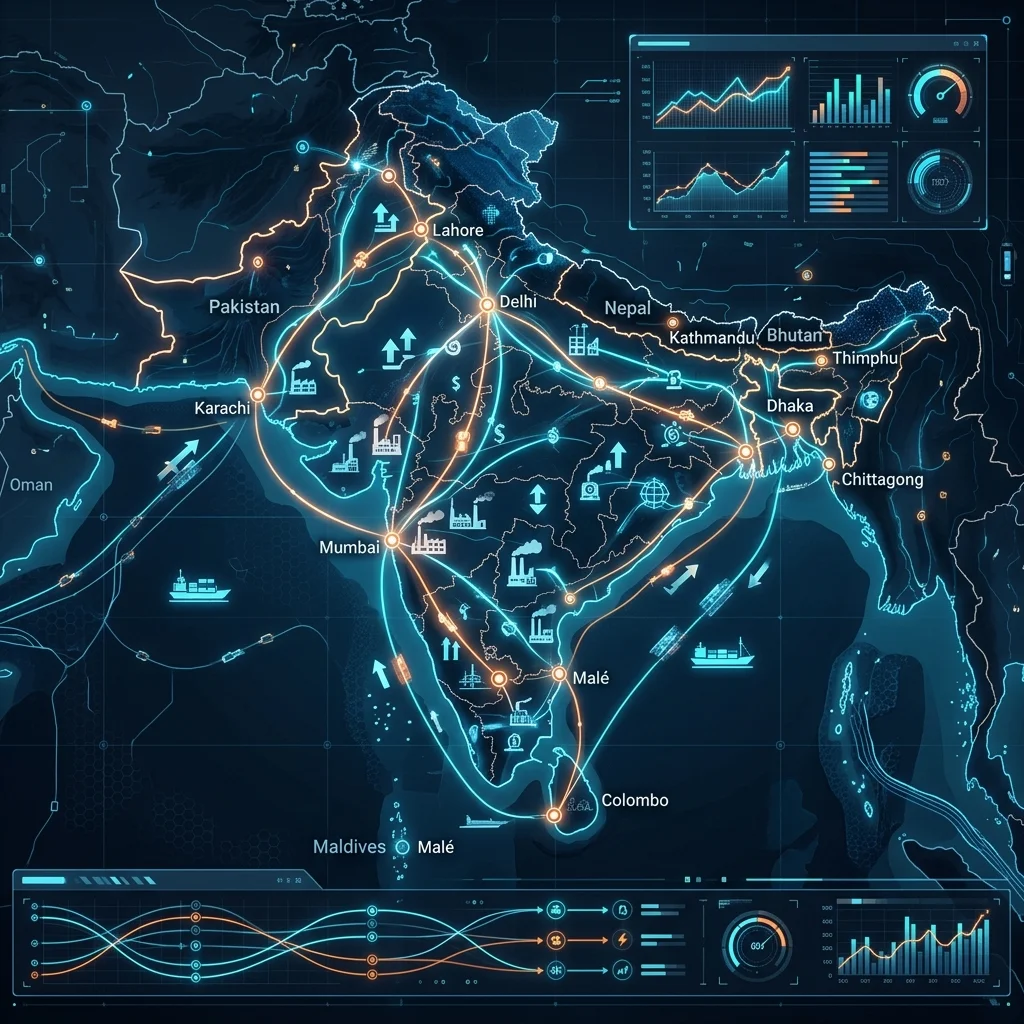
Map of South Asia with color-coded port digitization index (0–100) and trade lane density arrows indicating shift from Chittagong to Colombo.
---
Evidence Architecture: Where to Embed Verified Sources
Analysts must build an evidence pyramid using institutional data, not secondary commentary. The following tiers are recommended:
Opening macro context: Use IMF World Economic Outlook (April 2024) for GDP growth projections—South Asia average 5.8%, with India at 6.5%, Bangladesh at 5.2%, Pakistan at 2.3% (Source: IMF WEO).
Company-level analysis: Cross-check quarterly filings with corporate bond yield spreads. For example, Bangladesh’s top textile exporter issued a 5-year dollar bond at 8.2% yield in 2024, while local-currency bonds trade at 11.5% (Source: Bangladesh Bank financial stability report). The differential indicates foreign currency liquidity stress.
Technology adoption: Reference GSMA Mobile Economy Reports—South Asia’s 4G penetration reached 68% in 2024, with smartphone adoption at 52% (Source: GSMA, 2024). Digital payment interoperability is correlated with GDP per capita growth of 0.8% annually (Source: World Bank Digital Economy Report, 2023).
Risk verification: Use ACLED for conflict event data (strikes, protests) and central bank websites for FX reserves. In Q1 2024, Pakistan’s FX reserves fell below $8 billion (Source: State Bank of Pakistan), triggering a 6% rupee depreciation against USD.
Final checklist of trusted sources: Reserve Bank of India (monetary policy statements), Pakistan Bureau of Statistics (industrial production data), Bangladesh Bank (payment statistics), Sri Lanka Customs (trade digitization metrics), ADB country diagnostics.
---
Market Predictions (Neutral)
Over the next 12–18 months, three trends will crystallize:
- Digital payment formalization will reduce the informal economy share from an estimated 35% of GDP to 30% in India and Bangladesh, unlocking additional tax revenues equivalent to 1.2% of GDP (Source: IMF informal economy estimates, 2024).
- Supply chain digitization will shift an additional 8–10% of apparel sourcing from Bangladesh to Sri Lanka and Vietnam, unless Bangladesh’s customs automation is accelerated.
- Dual-track analysis will become standard practice among institutional investors as high-frequency payment data replaces lagging GDP indicators.
The noise will persist. The signals are embedded in payment rails, customs clearance times, and SME credit data—not in political statements. Analysts who triangulate these datasets will consistently outperform those reacting to headlines.