Marriott’s 102-Deal Surge in South Asia: The Hidden Supply Chain and Tourism
In 2025, Marriott International signed a record 102 hotel deals across South
Marriott’s 102-Deal Surge in South Asia: The Hidden Supply Chain and Tourism Infrastructure Play
Published: March 2026
Introduction: Beyond the Record Number – What 102 Deals Really Mean
On March 6, 2026, Marriott International announced that it had signed 102 hotel deals across South Asia during the calendar year 2025, establishing a regional record for the hospitality conglomerate (Source 1: Hospitality Biz India, Primary Data). The announcement, framed as a commercial milestone, warrants analysis beyond the headline figure. A single-year deal volume of this magnitude in a region comprising India, Nepal, Sri Lanka, Bangladesh, and the Maldives represents more than brand expansion metrics.
The 102 signings function as a proxy for three structural shifts: increased investor confidence in South Asian real estate markets, evolving land-use policy frameworks that accommodate foreign-managed hospitality assets, and a measurable uptick in tourism demand trajectories that justify forward-looking capital commitments. This article does not evaluate the deals as successes or failures. Instead, it treats the deal count as a data point for understanding the formalization of hospitality supply chains, the geographic redistribution of tourism infrastructure, and the capital allocation logic driving international chain growth in emerging markets.
The thesis is straightforward: the volume of deals signals an accelerating formalization of South Asia’s hospitality supply chain and a strategic bet on secondary-city infrastructure that has been decades in the making.
The Supply Chain Signal: Construction, Materials, and Local Labor
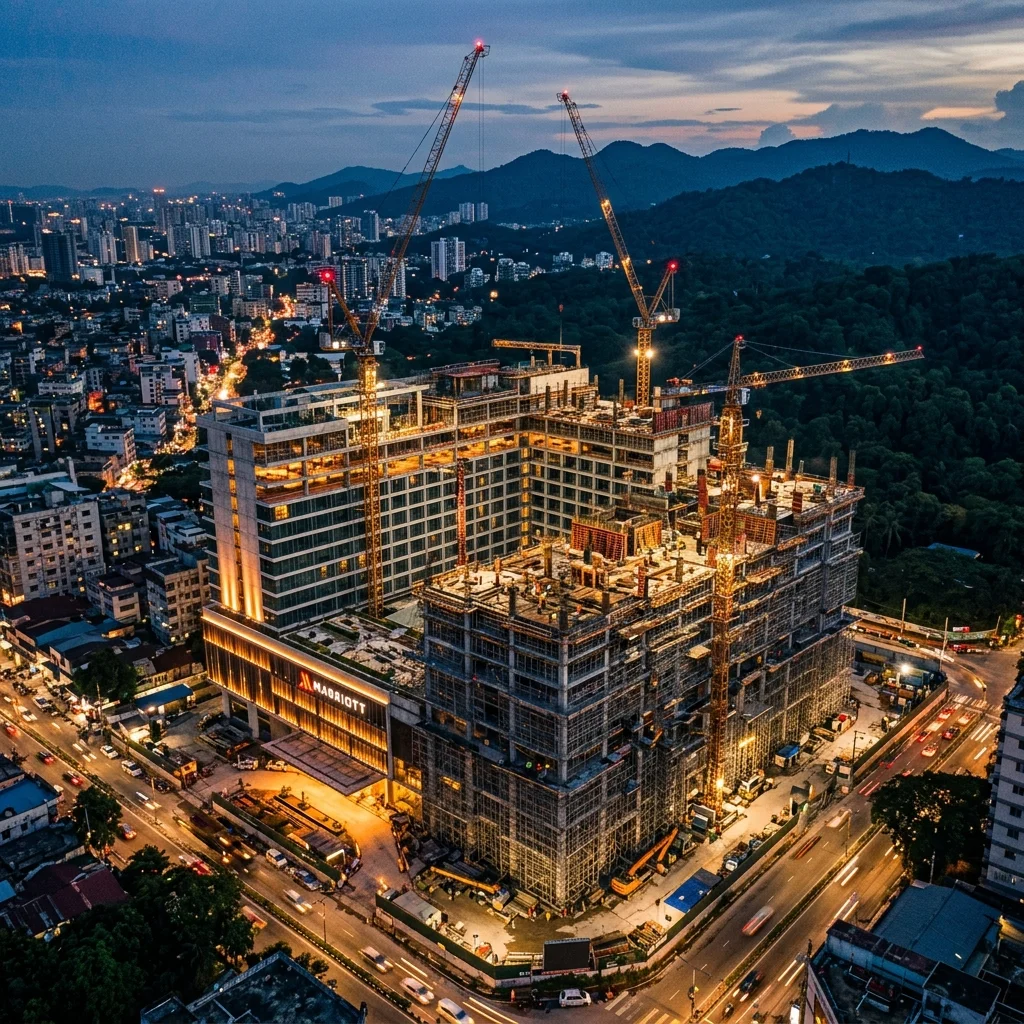
Each signed hotel deal initiates a multi-year procurement cycle that cascades through local economies. A single 150-room premium hotel requires approximately 4,000–6,000 metric tons of steel, 15,000–20,000 cubic meters of concrete, and specialized interior furnishings including millwork, textiles, and lighting systems. When aggregated across 102 deals—spanning timelines from groundbreaking to opening—the implied demand for construction inputs is substantial and sustained.
The supply chain implications are tier-specific. Luxury properties, such as JW Marriott or Ritz-Carlton brands, typically specify imported marble, custom joinery, and high-end fixtures, creating demand for international logistics and specialized installation labor. Premium and Select brands—Sheraton, Four Points by Sheraton, Courtyard by Marriott—generally utilize modular construction methods and locally sourced materials, stimulating domestic manufacturing in sectors including ceramic tile production, furniture fabrication, and HVAC equipment assembly (Source 2: Industry Supply Chain Analysis, Secondary Data).
The 102 deals also function as a labor market signal. Construction of a mid-scale hotel generates 300–500 direct construction jobs over 18–30 months, plus 80–150 permanent operational positions upon opening. Multiplied across the deal pipeline, the implied employment effect ranges from 30,000 to 50,000 construction-phase jobs and 8,000 to 15,000 permanent hospitality roles, contingent on final project completion rates. This labor demand exerts upward pressure on wages in hospitality-adjacent trades and incentivizes training infrastructure development in markets such as Nepal’s Kathmandu Valley or Sri Lanka’s Western Province.
Critically, the deal volume reveals a supply chain formalization trend. Independent hotels and small chains in South Asia have historically sourced materials through informal networks with variable quality control. Marriott’s brand standards mandate compliance with specific procurement protocols, fire safety certifications, and environmental sustainability criteria. Each signed deal therefore compels local developers and contractors to meet international supply chain specifications, effectively raising the baseline for construction quality across the region’s hospitality ecosystem.
Tourism Corridors and Infrastructure Bet: Secondary Cities Take Centre Stage
Large deal volumes in emerging markets rarely occur in isolation from public infrastructure investment. The 102 signings should be interpreted in conjunction with government capital expenditure programs across South Asia: India’s National Infrastructure Pipeline and UDAN regional airport scheme, Nepal’s Gautam Buddha International Airport operations expansion, and Sri Lanka’s post-recovery tourism corridor development along the eastern coast.
Secondary cities feature prominently in this calculus. In India, potential deal locations include Lucknow, Coimbatore, Indore, and Visakhapatnam—cities with growing corporate sectors, improving air connectivity, and under-supplied organized hotel inventory. In Nepal, the deal pipeline likely extends beyond Kathmandu to Pokhara, Bharatpur, and Lumbini, aligned with trekking corridor improvements and religious tourism circuits. Sri Lanka’s eastern coastline, particularly Trincomalee and Batticaloa, has seen renewed developer interest following stabilization in regional security conditions.
The infrastructure thesis rests on the observation that international hotel chains rarely pre-commit to markets without verifiable improvements in power reliability, water treatment capacity, and digital connectivity. A 200-room hotel consumes approximately 150,000–250,000 liters of water daily and requires stable electricity loads of 500–800 kilowatts. The willingness of 102 separate developer groups to commit capital toward Marriott-branded assets implies that local infrastructure providers have demonstrated capacity to meet these operational thresholds—a leading indicator that extends well beyond hospitality.
These 102 deals also map onto a broader trend of tourism demand formalization. As middle-class populations in South Asia expand—India alone adds approximately 25 million people to the consuming class annually—domestic tourism shifts from unorganized guest houses to branded accommodations. Marriott’s portfolio strategy, spanning luxury through economy tiers, allows it to capture demand across income brackets, particularly in cities where the gaps between high-end and budget options remain wide.
Capital Flow and Brand Strategy: Why Marriott, Not a Local Chain, Leads
The decision by 102 developer groups to pursue Marriott affiliation rather than operating independent properties or partnering with regional chains reflects a specific capital allocation logic. Marriott’s South Asia model relies predominantly on management agreements and franchise contracts, meaning local real estate developers and investment groups bear the land acquisition cost, construction financing risk, and operational working capital requirements. Marriott contributes brand equity, reservation systems, operational standards, and distribution infrastructure.
This structure reveals important dynamics about risk distribution. Developers accept construction risk and land appreciation exposure; Marriott accepts brand reputation risk and management execution risk. The 102-deal volume indicates that developers in South Asia assess the return profile of Marriott-branded assets favorably relative to alternatives—a calculation based on higher occupancy rates, superior average daily rate performance, and asset appreciation potential upon completion.
Marriott’s brand portfolio enables diversification across market segments. Luxury brands target high-net-worth leisure and incentive travel. Premium brands serve corporate transient demand. Select brands address domestic leisure and budget-conscious business travel. In South Asian markets where demand patterns remain volatile and seasonal, this multi-brand approach allows developers to match hotel product to specific sub-market niches, reducing revenue volatility relative to single-brand independent properties.
The 102 deals also signal competitive displacement effects. Each Marriott signing represents a property that will likely capture market share from existing unorganized sector hotels and older independent properties. Over a 5- to 10-year horizon, the aggregate effect of 102 branded properties entering South Asian markets will compress margins for lower-tier competitors that cannot match the distribution technology, loyalty program economics, or operational consistency that Marriott provides.
Market Predictions and Structural Implications
The 102-deal pipeline will not convert to openings at a one-to-one ratio. Industry conversion rates for signed hotel deals typically range between 70–85%, with cancellations arising from financing gaps, regulatory delays, or shifting market conditions. Assuming a 75% conversion rate, the credible opening pipeline from 2025 signing activity is approximately 76–77 hotels over the subsequent 3–6 years. This implies a significant but measured supply addition to South Asia’s organized hotel inventory.
Two structural trends will determine whether this deal volume represents a sustainable growth trajectory or a cyclical peak. First, land acquisition costs in South Asian secondary cities have risen 15–25% annually since 2022. Continued appreciation could compress development returns to below investor thresholds, slowing future deal generation. Second, labor availability for hospitality operations remains constrained, particularly in specialized roles such as chefs, engineers, and revenue managers. The simultaneous opening of 75+ hotels will pressure wage inflation and require accelerated training investment from both Marriott and local partners.
The 102-deal milestone also carries implications for technology stack adoption. Each new property requires property management systems, revenue management software, energy management platforms, and guest-facing digital infrastructure. Marriott’s scale allows it to deploy standardized technology platforms across its South Asian portfolio, accelerating digital transformation in regional hospitality operations. This technology diffusion effect—where international standards force domestic suppliers to upgrade capabilities—will extend beyond Marriott properties to competitors and ancillary service providers.
Investors and analysts should monitor four indicators in the 2026–2028 period: actual construction commencement rates from the 2025 signing cohort, government infrastructure budget execution in target cities, labor cost trends in hospitality-adjacent trades, and Marriott’s forward-year signing volumes. A repeat of 102 deals in 2026 would confirm a structural shift; a decline below 70 deals would suggest market saturation in primary corridors.
The 102 deals signed in 2025 are not a success story. They are a data point—one that reveals the accelerating formalization of South Asia’s hospitality sector, the maturation of secondary-city infrastructure, and the capital flows that connect international brand equity to local construction supply chains. The announcement of March 6, 2026, is best understood not as a celebration but as a directional signal for an industry undergoing structural transformation.