Delhi''s EV Tax Break: A Strategic Move or a Subsidy for the Affluent?
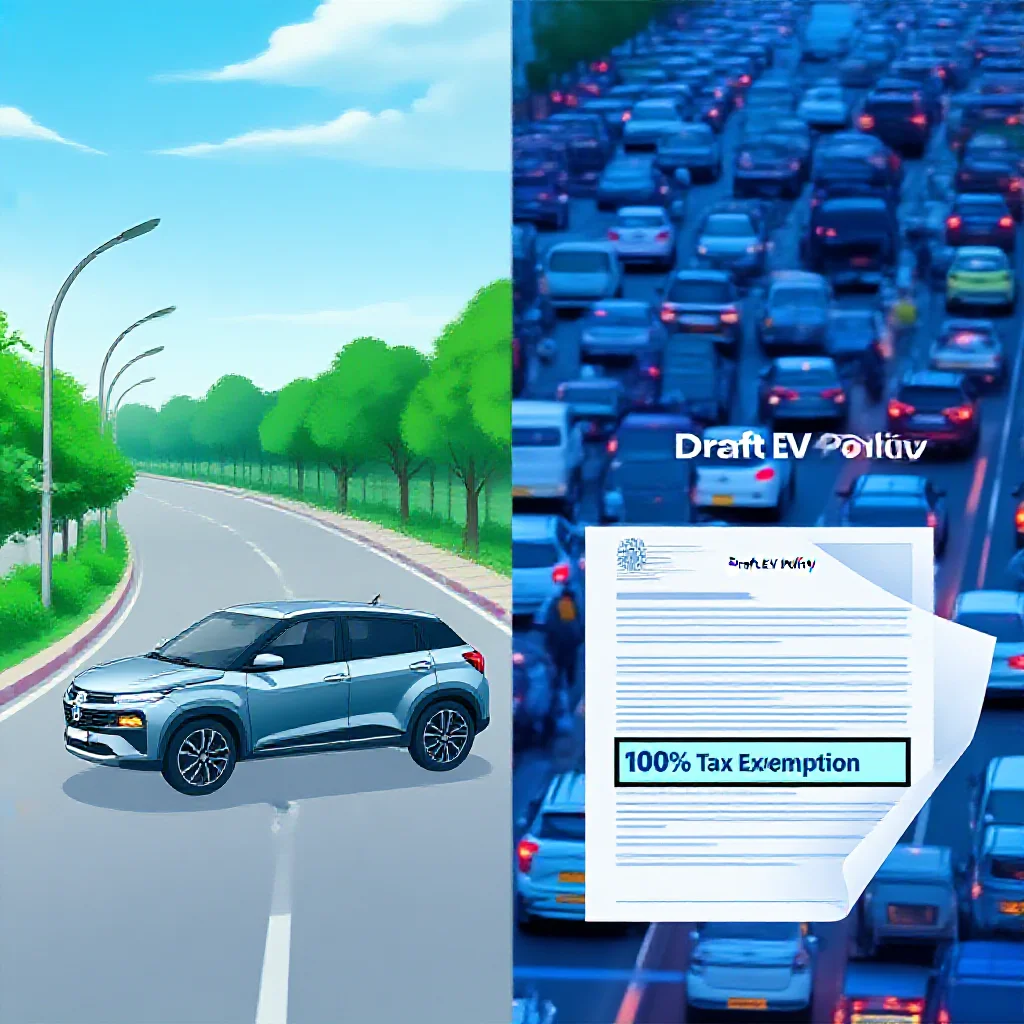
The Delhi government''s draft EV policy, offering a 100% road tax and registration
Delhi's EV Tax Break: A Strategic Move or a Subsidy for the Affluent?
The Delhi government has released a draft electric vehicle (EV) policy. The draft policy proposes a 100% exemption on road tax and registration fees for electric cars priced under ₹30 lakh. The stated aims are to boost EV adoption and reduce air pollution in the national capital. (Source 1: Delhi Government Draft EV Policy)
Beyond the Green Veneer: Decoding the Policy's Economic Engine
The surface narrative presents a straightforward environmental intervention: incentivize cleaner vehicles to combat Delhi's severe air quality crisis. However, the specific financial mechanism—a full tax waiver capped at a ₹30 lakh price point—reveals a more calculated economic axis.
The policy functions as a targeted market intervention, precisely targeting the ₹15-30 lakh price bracket. This segment represents the heart of India's aspiring upper-middle-class car market, encompassing premium hatchbacks, sedans, and compact SUVs. Data on vehicle registration statistics and current EV sales indicate this is the primary zone for high-volume, feature-rich personal vehicles. The exemption is not designed for mass-market entry-level cars nor for luxury vehicles, but for this specific, economically significant tier.
A logical hypothesis follows: the policy is less about universal EV access and more about creating a critical mass of economically viable EV owners within a defined demographic. The strategic objective is to generate concentrated, bankable demand to justify large-scale private investment in charging infrastructure. By ensuring a sufficient density of higher-value EVs, the policy de-risks capital expenditure on charging networks, aiming to trigger a self-sustaining ecosystem.
!Infographic comparing Indian car price segments with highlight on ₹15-30 lakh bracket

Fast Analysis vs. Slow Audit: Incentive Efficacy and Market Distortion
A fast analysis focuses on immediate, verifiable impacts. Original Equipment Manufacturers (OEMs) with ready models in this bracket, such as Tata Motors (Nexon EV, Curvv), MG Motor India (ZS EV), and Hyundai (Kona Electric), are positioned for an instant demand surge. The short-term effect will likely be a measurable spike in registrations for these specific models within Delhi, validating the policy's direct stimulus function.
A slow, deeper audit examines secondary effects and long-term sustainability. A primary concern is the creation of a subsidy-dependent market and the risk of a sharp "cliff effect" for models priced just above the ₹30 lakh threshold, potentially distorting manufacturer pricing strategies. A more profound, unspoken impact may be on the used internal combustion engine (ICE) vehicle market in Delhi. By enhancing the cost-of-ownership advantage for new EVs, the policy could accelerate the depreciation of used ICE vehicles, indirectly pushing a segment of used-car buyers toward the incentivized new EV category.
Evidence from other jurisdictions, such as Oslo and Shenzhen, indicates that similar targeted incentives can rapidly alter market composition but also require careful phase-out planning to avoid demand shocks. The long-term efficacy hinges on whether the initial stimulus catalyzes sufficient ancillary investment to make EVs viable without perpetual fiscal support.
!Scale balancing Immediate Demand Boost and Long-Term Market Sustainability
The Unspoken Supply Chain Ripple Effect
The generation of concentrated demand in a major market like Delhi sends a powerful signal upstream in the supply chain. For battery manufacturers and component suppliers, predictable demand from a high-profile region aids in production planning and can justify scaling up capacity. This demand signal may be as strategically valuable as the demand itself, encouraging suppliers to prioritize the Indian EV ecosystem.
The infrastructure investment hypothesis faces a verification test. The policy's success in attracting private capital for charging stations depends on the realized density of EV adoption in targeted neighborhoods. Investment will likely cluster in areas with high concentrations of the policy's beneficiary demographic, potentially creating an uneven infrastructure map that mirrors existing socio-economic geography rather than serving city-wide mobility needs.
Conclusion: Neutral Market and Industry Predictions
The draft policy is a strategic market-creation tool dressed in environmental policy clothing. Its immediate effect will be a quantifiable increase in mid-premium EV sales in Delhi, benefiting specific OEMs and early-adopter consumers within the target income bracket.
The intermediate-term outcome will be a test of the infrastructure investment thesis. If private charging networks expand in correlation with new vehicle registrations, the policy may be deemed successful in its core, unstated objective. Concurrently, the used ICE vehicle market in Delhi will likely experience downward price pressure.
The long-term industry prediction involves a normalization challenge. The ₹30 lakh cap creates an artificial market segmentation. Future policy evolution will necessitate a gradual transition from purchase incentives to usage-based incentives or infrastructure support to ensure market stability and broader access. The ultimate measure will be whether the initial, targeted stimulus successfully initiates a chain reaction that eventually democratizes EV access beyond its original, affluent beneficiary base.